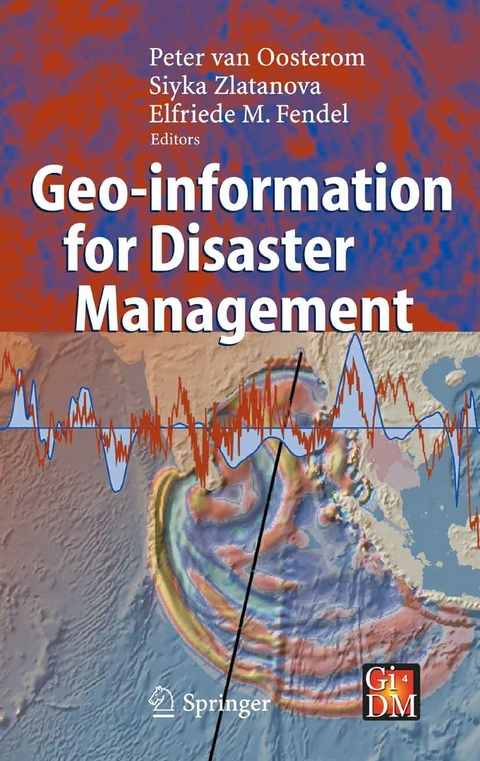
Geo-information for Disaster Management (eBook)
LII, 1433 Seiten
Springer Berlin (Verlag)
978-3-540-27468-1 (ISBN)
Geo-information technology can be of considerable use in disaster management, but with considerable challenge in integrating systems, interoperability and reliability. This book provides a broad overview of geo-information technology, software, systems needed, currently used and to be developed for disaster management. The text invites discussion on systems and requirements for use of geo-information under time and stress constraints and unfamiliar situations, environments and circumstances.
Foreword 5
Goal and Objectives 6
Conference topics 7
Paper Selection Process 7
Acknowledgement 9
Table of Contents 11
Author Index 23
Programme Committee 26
Local Organizing Committee 26
Orchestra: Developing a Unified Open Architecture for Risk Management Applications 27
Abstract 27
1 The Current Situation in Risk Management 28
2 The Orchestra Project 29
3 The Orchestra Reference Model 30
4 Geographic Information Services for Risk Management 34
5 The Use of Ontologies for Improved Semantic Interoperability 36
6 Examples of the Use of Orchestra 38
7 Concluding Remarks 42
References 42
Laser Scanning Applications on Disaster Management 44
Abstract 44
1 Laser Scanner Instruments 45
2 Laser Scanner Survey 46
3 The Treatment of Laser Scanner Data 47
4 An Application: The Trappistes Falaise 52
5 Conclusions 58
References 58
ICT for Environmental Risk Management in the EU Research Context 75
Abstract 75
1 European Research in the Field of Risk Management 75
2 FP6 Research 76
3 EU-MEDIN 77
4 GMES 77
5 ICT for Risk Management 77
Airborne Passive Microwave Radiometry for Emergency Response 81
Abstract 81
1 Introduction 81
2 Airborne Passive Microwave Radiometry 82
3 Conclusion 87
4 Epilogue 87
Acknowledgement 87
References 88
Flood Vulnerability Analysis and Mapping in Vietnam 91
Abstract 91
1 Extreme Events Engineering & Monitoring (EEEM)
2 Flooding Disasters in Vietnam 97
3 EEEM Activities in Vietnam 99
4 Need for Flood Vulnerability Analysis 100
5 Geo Information for Flood Vulnerability Analysis 104
Acknowledgements 106
Geo Information Breaks through Sector Think 108
Abstract 108
Preface 110
1 Introduction 110
2 The Supply of Geo Information in a Wide Perspective 113
3 The VNET System 119
4 Conclusions and Recommendations 126
Annex 1 128
Annex 2 130
Annex 3 131
Accurate On-Time Geo-Information for Disaster Management and Disaster Prevention by Precise Airborne Lidar Scanning 132
Abstract 132
1 Background 133
2 TopoSys Falcon 134
3 High Precision Topographic Base Data 136
4 Real-Time Data Acquisition 139
5 Outlook 141
Methodology for Making Geographic Information Relevant to Crisis Management 143
Abstract 143
1 Responsibilities 143
2 Benefits for the Society 144
3 Conclusions 149
The Value of Gi4DM for Transport & Water Management
Abstract 151
1 Introduction 151
2 Theoretical Background of Disaster Management 152
3 Status Description of DM and GI within V& W
4 (Geographic) Information Systems for Disaster Management 159
5 GeoData Infrastructure Rijkswaterstaat 161
6 DM Scenario1 for OGC-Compliant Services Architecture 167
7 Final remarks 174
References 174
A Case Study in Multiagency GIS for Managing a Large-Scale Natural Disaster 176
Abstract 176
1 Introduction 176
2 Hazardous Pre-event Conditions, Multiple Participating Agencies 177
3 Applying GIS for Preplanning 180
4 Building Data and Applications 181
5 Responding to the San Bernardino County, California Wildfires 182
6 Providing Diverse Analysis and Mapping 184
7 Utilizing Data Visualization 186
8 Pinpointing New Fire Lines and Creating Contingency Plans Using Mobile GIS 186
9 GIS in San Diego County, California 187
10 Post Fire Analysis for the San Bernardino County Fires 188
11 Counting the Costs 190
12 Concluding Remarks 190
User-Oriented Provision of Geo-Information in Disaster Management: Potentials of Spatial Data Infrastructures considering Brandenburg/ Germany as an Example 192
Abstract 192
1 Introduction: Spatial Data Infrastructure - What is it? 193
2 Disaster Management as Focusing Field of Work 195
3 User-Oriented Support of Operational Disaster Management: Methods of Resolution inside the SDI of Brandenburg 197
4 Conclusions 199
References 200
PEGASUS: A Future Tool for Providing Near Real- Time High Resolution Data for Disaster Management 201
Abstract 201
1 Introduction 201
2 The PEGASUS Project 202
3 Characteristics of the Payload and Possible Applications 205
4 Conclusions 208
References 208
A Decision Support System for Preventive Evacuation of People 248
Abstract 248
1 Introduction 249
2 Evacuation of People 251
3 Formulation of the Methods 256
4 Case Study of Flevoland 265
5 Conclusions 271
References 272
Considering Elevation Uncertainty for Managing Probable Disasters 273
Abstract 273
1 Introduction 273
2 Uncertain DEMs 274
3 Risk Assessment and Disaster Management through Uncertainty 278
4 CASE STUDIES 279
5 Remarks - Comments 283
REFERENCES 284
Emergency Preparedness System for the Lower Mekong River Basin: A Conceptual Approach Using Earth Observation and Geomatics 286
Abstract 286
1 Introduction 287
2 The Lower Mekong Basin 287
3 Objectives of the Project 289
4 Methodology 290
5 Preliminary Results 294
6 Conclusions 295
Acknowledgements 296
References 297
User Requirements for a Mobile Disaster Documentation System 321
Abstract 321
1 Introduction 322
2 Related Work 322
3 User Requirements for the Documentation Process 323
4 Conclusion and Further Work 325
References 325
Use of Photogrammetry, Remote Sensing and Spatial Information Technologies in Disaster Management, especially Earthquakes 327
Abstract 327
1 Introduction 328
2 Photogrammetry and GIS in the Earthquake Research 328
3 Data Aquisition by Photogrammetry 329
4 Information Systems and Query (Analysis) 332
4.3 Data Acquisition by means of Remote Sensing 335
5 Conclusions 336
References 337
The 26 December 2004 Sumatra Earthquake and Tsunami Seen by Satellite Altimeters and GPS 339
Abstract 339
1 Introduction 340
2 The Tsunami Captured by Satellite Altimeters 340
3 Crustal Site Displacements Observed with GPS 342
4 Conclusions 345
Acknowledgements 345
References 352
Near-Real Time Post-Disaster Damage Assessment with Airborne Oblique Video Data 353
Abstract 353
1 Introduction 354
2 Study Areas and Data Used 356
3 Previous Use of Video Data for Damage Assessment 358
4 Methodology 360
5 Results 362
6 Conclusions 366
Acknowledgments 367
References 367
Abilities of Airborne and Space-Borne Sensors for Managing Natural Disasters 370
Abstract 370
1 Introduction 370
2 Type of Disaster 372
3 Sensor Technology 375
4 Dissemination to the Right Persons 377
5 Discussion 377
6 Conclusions 379
References 379
Geo-Information for Urban Risk Assessment in Developing Countries: The SLARIM project 394
Abstract 394
1 Introduction 395
2 The SLARIM Project 396
3 Earthquake Loss Estimation in Lalitpur, Nepal. 396
4 Conclusions 405
Acknowledgements 406
References 406
Findings of the European Platform of New Technologies for Civil Protection: Current Practice and Challenges 422
Abstract 422
1 Current Practice 422
2 Challenges 425
3 Conclusions 427
References 427
Geo-Information at the Belgian Federal Crisis Centre 429
Abstract 429
1 The Federal Crisis Centre: Basic Missions and Structure of the Organization 430
2 Crisis Management in Belgium 431
3 Geo-Information for Crisis and Disaster Management at Federal Level 433
4 Case Study: Cartography of Pipelines 436
5 Priorities for Developments in Geo-Information 437
6. Conclusion about Geo-Information at Crisis Centre 438
Real Time 3D Environment Simulation Applied to the Disaster Management Field: Our Experience 439
Abstract 439
1 Introduction 439
2 The Vision 440
3 What Constitutes a Simulated Environment? 441
4 Requirements 443
5 Past and Present 444
6 Functionality 445
7 HorizoN Sentry 447
8 Demonstration and Use 449
9 Results 451
10 The Future 451
11 Present Strategy, Partnerships and Future Directions 452
12 Conclusion 453
References 454
Geo-Information for Disaster Management: Lessons from 9/11 456
Abstract 456
1 Introduction 456
2 Background of Geo-Information for Disaster Management 457
3 The 9/11 Event 459
4 Lessons Learned from the World Trade Center 461
5 Solutions Developed from the 9/11 Lessons 469
6 Concluding Recommendations 475
References 476
Soft Real-Time GIS for Disaster Monitoring 478
Abstract 478
1 Introduction 478
2 What is a Real-Time GIS? 479
3 A Barrier to Overcome: Spatio-Temporal Real-Time Indexing 484
4 Conclusions 491
References 491
Step-Wise Improvement of Precursor Services to an Integrated Crisis Information Center for Mountainous Areas 493
Abstract 493
1 The Challenge - Risk Warning and Crisis Management within Mountainous Areas 493
2 The Approach - Alpine Safety, Security & Informational Services and Technologies ( ASSIST Project)
3 Concluding Remarks 507
Alsat-1: First Member of the DMC 508
Abstract 508
1 Alsat-1 Mission Constraint 508
2 Satellite description 511
3 Disaster Monitoring Constellation - DMC 514
4 Illustration of Disaster Monitoring Images 516
5 Conclusion 528
Acknowledgements 528
References 528
Experience and Perspective of Providing Satellite Based Crisis Information, Emergency Mapping & Disaster Monitoring Information to Decision Makers and Relief Workers
Abstract 530
1 Introduction 531
2 Servicing All Pillars of Civil Human Security 531
3 Earth Observation for All Phases of the Disaster Cycle 535
4 Interfacing between Space Technology and the Relief Community 537
5 Supporting the “International Charter on Space and Major Disasters” 538
6 The DFD-ZKI Service Cycle 540
Survey Methodologies for the Preservation of Cultural Heritage Sites 543
1 Involved Technologies 544
2 Guarini Chapel Survey Test 546
3 Graines Castle Survey Test 549
4 Conclusion 551
References 551
A New Geo-Information Architecture for Risk Management 552
Abstract 1 Introduction 552
2 Problem Statement 552
3 Project Summary 554
4 Thematic Analysis 556
5 Geo-Information Infrastructure 557
Software to Support a Specialized Bank of Electronic Maps 560
Abstract 560
1 Introduction 561
2 DMB-IBRAE Structure and Functioning 562
3 MAPVIEW Software to Work with DMB 563
4 Conclusions 567
References 567
Project OCTAGON: Special UAVs - Autonomous Airborne Platforms 568
Abstract 568
1 Introduction 568
2 Scientific and Technical Objectives 569
3 Concluding Remarks 576
Disaster Prevention for Alpine Routes 577
Abstract 577
1 Introduction 577
2 Indicators 578
3 Decision Support Concept 580
4 Earth Observation Methodology 582
5 Results 589
6 Conclusions 591
Acknowledgements 591
References 592
Step by Step Constitution of an Emergency Management Based Object Model and Database System on Linux for the I. T. U. Campus D. I. S. 593
Abstract 593
1 Introduction 593
2 The Aim of the TABiS 594
3 Designing the System 599
Visual System for Metric 3D Data Gathering and Processing in Real Time 616
Abstract 616
1 Introduction 616
2 Conception 617
Acknowledgement 624
References 624
Risk Assessment Using Spatial Prediction Model for Natural Disaster Preparedness 625
Abstract 625
1 Introduction 626
2 An application to a Landslide Hazard-Risk Study Area near Boeun, South Korea 628
3 Risk Visualization and Disaster Preparedness Plans: What is so Special about the Risk Maps? 633
4 An Approach to Spatial Predictions 637
5 Software Tools for Spatial Prediction Models and Spatial Risk Analysis 640
6 Concluding Remarks 644
Acknowledgements 645
References 645
Automatically Extracting Manmade Objects from Pan-Sharpened High-Resolution Satellite Imagery Using a Fuzzy Segmentation Method 647
Abstract 647
1 Introduction 647
2 Fuzzy-Based Segmentation 648
3 Our Object Extraction Method 652
4 Experiments and Results 654
5 Conclusions 658
Acknowledgements 658
References 658
Extension of NASA's Science and Technology Results, Earth Observations for Decision Support 660
Abstract 660
1 Introduction 661
2 Partnerships 663
3 Societal Benefits 665
4 Systems Approach 667
5 NASA's Role 668
6 Disaster Management Application 669
7 Goals 670
8 Summary and Grand Challenge 671
References 672
A Concept of an Intelligent Decision Support for Crisis Management in the OASIS project 673
Abstract 673
1 Introduction 673
2 Decision Support in Crisis Management 674
3 Technical Concept 676
4 A vision of Intelligent Decision Support in Crisis Situations 678
5 Sub-Project Overall Description 683
References 686
Mapping World Events 687
Abstract 687
1 Introduction 688
2 EMM Technical Overview 688
3 EMM Alert System 689
4 Thematic Statistical Indicators for World Countries 690
5 Definitions of Socio-Political Indicators 691
6 Daily Cluster Analysis 695
7 Geographic Place Name Recognition 695
8 Conclusions and Future Work 699
References 700
Towards an Integrated Concept for Geographical Information Systems in Disaster Management 719
Abstract 719
1 Introduction 719
2 Challenges 722
3 Concept of an Integrated Information System 727
4 Application Scenario 732
5 Summary 733
References 734
A Distributed Spatial Data Library for Emergency Management 737
Abstract 737
1 Introduction - Emergency Management in Australia 738
2 A Community Data Taxonomy Model 740
3 Feedback and Review of the Taxonomy 744
4 Legal Barriers 747
5 Technological Barriers 750
6 Cultural Barriers 751
7 The Road Ahead 752
List of Acronyms 753
References 753
On Quality-Aware Composition of Geographic Information Services for Disaster Management 755
Abstract 755
1 Introduction 755
2 Defining Quality of Service 757
3 An Overview of Disaster Management 759
4 QoS Model for Disaster Management 760
5 Geo-Service Infrastructure 762
6 Implementing the QoS Framework 765
7 Summary 769
References 769
Web-Based Assessment and Decision Support Technology 771
Abstract 771
1 Introduction: What Decision Support and Risk Assessment Have in Common 771
2 Impacts of Climate Change in the Arctic: The BALANCE Project 772
3 Web-Based Impact and Vulnerability Assessment Using Multi- Criteria Evaluation: The BALANCE ADSS 773
4 Service Architecture and Service Chaining 776
5 Conclusions and Future Work 779
Acknowledgements 779
References 780
Evaluating the Relevance of Spatial Data in Time Critical Situations 782
Abstract 782
1 Introduction 783
2 Heterogeneity and Relevance 784
3 Formal Ontologies 787
4 Conclusions and Next Steps 789
References 790
Dealing with Uncertainty in the Real-Time Knowledge Discovery Process 792
Abstract 792
1 Introduction 793
2 Efficiency 796
3 Usability 798
4 Conclusions 799
References 800
Building Disaster Anticipation Information into the Ghana Development and Poverty Mapping and Monitoring System 811
Abstract 811
1 Potential and Real Disasters in Ghana 812
2 Information for Disaster Management 815
3 The EMMSDAG Structure 817
7 The EMMSDAG Infrastructure 819
8 Conclusion 820
Vulnerability Assessment for Food Crisis Management in the Sahel Region 821
Abstract 821
1 Introduction 822
2 Methods 824
3 Conclusions 828
Using Remote Sensing Data for Earthquake Damage Assessment in Afghanistan: The Role of the International Charter 830
ABSTRACT 830
1 Introduction 831
2 Results 834
3 Conclusion 840
References 840
3D Buffering: A Visualization Tool for Disaster Management 842
Abstract 842
1 Introduction 843
2 3D Buffering: A Vizualization Tool of Geospatial Primitives 844
3 Experiments and Discussions 863
4 Conclusions 864
References 865
A GIS-Based Spatial Decision Support System for Emergency Services: London’s King’s Cross St. Pancras Underground Station 867
1 Introduction 867
2 Disaster and Emergency Management 868
3 Successful Emergency Response Depends on Preparedness 869
4 The Role of a SDSS 871
5 A Prototype SDSS for Kings’ Cross Emergency Services 872
6 The Multi-Scalar Evacuation Model 873
7 The Current State of KXSDSSES 877
8 Conclusion 878
Acknowledgements 879
References 879
CityGML: Interoperable Access to 3D City Models 882
Abstract 882
1 Introduction 882
2 Related Work 884
3 CityGML: Unified 3D City Modeling 885
4 Application of CityGML for Disaster Management 893
5 Pilot 3D: First Implementation and Evaluation 894
6 Conclusions and Further Work 896
Acknowledgements 896
References 897
Population Density Estimations for Disaster Management: Case Study Rural Zimbabwe 899
Abstract 899
1 Introduction 900
2 Background 901
3 Methodology 904
4 Results and Discussion 914
5 Conclusions 916
Acknowledgments 917
References 917
The Fourth Column in Action: Dutch Municipalities Organizing Geo-Information for Disaster Management 920
Abstract 920
1 Introduction 921
2 DataLand: A Brief History 923
3 Organizational Challenges 924
4 Technical Challenges 926
5 DataLand and Disaster Management 928
6 Epilogue 930
References 932
GRIFINOR: Integrated Object-Oriented Solution for Navigating Real- Time 3D Virtual Environments 933
Abstract 933
1 Introduction 934
2 GRIFINOR 935
3 System Architecture 937
4 Specific New Technologies in GRIFINOR 940
5 Conclusions 943
Acknowledgements 944
References 944
An Intelligent Hybrid Agent for Medical Emergency Vehicles Navigation in Urban Spaces 946
Abstract 946
1 Introduction 947
2 The Problem of the Shortest Route and the Proposal of the DSS 948
3 Use of GIS to Manage Medical Emergencies 955
4 Conclusions 956
References 957
GIS Solutions in Public Safety: A Case Study of the Broward County Sheriff 959
Abstract 959
1 Introduction 959
2 Literature Review 961
3 Technology - Software 962
4. Evolving Enterprise GIS 966
5 Lessons Learned and Recommendations 970
References 972
Task-Centred Adaptation of Geographic Information to Support Disaster Management 990
Abstract 990
1 Introduction 990
2 Geographic Information and Disaster Response 991
3 Concepts of Adaptation 992
4 Case Study 996
5. Conclusions 999
References 1000
The Adoption of Geo-information and Geographic Information Systems for Natural Disaster Risk Management by Local Authorities 1002
Abstract 1002
1 Introduction 1003
2 Organizational Routines 1005
3 Case Studies 1006
4 Conclusions 1009
References 1010
Web-Based 3D Visual User Interface to a Flood Forecasting System 1013
Abstract 1013
1 Introduction 1014
2 A Visual Approach to Better Forecasting Decisions 1016
3 Plug-In Viewer 1022
4 Multiple Visualization Components 1023
5 FloodViewer Dynamic Document 1023
6 Collaborative Flood Forecasting System 1027
7 Conclusion 1028
Acknowledgements 1030
References 1030
A Web Application for Landslide Inventory Using Data- Driven SVG 1032
Abstract 1032
1 The Official Landslide Map of the Serchio Basin 1032
2 GDILIGHT: Lightweight Geo-Data Infrastructures Based on Open Standards and Open Source Software 1035
3 Implementation of the Landslide Inventory Tool 1040
4 Conclusion and Future Work 1044
Seismic Emergency Management: Technologies at Work 1082
Abstract 1082
1 Introduction 1082
2 SIGE 1084
3 Local Activities 1090
4 Conclusion 1099
5 European Project 1100
Acronyms 1102
References 1102
Pedestrian Navigation in Difficult Environments: Results of the ESA Project SHADE 1104
Abstract 1104
1 System Architecture 1107
2 Integrity Determination 1110
3 System Demonstrations 1111
4 User Feedback 1114
5 Project Results 1115
References 1117
Location Interoperability Services for Medical Emergency Operations during Disasters 1118
Abstract 1118
1 Healthcare: Challenges for ICT 1119
2 LBS Background 1120
3 Applications using LBS 1122
4 Technology for LBS 1124
5 LBS for Health Care in Disaster Management 1126
6 Indoor Location for Emergency Services 1128
7 System Architecture 1129
8 Discussion and Conclusions 1130
References 1132
Evacuation Route Calculation of Inner Buildings 1133
Abstract 1133
1 Introduction 1133
2 Current Evacuation Systems 1134
3 A System for an Evacuation Route Calculation 1137
4 Concluding Remarks 1150
References 1151
Geo Embedded Navigation 1152
Abstract 1152
1 Introduction 1152
2 Types of Navigation 1153
3 The Algorithm 1155
4 Discussion 1159
References 1160
LoBI-X: Location-Based, Bi-Directional, Information Exchange, over Wireless Networks 1161
Abstract 1161
1 Introduction 1161
3 Platform Description 1162
4 Technical Development 1165
5 Conclusions 1168
References 1168
Integrated Distributed GIS Approach for Earthquake Disaster Modeling and Visualization 1170
Abstract 1170
1 Introduction 1171
2 Methodology 1172
3 GeoServNet Architecture 1175
4 Importance of Distributed GIS 1176
5 Results 1177
6 Conclusions 1178
Acknowledgements 1178
References 1179
M3Flood: An Integrated System for Flood Forecasting and Emergency Management 1180
Abstract 1180
1 Introduction 1180
2 The Italian Operational Context: the Functional Centre and Civil Defense 1181
3 The Spanish Operational Context 1184
4 Operation in Real-Time 1187
5 System Features 1190
6 System Configurability 1194
7 Conclusions 1196
Mobile Hardware and Software Complex to Support Work of Radiation Safety Experts in Field Conditions 1198
Abstract 1198
1 Introduction 1199
2 Hardware of the Mobile Complex 1200
3 Software of the Mobile Complex 1203
4 Experience of the Mobile Complex Use 1209
References 1211
The New Zoning Approach for Earthquake Risk Assessment 1212
Abstract 1212
1 Introduction 1213
2 Earthquake and Loss Estimation 1214
3 Istanbul Earthquake Master Plan 1215
4 Conclusion 1223
References 1224
Application of Remote Sensing and GIS Technology in Forest Fire Risk Modeling and Management of Forest Fires: A Case Study in the Garhwal Himalayan Region 1225
Abstract 1225
1 Introduction 1226
2 Study Area 1227
3 Data Used and Methodology 1228
4 Generation of DEM, Slope, Aspect & Elevation Map
5 Conclusion 1239
References 1240
A Web GIS for Managing Post-Earthquake Emergencies 1241
Abstract 1241
1 The GNDT Project 1241
2 The Web GIS 1245
3 The Earthquake Simulation Functionality 1252
Terminology1 1255
References 1256
The Global Terrestrial Network for River Discharge ( GTN- R): Near Real- Time Data Acquisition and Dissemination Tool for Online River Discharge and Water Level Information 1282
Abstract 1282
1 Introduction 1283
2 Framework 1284
3 Problem 1285
4 Beneficiaries 1287
5 Basic Concept 1288
6 Software 1290
7 Add-On Modules 1292
8 Data Acquisition Issues 1292
9 Conclusion and Outlook 1293
References 1297
AVHRR Data for Real-Time Operational Flood Forecasting in Malaysia 1341
Abstract 1341
1 Flood Forecasting and the Impact of Tropical Monsoon Storms in Malaysia 1343
2 AVHRR Data for Meteorological and Precipitation Monitoring 1344
3 AVHRR Data for Real-Time Flood Forecasting in Malaysia 1344
4 Processing of AVHRR data for Rainfall Intensity 1345
5 Algorithm for Processing of AVHRR Data for Rainfall Intensity 1346
6 Conclusion 1352
References 1353
Supporting Flood Disaster Response by Freeware Spatial Data in Hungary 1355
Abstract 1355
1 Introduction 1356
2 Spatial Data Acquisition 1357
3 Spatial Extent of the Flooded Areas 1359
4 Spatial Analysis of the Crisis Situation 1360
5 Conclusions 1362
References 1363
The Use of GIS as Tool to Support Risk Assessment 1364
Abstract 1364
1 The Complex Issues Related to Risks 1365
2 The Need for a Different Approach 1365
3 The Assessment Method 1366
4 Building the Maps 1368
5 Application of the Method in Field: Assessment of the Risk of Flooding in the Municipal Territory of Monopoli 1368
7 Conclusions 1382
References 1382
Ignored Devastating Disasters and Hazards: The Case of the Horn of Africa 1383
Abstract 1383
1 Introduction 1384
2 The Horn of Africa and the Commonly Occurring disasters 1385
3 Disaster Management 1391
References 1393
Tight Coupling of SFlood and ArcView GIS 3.2 for Flood Risk Analysis 1394
Abstract 1394
1 Introduction 1394
2 Study Area 1395
3 Methodology 1396
4 Conclusion 1405
Acknowledgements 1405
References 1405
Public Participation Geographic Information Sharing Systems for Community Based Urban Disaster Mitigation 1407
Abstract 1407
1 Introduction 1408
2 The Three Pilot Projects 1408
References 1414
A Decision Support System for Preventive Evacuation of People (p. 230-231)
Kasper van Zuilekom1, Martin van Maarseveen1 and Marcel van der Doef2
1 University of Twente, Faculty of Engineering, Center for Transport
Studies, P.O. Box 217, 7500 AA Enschede, the Netherlands.
Email: k.m.vanzuilekom@utwente.nl,
m.f.a.m.vanmaarseveen@utwente.nl
2 Directorate General of Public Works and Water Management, the Road
and Hydraulic Engineering Institute, P.O. Box 5044, 2600 GA Delft, the
Netherlands.
Email: m.r.vddoef@dww.rws.minvenw.nl
Abstract
As a densely populated country in a delta the Netherlands have to be very considered about flooding risks. Up to 65% of its surface is threatened by either sea or rivers. The Dutch government has started a research project ‘Floris’ (Flood Risk and Safety in the Netherlands) to calculate the risks of about half of the 53 dike-ring areas of The Netherlands. This project has four tracks: (1) determining the probability of flooding risks of dike-rings areas, (2) the reliability of hydraulic structures, (3) the consequences of flooding and (4) coping with uncertainties.
As part of the third track, the consequences of flooding, the Ministry of Transport, Public Works and Water Management has asked the University of Twente to develop a Decision Support System for analyzing the process of preventive evacuation of people and cattle from a dike-ring area. This Support System, named Evacuation Calculator (EC), determines the results of several kinds of traffic management in terms of evacuation progress in time and traffic load. The EC makes a distinction between four types of traffic management scenarios: (1) reference, (2) nearest exit, (3) traffic management, (4) out-flow areas. The scenarios one and two represent a situation where no traffic management or limited traffic management is present. Scenario three (traffic management) calculates an optimal traffic management (given the model assumptions). Within the fourth scenario the user has the freedom to adjust the scenarios by (re)defining out-flow areas. In this way the user has the possibility to adapt to local possibilities and restraints. The limited data need and efficient algorithms in the EC make it possible to model large-scale problems.
Targets in the EC development were twofold: (1) a safe estimate of the evacuation time and (2) to support the development of an evacuation planning. These targets are met by the development of scenarios with specific and well defined objectives. Optimization methods were developed to solve the problems and meet the objectives. The classical framework of transport planning is used as a basis, but with extensions: Trip generation: a broad range of traffic categories are defined. For each category has there own departure rate in time. Trip distribution: the core of the EC. The objectives of the scenarios are determining the distribution. The evacuation time is calculated. Traffic assignment: visualization of the traffic flows. The paper will describe the structure of the EC, its objective functions and problem solving techniques. Furthermore a case study of dike-ring Flevoland is presented.
1 Introduction
Water plays a key role in the safety of the Netherlands. Up to 65% of its area, an area in which many of the economic activities take place, is threatened by either sea or rivers. It is a condition that needs permanent attention. Moreover, the country has to cope with serious consequences of environmental changes. The climate is changing as a result of pollution and use of fossil energy. Temperatures are expected to go up, rainfall will increase in intensity and frequency, and eventually sea level will rise. At the same time the soil will sink because of gas and salt extraction. All these factors together make it more difficult to protect the Netherlands against flooding, despite dikes and hydraulic structures. In view of these problems the Dutch government has started the research project ‘Floris’ (Flood Risk and Safety in the Netherlands). This project has four tracks: (1) determining the probability of flood risks, (2) the reliability of hydraulic structures, (3) the consequences of flooding, and (4) coping with uncertainties.
| Erscheint lt. Verlag | 28.2.2006 |
|---|---|
| Zusatzinfo | LII, 1433 p. |
| Verlagsort | Berlin |
| Sprache | englisch |
| Themenwelt | Mathematik / Informatik ► Informatik ► Web / Internet |
| Naturwissenschaften ► Geowissenschaften ► Geografie / Kartografie | |
| Technik | |
| Schlagworte | ACCESS • classification • Communication • disaster management • ecotoxicology • Environment • Geo-information • geo-services • information system • Information Technology (IT) • Management • Positioning • response • Technology • Time |
| ISBN-10 | 3-540-27468-5 / 3540274685 |
| ISBN-13 | 978-3-540-27468-1 / 9783540274681 |
| Informationen gemäß Produktsicherheitsverordnung (GPSR) | |
| Haben Sie eine Frage zum Produkt? |
 PDF (Wasserzeichen)
DRM: Digitales Wasserzeichen
Dieses eBook enthält ein digitales Wasserzeichen und ist damit für Sie personalisiert. Bei einer missbräuchlichen Weitergabe des eBooks an Dritte ist eine Rückverfolgung an die Quelle möglich.
Dateiformat: PDF (Portable Document Format)
Mit einem festen Seitenlayout eignet sich die PDF besonders für Fachbücher mit Spalten, Tabellen und Abbildungen. Eine PDF kann auf fast allen Geräten angezeigt werden, ist aber für kleine Displays (Smartphone, eReader) nur eingeschränkt geeignet.
Systemvoraussetzungen:
PC/Mac: Mit einem PC oder Mac können Sie dieses eBook lesen. Sie benötigen dafür einen PDF-Viewer - z.B. den Adobe Reader oder Adobe Digital Editions.
eReader: Dieses eBook kann mit (fast) allen eBook-Readern gelesen werden. Mit dem amazon-Kindle ist es aber nicht kompatibel.
Smartphone/Tablet: Egal ob Apple oder Android, dieses eBook können Sie lesen. Sie benötigen dafür einen PDF-Viewer - z.B. die kostenlose Adobe Digital Editions-App.
Buying eBooks from abroad
For tax law reasons we can sell eBooks just within Germany and Switzerland. Regrettably we cannot fulfill eBook-orders from other countries.
aus dem Bereich