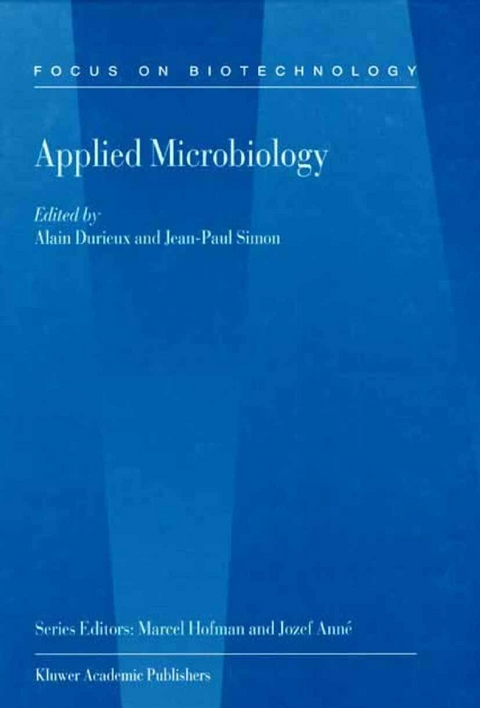
Applied Microbiology (eBook)
288 Seiten
Springer Netherlands (Verlag)
978-0-306-46888-9 (ISBN)
This book illustrates the major trends in applied microbiology research with immediate or potential industrial applications. The papers proposed reflect the diversity of the application fields. New microbial developments have been done as well in the food and health sectors than in the environmental technology or in the fine chemical production. All the microbial genera are involved : yeast, fungi and bacteria. The development of biotechnology in parallel with the industrial microbiology has enabled the application of microbial diversity to our socio-economical world. The remarkable properties of microbes, inherent in their genetic and enzymatic material, allow a wide range of applications that can improve our every day life. Recent studies for elucidating the molecular basis of the physiological processes in micro-organisms are essential to improve and to control the metabolic pathways to overproduce metabolites or enzymes of industrial interest. The genetic engineering is of course one of the disciplines offering new horizons for the fantastic microbial factory . Studies of the culture parameter incidence on the physiology and the morphology are essential to control the response of the micro-organisms before its successful exploitation at the industrial scale. For this purpose, fundamental viewpoints are necessary. Development of novel approaches to characterise micro-organisms would also facilitate the understanding of the inherent metabolic diversity of the microbial world, in terms of adaptation to a wide range of biotopes and establishment of microbial consortia.
EDITORS PREFACE 6
IN MEMORY 7
TABLE OF CONTENTS 8
Part 1 STARTERS 16
NEW ASPECTS OF FUNGAL STARTER CULTURES FOR FERMENTED FOODS 17
Abstract 17
1. Introduction 17
2. Penicillium nalgiovense 19
3. Penicillium camemberti 27
4. Penicillium roqueforti 29
5. Conclusions 31
References 31
STARTERS FOR THE WINE INDUSTRY 34
Abstract 34
1. Introduction 34
2. Yeast starters in winemaking 35
3. Malolactic starters in winemaking 41
4. The future of starters for winemaking 46
5. Conclusion 48
References 48
Part 2 PHYSIOLOGY, BIOSYNTHESIS AND METABOLIC ENGINEERING 51
METABOLISM AND LYSINE BIOSYNTHESIS CONTROL IN BREVIBACTERIUM FLAVUM: IMPACT OF STRINGENT RESPONSE IN BACTERIAL CELLS 52
Abstract 52
1. Introduction 52
2. Materials and Methods 53
3. Results and Discussion 53
4. Conclusions 57
References 58
MOLECULAR BREEDING OF ARMING YEASTS WITH HYDROLYTIC ENZYMES BY CELL SURFACE ENGINEERING 59
Abstract 59
1. Introduction 60
2. Principle of Cell Surface Engineering of Yeast 63
3. Display of Amylolytic Enzymes on the Yeast Cell Surface 65
4. Display of Cellulolytic Enzymes on the Yeast Cell Surface 67
5. Display of Lipase on the Yeast Cell Surface 70
6. Cell Surface Engineering as a Novel Field of Biotechnology 70
References 71
METABOLIC PATHWAY ANALYSIS OF SACCHAROMYCES CEREVISIAE 74
Abstract 74
1. Introduction 74
2. Metabolic pathway analysis 75
3. Steady- state continuous cultivation – an excellent tool for metabolic pathway analysis 78
4. Metabolic pathway analysis applied to Saccharomyces cerevisiae 79
Acknowledgements 84
References 84
Part 3 STATE PARAMETERS AND CULTURE CONDITIONS 85
EFFECT OF AERATION IN PROPAGATION ON SURFACE PROPERTIES OF BREWERS’ YEAST 86
Abstract 86
1. Introduction 86
2. Materials and Methods 87
3. Results 89
4. Discussion 93
5. Conclusions 95
References 96
EFFECT OF THE MAIN CULTURE PARAMETERS ON THE GROWTH AND PRODUCTION COUPLING OF LACTIC ACID BACTERIA 97
Abstract 97
1. Introduction 97
2. Materials and methods 98
3. Results and Discussion 99
4. Conclusions 103
Acknowledgements 103
References 103
PSEUDOHYPHAL AND INVASIVE GROWTH IN SACCHAROMYCES CEREVISIAE 105
Abstract 105
1. Introduction 105
2. Signal transduction in Saccharomyces cerevisiae 106
3. Molecular nature of signal transduction processes resulting in pseudohyphal differentiation 108
4. Scientific and industrial relevance 123
Acknowledgements 125
References 125
MICROBIAL PRODUCTION OF THE BIODEGRADABLE POLYESTER POLY-3-HYDROXYBUTYRATE (PHB) FROM AZOTOBACTER CHROOCOCCUM 6B: RELATION BETWEEN PHB MOLECULAR WEIGHT, THERMAL STABILITY AND TENSILE STRENGTH 130
Abstract 130
1. Materials and methods 130
2. Results and discussion 131
3. Conclusions 134
References 134
Part 4 NOVEL APPROACHES TO THE STUDY OF MICROORGANISMS 136
SHARING OF NUTRITIONAL RESOURCES IN BACTERIAL COMMUNITIES DETERMINED BY ISOTOPIC RATIO MASS SPECTROMETRY OF BIOMARKERS 137
1. Introduction 137
2. Taxon specific biomarkers 138
3. Isotopic fractionation in microorganisms 140
4. Carbon sharing in a pollutant degrading bacterial community 141
5. Outlook 146
Acknowledgement 146
References 146
A COMPARISON OF THE MECHANICAL PROPERTIES OF DIFFERENT BACTERIAL SPECIES 149
1. Introduction 149
2. Materials and methods 152
3. Results and discussion 154
4. Conclusions and future developments 155
References 156
Part 5 NOVEL APPLICATIONS 157
KOCURIA ROSEA AS A NEW FEATHER DEGRADING BACTERIA 158
Abstract 158
1. Introduction 158
2.Isolation, identification and adaptation of feather-degrading microorganisms 159
3. Microbial growth and feather degradation 161
4. Industrial applications 164
Acknowledgements 167
References 167
COMPARISON OF PB2+ REMOVAL CHARACTERISTICS BETWEEN BIOMATERIALS AND NON- BIOMATERIALS 169
Abstract 169
1. Introduction 169
2. Materials and methods 170
3. Results and discussion 171
4. Conclusions 175
References 175
HYDROCARBON UTILISATION BY STREPTOMYCES SOIL BACTERIA 176
Abstract 176
1. Materials and methods 176
2. Results and discussion 178
3. Conclusion 181
References 181
PART 6 FOOD SECURITY AND FOOD PRESERVATION 182
MOLECULAR DETECTION AND TYPING OF FOODBORNE BACTERIAL PATHOGENS: A REVIEW 183
Abstract 183
1. Introduction 184
2. Characteristics of the foodborne bacterial pathogens 184
3. Molecular detection and identification of foodborne bacterial pathogens 188
4. Molecular typing of foodborne bacterial pathogens 198
5.Molecular typing of some specific bacterial foodborne pathogens 211
References 219
BIOENCAPSULATION TECHNOLOGY IN MEAT PRESERVATION 229
Abstract 229
1. Introduction 230
2. Meat preservation 231
3. The application of encapsulation technology to meat preservation 233
4. Control of emerging pathogens 240
5. The application of encapsulation technology to bacteriocin delivery 241
6. Conclusions and future work 251
References 251
INDEX 257
| Erscheint lt. Verlag | 11.4.2006 |
|---|---|
| Sprache | englisch |
| Themenwelt | Mathematik / Informatik ► Mathematik ► Angewandte Mathematik |
| Naturwissenschaften ► Biologie ► Biochemie | |
| Naturwissenschaften ► Biologie ► Mikrobiologie / Immunologie | |
| Naturwissenschaften ► Biologie ► Ökologie / Naturschutz | |
| Technik ► Lebensmitteltechnologie | |
| Technik ► Umwelttechnik / Biotechnologie | |
| ISBN-10 | 0-306-46888-3 / 0306468883 |
| ISBN-13 | 978-0-306-46888-9 / 9780306468889 |
| Informationen gemäß Produktsicherheitsverordnung (GPSR) | |
| Haben Sie eine Frage zum Produkt? |
 PDF (Wasserzeichen)
Größe: 6,2 MB
DRM: Digitales Wasserzeichen
Dieses eBook enthält ein digitales Wasserzeichen und ist damit für Sie personalisiert. Bei einer missbräuchlichen Weitergabe des eBooks an Dritte ist eine Rückverfolgung an die Quelle möglich.
Dateiformat: PDF (Portable Document Format)
Mit einem festen Seitenlayout eignet sich die PDF besonders für Fachbücher mit Spalten, Tabellen und Abbildungen. Eine PDF kann auf fast allen Geräten angezeigt werden, ist aber für kleine Displays (Smartphone, eReader) nur eingeschränkt geeignet.
Systemvoraussetzungen:
PC/Mac: Mit einem PC oder Mac können Sie dieses eBook lesen. Sie benötigen dafür einen PDF-Viewer - z.B. den Adobe Reader oder Adobe Digital Editions.
eReader: Dieses eBook kann mit (fast) allen eBook-Readern gelesen werden. Mit dem amazon-Kindle ist es aber nicht kompatibel.
Smartphone/Tablet: Egal ob Apple oder Android, dieses eBook können Sie lesen. Sie benötigen dafür einen PDF-Viewer - z.B. die kostenlose Adobe Digital Editions-App.
Buying eBooks from abroad
For tax law reasons we can sell eBooks just within Germany and Switzerland. Regrettably we cannot fulfill eBook-orders from other countries.
PDF (Adobe DRM)Kopierschutz: Adobe-DRM
Adobe-DRM ist ein Kopierschutz, der das eBook vor Mißbrauch schützen soll. Dabei wird das eBook bereits beim Download auf Ihre persönliche Adobe-ID autorisiert. Lesen können Sie das eBook dann nur auf den Geräten, welche ebenfalls auf Ihre Adobe-ID registriert sind.
Details zum Adobe-DRM
Dateiformat: PDF (Portable Document Format)
Mit einem festen Seitenlayout eignet sich die PDF besonders für Fachbücher mit Spalten, Tabellen und Abbildungen. Eine PDF kann auf fast allen Geräten angezeigt werden, ist aber für kleine Displays (Smartphone, eReader) nur eingeschränkt geeignet.
Systemvoraussetzungen:
PC/Mac: Mit einem PC oder Mac können Sie dieses eBook lesen. Sie benötigen eine
eReader: Dieses eBook kann mit (fast) allen eBook-Readern gelesen werden. Mit dem amazon-Kindle ist es aber nicht kompatibel.
Smartphone/Tablet: Egal ob Apple oder Android, dieses eBook können Sie lesen. Sie benötigen eine
Geräteliste und zusätzliche Hinweise
Buying eBooks from abroad
For tax law reasons we can sell eBooks just within Germany and Switzerland. Regrettably we cannot fulfill eBook-orders from other countries.
aus dem Bereich