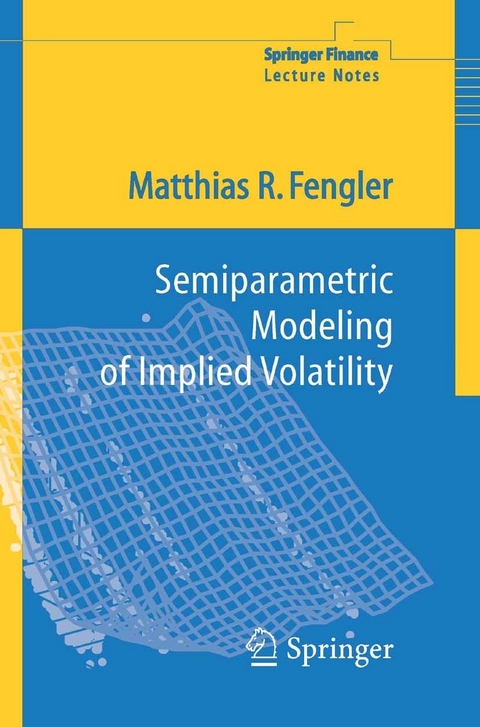
Semiparametric Modeling of Implied Volatility (eBook)
224 Seiten
Springer Berlin (Verlag)
978-3-540-30591-0 (ISBN)
Matthias Fengler took his PhD in Finance at the Humboldt-Universität zu Berlin and is now a quantitative analyst at Sal. Oppenheim, Frankfurt.
Acknowledgements 8
Frequently Used Notation 9
Contents 13
1 Introduction 16
2 The Implied Volatility Surface 24
2.1 The Black-Scholes Model 24
2.2 The Self-Financing Replication Strategy 26
2.3 Risk Neutral Pricing 27
2.4 The BS Formula and the Greeks 29
2.5 The IV Smile 34
2.6 Static Properties of the Smile Function 42
2.6.1 Bounds on the Slope 42
2.6.2 Large and Small Strike Behavior 43
2.7 General Regularities of the IVS 45
2.7.1 Static Stylized Facts 45
2.7.2 DAX Index IV between 1995 and 2001 48
2.8 Relaxing the Constant Volatility Case 49
2.8.1 Deterministic Volatility 50
2.8.2 Stochastic Volatility 51
2.9 Challenges Arising from the Smile 55
2.9.1 Hedging and Risk Management 55
2.9.2 Pricing 57
2.10 IV as Predictor of Realized Volatility 57
2.11 Why Do We Smile? 58
2.12 Summary 61
3 Smile Consistent Volatility Models 62
3.1 Introduction 62
3.2 The Theory of Local Volatility 64
3.3 Backing the LVS Out of Observed Option Prices 66
3.4 The dual PDE Approach to Local Volatility 69
3.5 From the IVS to the LVS 70
3.6 Asymptotic Relations Between Implied and Local Volatility 75
3.7 The Two-Times-IV-Slope Rule for Local Volatility 77
3.8 The K-Strike and T -Maturity Forward Risk-Adjusted Measure 79
3.9 Model-Free (Implied) Volatility Forecasts 81
3.10 Local Volatility Models 82
3.10.1 Deterministic Implied Trees 82
3.10.2 Stochastic Implied Trees 95
3.10.3 Reconstructing the LVS 99
3.11 Excellent Fit, but...: the Delta Problem 103
3.12 Stochastic IV Models 106
3.13 Summary 109
4 Smoothing Techniques 112
4.1 Introduction 112
4.2 Nadaraya-Watson Smoothing 114
4.2.1 Kernel Functions 114
4.2.2 The Nadaraya-Watson Estimator 115
4.3 Local Polynomial Smoothing 117
4.4 Bandwidth Selection 119
4.4.1 Theoretical Framework 119
4.4.2 Bandwidth Choice in Practice 121
4.5 Least Squares Kernel Smoothing 130
4.5.1 The LSK Estimator of the IVS 130
4.5.2 Application of the LSK Estimator 132
4.6 Summary 138
5 Dimension-Reduced Modeling 140
5.1 Introduction 140
5.2 Common Principal Component Analysis 143
5.2.1 The Family of CPC Models 143
5.2.2 Estimating Common Eigenstructures 146
5.2.3 Stability Tests for Eigenvalues and Eigenvectors 149
5.2.4 CPC Model Selection 153
5.2.5 Empirical Results 154
5.3 Functional Data Analysis 170
5.3.1 Basic Set-Up of FPCA 171
5.3.2 Computing FPCs 172
5.4 Semiparametric Factor Models 175
5.4.1 The Model 177
5.4.2 Norming of the Estimates 181
5.4.3 Choice of Model Parameters 182
5.4.4 Empirical Analysis 186
5.4.5 Assessing Prediction Performance 197
5.5 Summary 199
6 Conclusion and Outlook 202
A Description and Preparation of the IV Data 204
A.1 Preliminaries 204
A.2 Data Correction Scheme 205
B Some Results from Stochastic Calculus 210
C Proofs of the Results on the LSK IV Estimator 216
C.1 Proof of Consistency 216
C.2 Proof of Asymptotic Normality 218
References 222
Index 236
5 Dimension-Reduced Modeling (p.125)
5.1 Introduction
The IVS is a complex, high-dimensional random object. In building a model, it is thus desirable to have a low-dimensional representation of the IVS. This aim can be achieved by employing dimension reduction techniques. Generally it is found that two or three factors with appealing .nancial interpretations are su.cient to capture more than 90% of the IVS dynamics. This implies for instance for a scenario analysis in risk-management that only a parsimonious model needs to be implemented to study the vega-sensitivity of an option portfolio, Fengler et al. (2002b). This section will give a general overview on dimension reduction techniques in the context of IVS modeling. We will consider techniques from multivariate statistics and methods from functional data analysis. Sections 5.2 and 5.3 will provide an in-depth treatment of the CPC and the semiparametric factor model of the IVS together with an extensive empirical analysis of the German DAX index data.
In multivariate analysis, the most prominent technique for dimension reduction is principal component analysis (PCA). The idea is to seek linear combinations of the original observations, so called principal components (PCs) that inherit as much information as possible from the original data. In PCA, this means to look for standardized linear combinations with maximum variance. The approach appears to be sensible in an analysis of the IVS dynamics, since a large variance separates out systematic from idiosyncratic shocks that drive the surface. As a nice byproduct, the structure of the linear combinations reveals relationships among the variables that are not apparent in the original data. This helps understand the nature of the interdependence between di.erent regions in the IVS.
In .nance, PCA is a well-established tool in the analysis of the term structure of interest rates, see Gouri´eroux et al. (1997) or Rebonato (1998) for textbook treatments: PCA is applied to a multiple time series of interest rates (or forward rates) of various maturities that is recovered from the term structure of interest rates. Typically, a small number of factors is found to represent the dynamic variations of the term structure of interest rates. The studies of Bliss (1997), Golub and Tilman (1997), Ni.keer et al. (2000), and Molgedey and Galic (2001) are examples of this kind of literature.
This approach does not immediately carry over to the analysis of IVs due to the surface structure. Consequently, in analogy to the interest rate case, empirical work .rst analyzes the term structure of IVs of ATM options, only, Zhu and Avellaneda (1997) and Fengler et al. (2002b). Alternatively, one smile at one given maturity can be analyzed within the PCA framework, Alexander (2001b). Skiadopoulos et al. (1999) group IVs into maturity buckets, average the IVs of the options, whose maturities fall into them, and apply a PCA to each bucket covariance matrix separately. A good overview of these methods can be found in Alexander (2001a).
| Erscheint lt. Verlag | 19.12.2005 |
|---|---|
| Reihe/Serie | Springer Finance |
| Springer Finance | |
| Springer Finance Lecture Notes | |
| Springer Finance Lecture Notes | Springer Finance Lecture Notes |
| Zusatzinfo | XVI, 224 p. 61 illus. |
| Verlagsort | Berlin |
| Sprache | englisch |
| Themenwelt | Mathematik / Informatik ► Mathematik |
| Technik | |
| Wirtschaft ► Allgemeines / Lexika | |
| Wirtschaft ► Betriebswirtschaft / Management ► Finanzierung | |
| Wirtschaft ► Volkswirtschaftslehre | |
| Schlagworte | dynamic factor models • implied volatility • JEL: G12, G13 • local volatility • Modeling • non- and semiparametric regression • options • Portfolio • principal components models • Quantitative Finance • Semiparametric Model • Statistical Models • Volatility |
| ISBN-10 | 3-540-30591-2 / 3540305912 |
| ISBN-13 | 978-3-540-30591-0 / 9783540305910 |
| Informationen gemäß Produktsicherheitsverordnung (GPSR) | |
| Haben Sie eine Frage zum Produkt? |
 PDF (Wasserzeichen)
DRM: Digitales Wasserzeichen
Dieses eBook enthält ein digitales Wasserzeichen und ist damit für Sie personalisiert. Bei einer missbräuchlichen Weitergabe des eBooks an Dritte ist eine Rückverfolgung an die Quelle möglich.
Dateiformat: PDF (Portable Document Format)
Mit einem festen Seitenlayout eignet sich die PDF besonders für Fachbücher mit Spalten, Tabellen und Abbildungen. Eine PDF kann auf fast allen Geräten angezeigt werden, ist aber für kleine Displays (Smartphone, eReader) nur eingeschränkt geeignet.
Systemvoraussetzungen:
PC/Mac: Mit einem PC oder Mac können Sie dieses eBook lesen. Sie benötigen dafür einen PDF-Viewer - z.B. den Adobe Reader oder Adobe Digital Editions.
eReader: Dieses eBook kann mit (fast) allen eBook-Readern gelesen werden. Mit dem amazon-Kindle ist es aber nicht kompatibel.
Smartphone/Tablet: Egal ob Apple oder Android, dieses eBook können Sie lesen. Sie benötigen dafür einen PDF-Viewer - z.B. die kostenlose Adobe Digital Editions-App.
Buying eBooks from abroad
For tax law reasons we can sell eBooks just within Germany and Switzerland. Regrettably we cannot fulfill eBook-orders from other countries.
aus dem Bereich