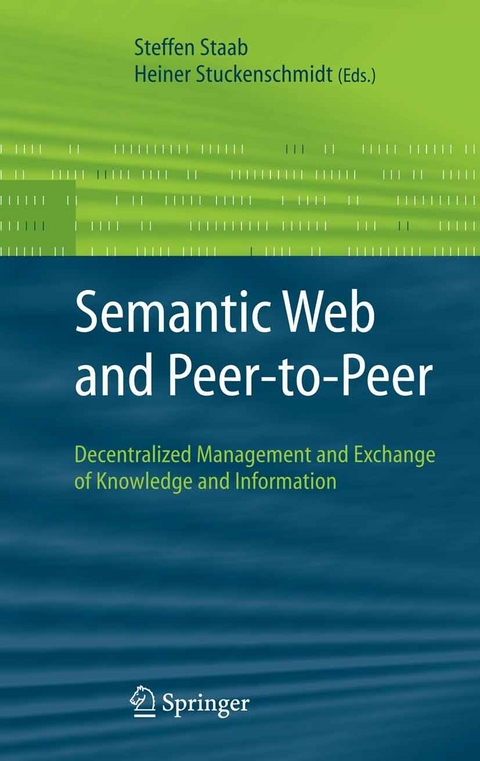
Semantic Web and Peer-to-Peer (eBook)
XIII, 365 Seiten
Springer Berlin (Verlag)
978-3-540-28347-8 (ISBN)
Just like the industrial society of the last century depended on natural resources, today's society depends on information and its exchange.
Staab and Stuckenschmidt structured the selected contributions into four parts: Part I, 'Data Storage and Access', prepares the semantic foundation, i.e. data modelling and querying in a flexible and yet scalable manner. These foundations allow for dealing with the organization of information at the individual peers. Part II, 'Querying the Network', considers the routing of queries, as well as continuous queries and personalized queries under the conditions of the permanently changing topological structure of a peer-to-peer network. Part III, 'Semantic Integration', deals with the mapping of heterogeneous data representations. Finally Part IV, 'Methodology and Systems', reports experiences from case studies and sample applications.
The overall result is a state-of-the-art description of the potential of Semantic Web and peer-to-peer technologies for information sharing and knowledge management when applied jointly.
PD Dr. Steffen Staab is a senior lecturer in applied computer science at the University of Karlsruhe. He has earned a M.S.E. from University of Pennsylvania, a Dr. rer. nat. from University of Freiburg and his habilitation from University of Karlsruhe. He has done research in the fields of computational linguistics, text mining, ontology engineering, knowledge management, and peer-to-peer. He has co-authored over 120 refereed publications and published 7 books, including a Handbook on Ontologies. In 1999, Steffen Staab has co-founded Ontoprise, the first Semantic Web company. He serves on the editorial board of IEEE Intelligent Systems, Journal of Web Semantics, Journal of Human-Computer Studies and Journal of Information Technology and Tourism. Steffen Staab has co-chaired a large number of workshops and several conferences. Recently, he serves as an area chair of ECAI-2004, Semantic Web track chair of WWW-2005, and co-chair of STAIRS-2004.
Dr. Heiner Stuckenschmidt Heiner Stuckenschmidt holds a post-doc position in the Knowledge Representation and Reasoning Group at the Vrije Universiteit Amsterdam where he received his PhD for work on Ontology-Based Information Sharing on the Semantic Web. He works includes Semantic Web related topics such as ontology languages, knowledge-based meta data management and robust and scalable terminological reasoning. Before moving to Amsterdam, he was employed as a researcher and lecturer at the University of Bremen. His research activities in Bremen included the application of ontologies for information sharing in web based information systems with a special focus on semantics-preserving information integration and spatially related information. He is organizer of a series of workshops on ontologies at international conferences (IJCAI'01, ECAI'02, IJCAI'03) and member of program committees of several semantic web related conferences (SWWS'01, ISWC'02, WWW'03) and has held / will hold tutorial at different conferences (K-CAP 2001, IJCAI'03, ISWC'03). He is editor of a book on the application of ontologies in the cadastral domain the author of a book on Information Sharing on the Semantic web and has published more than 40 paper in international journals, conferences and workshops.
PD Dr. Steffen Staab is a senior lecturer in applied computer science at the University of Karlsruhe. He has earned a M.S.E. from University of Pennsylvania, a Dr. rer. nat. from University of Freiburg and his habilitation from University of Karlsruhe. He has done research in the fields of computational linguistics, text mining, ontology engineering, knowledge management, and peer-to-peer. He has co-authored over 120 refereed publications and published 7 books, including a Handbook on Ontologies. In 1999, Steffen Staab has co-founded Ontoprise, the first Semantic Web company. He serves on the editorial board of IEEE Intelligent Systems, Journal of Web Semantics, Journal of Human-Computer Studies and Journal of Information Technology and Tourism. Steffen Staab has co-chaired a large number of workshops and several conferences. Recently, he serves as an area chair of ECAI-2004, Semantic Web track chair of WWW-2005, and co-chair of STAIRS-2004. Dr. Heiner Stuckenschmidt Heiner Stuckenschmidt holds a post-doc position in the Knowledge Representation and Reasoning Group at the Vrije Universiteit Amsterdam where he received his PhD for work on Ontology-Based Information Sharing on the Semantic Web. He works includes Semantic Web related topics such as ontology languages, knowledge-based meta data management and robust and scalable terminological reasoning. Before moving to Amsterdam, he was employed as a researcher and lecturer at the University of Bremen. His research activities in Bremen included the application of ontologies for information sharing in web based information systems with a special focus on semantics-preserving information integration and spatially related information. He is organizer of a series of workshops on ontologies at international conferences (IJCAI’01, ECAI’02, IJCAI’03) and member of program committees of several semantic web related conferences (SWWS’01, ISWC’02, WWW’03) and has held / will hold tutorial at different conferences (K-CAP 2001, IJCAI’03, ISWC’03). He is editor of a book on the application of ontologies in the cadastral domain the author of a book on Information Sharing on the Semantic web and has published more than 40 paper in international journals, conferences and workshops.
Preface 6
Contents 9
Peer-to-Peer and Semantic Web 12
1 The Semantic Web 12
1.1 Infrastructure for Machine-Readable Metadata 13
1.2 Representing Local and Shared Meaning 13
2 Peer-to-Peer 14
2.1 Peer-to-Peer and Knowledge Management 15
2.2 Peer-to-Peer and the (Semantic) Web 17
3 Aspects of Semantics-Based Peer-to-Peer Systems 17
3.1 Data Storage and Access 18
3.2 Querying the Network 20
3.3 Integration Mechanism 22
3.4 Building and Maintaining Semantic P2P Applications 25
3.5 Other Issues 26
4 Conclusions 27
References 27
Part I Data Storage and Access 29
Overview: Data Storage and Access 30
1 An RDF Query and Transformation Language 32
1.1 Introduction 32
1.2 Query Language requirements 33
1.2.1 Expressive power 33
1.2.2 Schema awareness 34
1.2.3 Program manipulation 34
1.2.4 Compositionality 34
1.2.5 Semantics 34
1.3 The Syntax of SeRQL 35
1.3.1 Path Expressions 35
1.3.2 Filters and operators 39
1.4 Formal Interpretation of SeRQL 40
1.4.1 Mapping Basic Path Expressions to Sets 40
1.4.2 Functions 42
1.4.3 Reducing Composed Expressions 44
1.5 Related work 45
1.6 Conclusions 46
References 46
2 RDF and Traditional Query Architectures 49
2.1 Introduction 49
2.2 Motivation 50
2.3 Hierarchical mediator architecture 52
2.3.1 Indexing Sources 54
2.3.2 Index Creation and Maintenance 54
2.3.3 Query Planning and Optimization 56
2.3.4 Object Identity 56
2.3.5 HMA Advantages and Limitations 57
2.4 Cooperative Mediator Architecture 59
2.4.1 Paradigm Shift 59
2.4.2 Query Processing and Query Optimization 60
2.4.3 Making the Query Plan Robust 61
2.5 Summary and Discussion 63
References 64
3 Query Processing in RDF/S-Based P2P Database Systems 67
3.1 Introduction 67
3.2 The SQPeer Middleware 69
3.2.1 RDF/S-based P2P databases and RQL Queries 70
3.2.2 RVL Advertisements of Peer Bases 71
3.2.3 Query Routing and Fragmentation 73
3.2.4 Query Planning and Execution 74
3.2.5 Query Optimization 76
3.3 P2P Architectures and SQPeer 79
3.3.1 Hybrid P2P SONs 80
3.3.2 Structured P2P SONs 82
3.4 Related Work 84
3.5 Summary 86
References 87
Part II Querying the Network 90
Overview: Querying the Network 91
4 Cayley DHTs - A Group-Theoretic Framework for Analyzing DHTs Based on Cayley Graphs 94
4.1 DHTs and Static DHT Topologies 94
4.2 Cayley DHTs - A Group-Theoretic Model for Analyzing DHTs 95
4.2.1 Groups and Cayley Graphs 95
4.2.2 Non-constant Degree Cayley DHTs 96
4.2.3 Constant Degree Cayley DHTs 98
4.2.4 Non-Cayley DHTs 102
4.3 Cayley Graph Properties and DHTs 102
4.3.1 Symmetry and Load Balancing 102
4.3.2 Hierarchy, Fault Tolerance, and Proximity 104
4.3.3 Connectivity and Fault Tolerance 104
4.3.4 Hamiltonicity and Cyclic Routing 106
4.4 Discussion and Related Work 106
4.5 Conclusions 108
References 108
5 Semantic Query Routing in Unstructured Networks Using Social Metaphors 111
5.1 Introduction 111
5.2 SWAP Platform 113
5.2.1 Meta-information 113
5.2.2 Querying for Data 114
5.3 Algorithm 114
5.3.1 The Social Metaphors 114
5.3.2 Protocol Scenario 115
5.3.3 Peer selection algorithm 116
5.4 Evaluation Setting 117
5.4.1 Data Source and Peer setup 117
5.4.2 Generation of queries in experiment 118
5.4.3 Initial con.guration of the Peer-to-Peer network simulation 118
5.4.4 Evaluation measures 119
5.5 Results 120
5.5.1 Hypotheses 120
5.5.2 Evaluation 120
5.6 Related Work 124
5.7 Conclusion 125
References 125
6 Expertise-Based Peer Selection 128
6.1 Introduction 128
6.2 Related Work on Semantic Overlay Networks 129
6.3 A Model for Expertise Based Peer Selection 131
6.3.1 Semantic Description of Expertise 131
6.3.2 Matching and Peer Selection 132
6.3.3 Semantic Overlay 132
6.4 Expertise Based Peer Selection in Bibster 133
6.5 Results of Simulation Experiments 135
6.6 Results of Field Study 141
6.7 Comparison with Results from Simulation Experiments 142
6.8 Conclusion 143
References 144
7 Personalized Information Access in a Bibliographic Peer-to-Peer System 146
7.1 Introduction 146
7.1.1 Example Scenarios 147
7.2 Ontology Based Similarity 148
7.2.1 The Bibliographic Ontologies 148
7.2.2 Semantic Similarity 150
7.3 Semantic User Profile 153
7.3.1 User Profile Representation 153
7.3.2 Initial User Profile and Profile Adaptation 155
7.4 Recommender Functions 156
7.4.1 Recommending Similar Items 156
7.4.2 Recommending Potentially Relevant Items 157
7.4.3 Recommending Similar Peers 157
7.5 Related Work 158
7.6 Conclusion 159
References 159
8 Designing Semantic Publish/Subscribe Networks Using Super-Peers 161
8.1 Introduction 161
8.2 A Formalism for Pub/Sub Systems Based on RDF 162
8.3 The Super-Peer Architecture 165
8.4 Processing Advertisements, Subscriptions and Notifications 168
8.4.1 Processing Advertisements 168
8.4.2 Processing Subscriptions 171
8.4.3 Processing Notifications 172
8.5 Dynamics of P2P Pub/Sub Networks 173
8.5.1 Of.ine Noti.cations and Rendezvous at Super-Peers 173
8.5.2 Peer Authentication 174
8.6 Related Work 176
8.7 Conclusions 177
8.8 Acknowledgements 178
References 178
Part III Semantic Integration 182
Overview: Semantic Integration 183
9 Semantic Coordination of Heterogeneous Classifications Schemas 185
9.1 Introduction 185
9.2 Our Approach 186
9.3 The Algorithm: 189
9.3.1 Semantic Elicitation 192
9.3.2 Semantic Comparison 194
9.4 Related Work 195
9.5 Conclusions 197
References 198
10 Semantic Mapping by Approximation 201
10.1 Introduction 201
10.2 Application in Peer-to-Peer 203
10.3 Internet Music Schemas 205
10.4 Approximate Matching 206
10.4.1 Normal Forms 207
10.5 Experiment with Approximate Matching 208
10.5.1 Example of an Approximate Matching 209
10.5.2 Comparison with Instance Data 210
10.6 Future Work 212
10.6.1 Improvements of Approximation Accuracy 213
10.6.2 Sources of Background Knowledge 213
10.7 Conclusion 214
Acknowledgements 214
References 214
11 Satisficing Ontology Mapping 216
11.1 Introduction 216
11.2 Terminology 218
11.2.1 Ontology 218
11.2.2 Mapping 218
11.2.3 Example 218
11.3 Process 219
1. Feature engineering 219
2. Selection of Next Search Steps. 219
3. Similarity Computation 219
4. Similarity Aggregation. 219
5. Interpretation 220
6. Iteration. 220
11.4 A Toolbox of Data Structures and Methods 220
11.4.1 Features of Ontological Entities 220
11.4.2 Similarity Computation 221
11.4.3 Similarity Aggregation 222
11.4.4 Interpretation 222
11.5 Approaches to Determine Mappings 222
11.5.1 Standard Mapping Approaches 222
11.5.2 QOM - Quick Ontology Mapping 224
11.6 Comparing Run-time Complexity 226
11.7 Empirical Evaluation and Results 227
11.7.1 Test Scenario Metrics 227
11.7.2 Results and Discussion 228
11.8 Related Work 230
11.9 Conclusion 230
References 231
12 Scalable, Peer-Based Mediation Across XML Schemas and Ontologies 233
12.1 Introduction 233
12.2 System Overview 235
12.2.1 Data, Schemas, and Queries 235
12.2.2 Data Sharing and Mediation 237
12.2.3 Query Processing 237
12.3 Mapping Requirements for Structured Data 238
12.4 Schema Mappings in Piazza 239
12.4.1 Mapping Language and Examples 241
12.4.2 Semantics of Mappings 245
12.4.3 Discussion 246
12.5 Query Answering Algorithm 247
12.5.1 Query Representation 248
12.5.2 The Rewriting Algorithm 250
12.6 Conclusions and Future Work 254
References 254
13 Semantic Gossiping: Fostering Semantic Interoperability in Peer Data Management Systems 257
13.1 Introduction 257
13.2 Motivation: Sharing Images Meaningfully 259
13.3 Of Semantic Neighborhoods and Schema Translations 261
13.4 Semantic Query Routing 263
13.4.1 Syntactic Measures 263
13.4.2 Semantic Measures 264
13.4.3 An illustrating example 266
13.5 Self-Healing Semantic Networks 267
13.6 Analyzing Semantic Interoperability in the Large 269
13.7 GridVine: Implementing Semantic Gossiping on top of a DHT 270
13.8 Conclusions 272
References 273
Part IV Methodology and Systems 274
Overview: Methodology and Systems 275
References 277
14 A Methodology for Distributed Knowledge Management Using Ontologies and Peer-to-Peer 279
14.1 Introduction 279
14.2 The Theory of Distributed Knowledge Management 281
14.3 Methods for Distributed Knowledge Management 284
14.4 Tools for Distributed Knowledge Management 287
14.4.1 Analysis 288
14.4.2 Design 290
14.4.3 Deployment 293
14.4.4 Evaluation 294
14.5 Summary 296
References 297
15 Distributed Engineering of Ontologies (DILIGENT) 299
15.1 Introduction and Motivation 299
15.2 DILIGENT Process 300
15.3 AIFB Case Study: An Argumentation Framework for DILIGENT 302
15.3.1 Threads of Arguments 302
15.3.2 Hypothesis 303
15.3.3 Hypothesis Validation 304
15.4 IBIT Case Study: a running DILIGENT Process 308
15.4.1 Organizational Setting 308
15.4.2 Technical Setting 309
15.4.3 Realizing a DILIGENT Process 309
15.4.4 Lessons Learned from the Realization 311
15.4.5 Tool Support for DILIGENT Steps 311
15.5 Related Work 316
15.6 Conclusion 316
References 317
16 A Peer-to-Peer Solution for Distributed Knowledge Management 319
16.1 Introduction 319
16.2 KEx: a P2P Architecture for DKM 320
16.2.1 K-peers 320
16.2.2 Roles of K-peers in KEx 323
16.2.3 K-Services 324
16.3 Development Framework 327
16.4 Conclusions and Research Issues 328
References 329
17 Xarop, a Semantic Peer-to-Peer System for a Virtual Organization 331
17.1 Introduction 331
17.1.1 The Tourism Sector in the Balearic Islands 331
17.1.2 Decision making in the Destination 332
17.1.3 Domains of Knowledge 333
17.2 Requirements Analysis 335
17.2.1 Organizational Context Analysis 336
17.2.2 Use Cases Description Searching for Information 337
17.3 XAROP platform description 338
17.3.1 Knowledge Providing functionalities 339
17.3.2 Knowledge Searching Functionalities 340
17.3.3 Managing Security Permissions 341
17.4 Conclusions 341
References 342
18 Bibster - A Semantics-Based Bibliographic Peer-to-Peer System 344
18.1 Introduction 344
18.2 Major Use Cases for Bibster 345
18.3 Design of Bibster 346
18.3.1 Ontologies in Bibster 346
18.3.2 Bibster Architecture and Modules 347
18.4 Semantic Extraction of Bibliographic Metadata 349
18.5 Semantic Querying 350
18.6 Expertise Based Peer Selection 352
18.7 Semantic Duplicate Detection 354
18.8 Results 355
18.9 Related Work 357
18.10 Conclusion 357
References 358
Author Index 359
| Erscheint lt. Verlag | 28.3.2006 |
|---|---|
| Zusatzinfo | XIII, 365 p. |
| Verlagsort | Berlin |
| Sprache | englisch |
| Themenwelt | Informatik ► Theorie / Studium ► Künstliche Intelligenz / Robotik |
| Schlagworte | ACCESS • Architecture • classification • data model • Data Modelling • Extensible Markup Language (XML) • Knowledge • knowledge management • mapping • Modeling • Networks • Ontologies • Ontology • ontology mapping • organization • P2P • Peer-to-Peer • RDF Query • Routing • semantic web • XML Schema |
| ISBN-10 | 3-540-28347-1 / 3540283471 |
| ISBN-13 | 978-3-540-28347-8 / 9783540283478 |
| Informationen gemäß Produktsicherheitsverordnung (GPSR) | |
| Haben Sie eine Frage zum Produkt? |
 PDF (Wasserzeichen)
DRM: Digitales Wasserzeichen
Dieses eBook enthält ein digitales Wasserzeichen und ist damit für Sie personalisiert. Bei einer missbräuchlichen Weitergabe des eBooks an Dritte ist eine Rückverfolgung an die Quelle möglich.
Dateiformat: PDF (Portable Document Format)
Mit einem festen Seitenlayout eignet sich die PDF besonders für Fachbücher mit Spalten, Tabellen und Abbildungen. Eine PDF kann auf fast allen Geräten angezeigt werden, ist aber für kleine Displays (Smartphone, eReader) nur eingeschränkt geeignet.
Systemvoraussetzungen:
PC/Mac: Mit einem PC oder Mac können Sie dieses eBook lesen. Sie benötigen dafür einen PDF-Viewer - z.B. den Adobe Reader oder Adobe Digital Editions.
eReader: Dieses eBook kann mit (fast) allen eBook-Readern gelesen werden. Mit dem amazon-Kindle ist es aber nicht kompatibel.
Smartphone/Tablet: Egal ob Apple oder Android, dieses eBook können Sie lesen. Sie benötigen dafür einen PDF-Viewer - z.B. die kostenlose Adobe Digital Editions-App.
Buying eBooks from abroad
For tax law reasons we can sell eBooks just within Germany and Switzerland. Regrettably we cannot fulfill eBook-orders from other countries.
aus dem Bereich