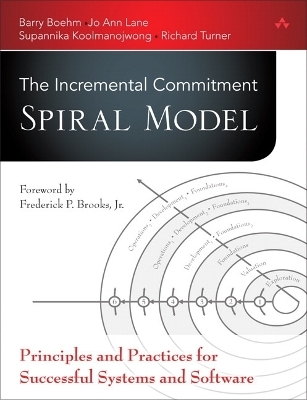
The Incremental Commitment Spiral Model
Addison-Wesley Educational Publishers Inc (Verlag)
978-0-321-80822-6 (ISBN)
- Titel ist leider vergriffen;
keine Neuauflage - Artikel merken
“I am seriously impressed with this ICSM book. Besides being conceptually sound, I was amazed by the sheer number of clear and concise characterizations of issues, relationships, and solutions. I wanted to take a yellow highlighter to it until I realized I’d be highlighting most of the book.”
–Curt Hibbs, Chief Agile Evangelist, Boeing
Use the ICSM to Generate and Evolve Your Life-Cycle Process Assets to Best Fit Your Organization’s Diverse and Changing Needs
Many systems development practitioners find traditional “one-size-fits-all” processes inadequate for the growing complexity, diversity, dynamism, and assurance needs of their products and services. The Incremental Commitment Spiral Model (ICSM) responds with a principle- and risk-based framework for defining and evolving your project and corporate process assets, avoiding pitfalls and disruption, and leveraging opportunities to increase value.
This book explains ICSM’s framework of decision criteria and principles, and shows how to apply them through relevant examples. It demonstrates ICSM’s potential for reducing rework and technical debt, improving maintainability, handling emergent requirements, and raising assurance levels.
Its coverage includes
What makes a system development successful
ICSM’s goals, principles, and usage as a process-generation framework
Creating and evolving processes to match your risks and opportunities
Integrating your current practices and adopting ICSM concepts incrementally, focusing on your greatest needs and opportunities
About the Website: Download the evolving ICSM guidelines, subprocesses, templates, tools, white papers, and academic support resources at csse.usc.edu/ICSM.
Barry Boehm developed a conceptual version of the spiral model at TRW in 1978, but only in 1981 was he able to employ it in successfully, leading the development of a corporate TRW software development environment. SInce the formal publication of this model in 1988, he and his colleagues have devoted extensive efforts to clarifying and evolving it through several intermediate versions into the ICSM. He is the USC Distinguished Professor of Computer Sciences, Industrial and Systems Engineering, and Astronautics; the TRW Professor of Software Engineering; the Chief Scientist of the DoD-Stevens-USC Systems Engineering Research Center, and the founding Director of the USC Center for Systems and Software Engineering. He was director of DARPA-ISTO for 1989-92, at TRW for 1973-89, at Rand Corporation for 1959—73, and at General Dynamics for 1955-59. He is a Fellow of the primary professional societies in computing (ACM), aerospace (AIAA), electronics (IEEE), systems engineering (INCOSE), and lean and agile development (LSS), and a member of the U.S. National Academy of Engineering. Jo Ann Lane is currently the systems engineering Co-Director of the University of Southern California Center for Systems and Software Engineering, a member of the Systems Engineering Research Center (SERC) Research Council representing the system of systems research area, and emeritus professor of computer science at San Diego State University. Her current areas of research include system of systems engineering, system affordability, expediting systems engineering, balancing lean and agile techniques with technical debt, and innovation in systems engineering. Previous publications include over 50 journal articles and conference papers. In addition, she was co-author of the 2008 Department of Defense Systems Engineering Guide for Systems of Systems and a contributor to the Systems Engineering Body of Knowledge (SEBoK). Prior to her current work in academia, she was a Vice President in SAIC’s Healthcare and Software and Systems Integration groups. Supannika Koolmanojwong is a faculty member and a researcher at the University of Southern California Center for Systems and Software Engineering. Her primary research areas are systems and software process modeling, software process improvement, software process quality assurance, software metrics and measurement, agile and lean software development and expediting systems engineering. She is a certified ScrumMaster and a certified Product Owner. Prior to joining USC, Dr. Koolmanojwong was a software engineer and a RUP/OpenUp Content Developer at IBM RationalSoftware Group. Dr. Richard Turner has more than 30 years of experience in systems, software, and acquisition engineering. He is currently a Distinguished Service Professor at the Stevens Institute of Technology in Hoboken, New Jersey, and a Principle Investigator with the Systems Engineering Research Center. Although on the author team for CMMI, Dr. Turner is now active in the agile, lean, and kanban communities. He is currently studying agility and lean approaches as a means to solve large-systems issues. Dr. Turner is a member of the Executive Committee of the NDIA/AFEI Agile for Defense Adoption Proponent Team, the INCOSE Agile SE Working Group, and was an author of the groundbreaking IEEE Computer Society/PMI Software Extension for the Guide to the PMBOK that spans the gap between traditional and agile approaches. He is a Fellow of the Lean Systems Society, a Golden Core awardee of the IEEE Computer Society, and co-author of three other books: Balancing Agility and Discipline: A Guide for the Perplexed, co-written with Barry Boehm, CMMI Survival Guide: Just Enough Process Improvement, coauthored with Suzanne Garcia, and CMMI Distilled.
Foreword xiii Preface xv
About the Authors xxi
Prologue 3
Chapter 0: Introduction 7
0.1 A World of Change 7
0.2 Creating Successful 21st-Century Systems 9
0.3 ICSM Distilled 16
0.4 Using the ICSM 25
0.5 Incremental ICSM Adoption Approaches 28
0.6 Examples of ICSM Use 29
0.7 How ICSM Might Have Helped a Complex Government Acquisition (healthcare.gov) 30
References 32
Part I: The Four ICSM Principles 35
Chapter 1: The First Principle: Stakeholder Value-Based Guidance 37
1.1 Failure Story: The Too-Good Road Surface Assessment Robot 38
1.2 Success Story: The Hospira Next-Generation Intravenous Medical Pump 42
1.3 The Fundamental System Success Theorem and Its Implications 47
1.4 The System Success Realization Theorem and Its Implications 49
References 55
Chapter 2: The Second Principle: Incremental Commitment and Accountability 57
2.1 A Failed Total-Commitment Project: Bank of America’s MasterNet 59
2.2 A Successful Incremental-Commitment Project: The TRW Software Productivity System 63
2.3 The Two Cones of Uncertainty and the ICSM Stages I and II 69
2.4 Alternative Incremental and Evolutionary Development Models 71
2.5 Development as C2ISR 75
References 78
Chapter 3: The Third Principle: Concurrent Multidiscipline Engineering 81
3.1 Failure Story: Sequential RPV Systems Engineering and Development 84
3.2 Success Story: Concurrent Competitive-Prototyping RPV Systems Development 86
3.3 Concurrent Development and Evolution Engineering 89
3.4 Concurrent Engineering of Hardware, Software, and Human Factors Aspects 92
3.5 Concurrent Requirements and Solutions Engineering 94
References 96
Chapter 4: The Fourth Principle: Evidence- and Risk-Based Decisions 97
4.1 Failure Story: The Unaffordable Requirement 99
4.2 Success Story: CCPDS-R 101
4.3 Feasibility Evidence as a First-Class Deliverable 104
4.4 How Much of Anything Is Enough? 107
4.5 Summing Up the Principles 108
References 109
Part II: ICSM Life Cycle and Stage I: Incremental Definition 113
Chapter 5: The ICSM Life Cycle 115
5.1 ICSM Life Cycle 115
5.2 Comparison of ICSM to Other Life-Cycle Models 115
5.3 Stage I: Deciding Why, What, When, Who, Where, How, and How Much 119
5.4 ICSM Case Study 120
Chapter 6: Exploration Phase 123
6.1 What Is the Exploration Phase? 123
6.2 What Are the Potential Pitfalls during Exploration? 126
6.3 Potential Major Risks to Watch for at the End of Exploration 127
6.4 How Exploration Scales from Small to Large, Complex Systems 128
6.5 Role of Principles in Exploration Activities 128
6.6 Exploration for the MedFRS Initiative 129
Chapter 7: Valuation Phase 133
7.1 What Is the Valuation Phase? 133
7.2 What Are the Potential Pitfalls during Valuation? 135
7.3 Major Risks to Watch for at End of Valuation 136
7.4 How Valuation Scales from Small to Large, Complex Systems 137
7.5 Role of Principles in Valuation Activities 138
7.6 Valuation for the MedFRS Initiative 139
Chapter 8: Foundations Phase 143
8.1 What Is the Foundations Phase? 143
8.2 What Are the Potential Pitfalls during Foundations? 146
8.3 Major Risks to Watch for at the End of Foundations 146
8.4 How Foundations Effort Scales from Small to Large, Complex Systems 147
8.5 Role of Principles in Foundations Activities 149
8.6 Foundations for the MedFRS System of Systems 150
8.7 Stage I Summary 152
Reference 152
Part III: Stage II: Incremental Development and Evolution 155
Chapter 9: Development Phase 157
9.1 What Is the Development Phase? 157
9.2 Ready to Release? 169
9.3 What Are the Potential Pitfalls during Development? 171
9.4 Major Risks to Watch for during Development 171
9.5 How Development Scales from Small to Large, Complex Systems 172
9.6 Role of Principles in Development Activities 174
9.7 MedFRS Development 174
Reference 178
Chapter 10: System Production and Operations 179
10.1 What Is “Production”? 179
10.2 What Are the Potential Pitfalls during Production? 180
10.3 Major Risks to Watch for during Production 181
10.4 What Is the Systems Operations Phase? 181
10.5 What Are the Potential Pitfalls during Operations? 183
10.6 Major Risks to Watch for during Operations 183
10.7 Production and Operations for the MedFRS Initiative 184
10.8 Stage II Summary 185
Part IV: Applying ICSM to Your Organization 189
Chapter 11: ICSM Patterns and Common Cases 191
11.1 ICSM Patterns 192
11.2 ICSM Common Cases 194
11.3 Common Case Examples 201
11.4 Summary: The ICSM Common Cases Overview 204
References 204
Chapter 12: ICSM and Your Organization 205
12.1 Leveraging Your Current Process Investments 205
12.2 Maximizing the Value of Your Organizational Knowledge 208
12.3 Where the Impact Is 208
References 210
Chapter 13: Evidence-Based Life-Cycle Management 211
13.1 Motivation and Context 211
13.2 Commitment Review Process Overview 212
13.3 Feasibility Evidence Description Development Process 213
13.4 Evaluation Framework for the FED 217
13.5 Example of Use 218
13.6 Applicability Outside ICSM 221
References 222
Chapter 14: Cost and Schedule Evidence Development 223
14.1 A Review of Primary Methods for Cost and Schedule Estimation 225
14.2 Estimations and the ICSM 228
14.3 The Bottom Line 233
References 233
Chapter 15: Risk—Opportunity Assessment and Control 235
15.1 The Duality of Risks and Opportunities 235
15.2 Fundamentals of Risk-Opportunity Management 236
15.3 Risk Management within ICSM 244
15.4 Risk and Opportunity Management Tools 245
15.5 Using Risk to Determine How Much Evidence Is Enough 247
References 247
Afterword 249
Appendix A: Evidence Evaluation Framework 253
Appendix B: Mapping between ICSM and Other Standards 261
Appendix C: A Value-Based Theory of Systems Engineering 277
Index 299
| Erscheint lt. Verlag | 19.6.2014 |
|---|---|
| Verlagsort | New Jersey |
| Sprache | englisch |
| Maße | 180 x 231 mm |
| Gewicht | 526 g |
| Themenwelt | Mathematik / Informatik ► Informatik ► Software Entwicklung |
| ISBN-10 | 0-321-80822-3 / 0321808223 |
| ISBN-13 | 978-0-321-80822-6 / 9780321808226 |
| Zustand | Neuware |
| Informationen gemäß Produktsicherheitsverordnung (GPSR) | |
| Haben Sie eine Frage zum Produkt? |
aus dem Bereich