


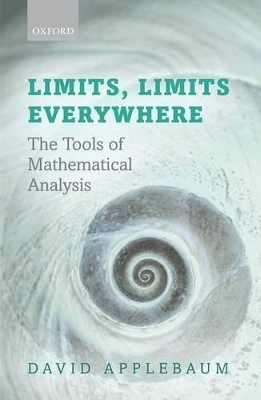
Limits, Limits Everywhere
The Tools of Mathematical Analysis
Seiten
2012
Oxford University Press (Verlag)
978-0-19-964008-9 (ISBN)
Oxford University Press (Verlag)
978-0-19-964008-9 (ISBN)
An account of elementary real analysis positioned between a popular mathematics book and a first year college or university text. This book doesn't assume knowledge of calculus and, instead, the emphasis is on the application of analysis to number theory.
A quantity can be made smaller and smaller without it ever vanishing. This fact has profound consequences for science, technology, and even the way we think about numbers. In this book, we will explore this idea by moving at an easy pace through an account of elementary real analysis and, in particular, will focus on numbers, sequences, and series.
Almost all textbooks on introductory analysis assume some background in calculus. This book doesn't and, instead, the emphasis is on the application of analysis to number theory. The book is split into two parts. Part 1 follows a standard university course on analysis and each chapter closes with a set of exercises. Here, numbers, inequalities, convergence of sequences, and infinite series are all covered. Part 2 contains a selection of more unusual topics that aren't usually found in books of this type. It includes proofs of the irrationality of e and π, continued fractions, an introduction to the Riemann zeta function, Cantor's theory of the infinite, and Dedekind cuts. There is also a survey of what analysis can do for the calculus and a brief history of the subject.
A lot of material found in a standard university course on "real analysis" is covered and most of the mathematics is written in standard theorem-proof style. However, more details are given than is usually the case to help readers who find this style daunting. Both set theory and proof by induction are avoided in the interests of making the book accessible to a wider readership, but both of these topics are the subjects of appendices for those who are interested in them. And unlike most university texts at this level, topics that have featured in popular science books, such as the Riemann hypothesis, are introduced here. As a result, this book occupies a unique position between a popular mathematics book and a first year college or university text, and offers a relaxed introduction to a fascinating and important branch of mathematics.
A quantity can be made smaller and smaller without it ever vanishing. This fact has profound consequences for science, technology, and even the way we think about numbers. In this book, we will explore this idea by moving at an easy pace through an account of elementary real analysis and, in particular, will focus on numbers, sequences, and series.
Almost all textbooks on introductory analysis assume some background in calculus. This book doesn't and, instead, the emphasis is on the application of analysis to number theory. The book is split into two parts. Part 1 follows a standard university course on analysis and each chapter closes with a set of exercises. Here, numbers, inequalities, convergence of sequences, and infinite series are all covered. Part 2 contains a selection of more unusual topics that aren't usually found in books of this type. It includes proofs of the irrationality of e and π, continued fractions, an introduction to the Riemann zeta function, Cantor's theory of the infinite, and Dedekind cuts. There is also a survey of what analysis can do for the calculus and a brief history of the subject.
A lot of material found in a standard university course on "real analysis" is covered and most of the mathematics is written in standard theorem-proof style. However, more details are given than is usually the case to help readers who find this style daunting. Both set theory and proof by induction are avoided in the interests of making the book accessible to a wider readership, but both of these topics are the subjects of appendices for those who are interested in them. And unlike most university texts at this level, topics that have featured in popular science books, such as the Riemann hypothesis, are introduced here. As a result, this book occupies a unique position between a popular mathematics book and a first year college or university text, and offers a relaxed introduction to a fascinating and important branch of mathematics.
David Applebaum obtained his PhD at the University of Nottingham in 1984. After postdoctoral appointments in Rome and Nottingham, he became a lecturer in mathematics at Nottingham Trent University (then Trent Polytechnic) in 1987 and was promoted to reader in 1994 and to a chair in 1998. He was Head of Department 1998-2001. He left Nottingham Trent for a chair in Sheffield in 2004 and served as Head of Department of Probability and Statistics there from 2007-10.
INTRODUCTION; I APPROACHING LIMITS; II EXPLORING LIMITS; FURTHER READING; APENDICES; HINTS AND SELECTED SOLUTIONS
| Erscheint lt. Verlag | 1.3.2012 |
|---|---|
| Zusatzinfo | 33 black and white line drawings |
| Verlagsort | Oxford |
| Sprache | englisch |
| Maße | 153 x 234 mm |
| Gewicht | 347 g |
| Themenwelt | Mathematik / Informatik ► Mathematik ► Analysis |
| ISBN-10 | 0-19-964008-4 / 0199640084 |
| ISBN-13 | 978-0-19-964008-9 / 9780199640089 |
| Zustand | Neuware |
| Informationen gemäß Produktsicherheitsverordnung (GPSR) | |
| Haben Sie eine Frage zum Produkt? |
Mehr entdecken
aus dem Bereich

aus dem Bereich
Festigkeits- und Verformungslehre, Baudynamik, Wärmeübertragung, …
Buch | Hardcover (2025)
De Gruyter Oldenbourg (Verlag)
CHF 125,90


