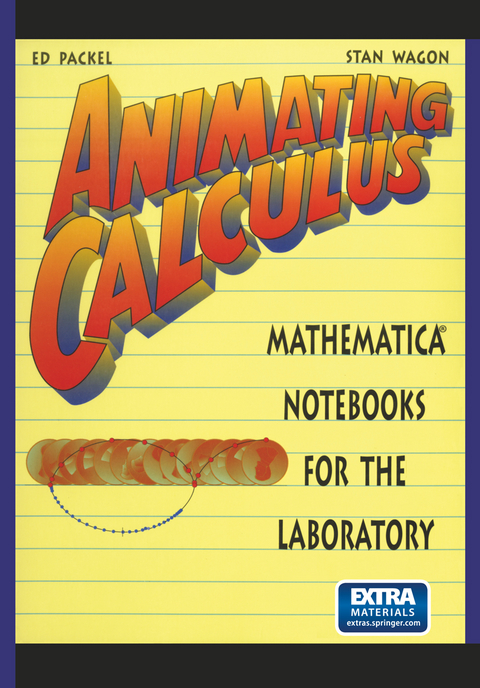
Animating Calculus
Springer-Verlag New York Inc.
978-0-387-94748-8 (ISBN)
Calculus and change. The two words go together. Calculus is about change, and approaches to teaching calculus are changing dramatically. Thus it is both timely and appropriate to apply techniques of animation to the varied and important graphical aspects of calculus. AB a computer algebra system, Mathematica is an excellent tool for numerical and symbolic computation. It also has the power to generate striking and colorful graphical images and to animate them dynamically. The combination of these capabilities makes Mathematica a natural resource for exploring the changing world of calculus and approaches to mastering it. In addition, Mathematica notebooks are easy to edit, allowing flexible input for commands to Mathematica and stylish text for explanation to the reader. Much has been written about the use and importance of technology in the teaching and learning of calculus. We will not repeat the arguments or feign objectivity. We are enthusiastic believers in the value of a significant laboratory experience as part oflearning calculus, and we think Mathematica notebooks are a most appropriate and exciting way to provide that experience. The notebooks that follow represent our choice of laboratory topics for a course in one-variable calculus. They offer a balance between what we think belongs in a first-year calculus course and what lends itself well to exploration in a Mathematica laboratory setting.
LAB 1 Initiation.- LAB 2 Plotting.- LAB 3 Derivatives: Measuring the Rate of Change.- LAB 4 The Race to Infinity.- LAB 5 Indeterminate Limits and L’Hôpital’s Rule.- LAB 6 Using Calculus to Land an Airplane.- LAB 7 Max-Min Methods: Mind Meets Machine.- LAB 8 Staying on Track with Newton’s Method.- LAB 9 Population Dynamics, Iteration, and Chaos.- LAB 10 What Is an Integral?.- LAB 11 The Fundamental Theorem.- LAB 12 The Needle Problem.- LAB 13 Integration by Machine.- LAB 14 Numerical Integration.- LAB 15 Differential Equations and Euler’s Method.- LAB 16 Probability and Calculus.- LAB 17 Roses, Snails, and Butterflies.- LAB IS Rolling Wheels.- LAB 19 Infinite Series of Constants.- LAB 20 Rhythm and Dissonance in the Harmonic Series.- LAB 21 Polynomial Approximation and Taylor Series.- LAB 22 A Deceptive Definite Integral.- APPENDIX 1 Troubleshooting.
| Erscheint lt. Verlag | 25.10.1996 |
|---|---|
| Zusatzinfo | XV, 292 p. With Diskette. |
| Verlagsort | New York, NY |
| Sprache | englisch |
| Maße | 170 x 244 mm |
| Themenwelt | Mathematik / Informatik ► Mathematik ► Analysis |
| Mathematik / Informatik ► Mathematik ► Angewandte Mathematik | |
| ISBN-10 | 0-387-94748-5 / 0387947485 |
| ISBN-13 | 978-0-387-94748-8 / 9780387947488 |
| Zustand | Neuware |
| Informationen gemäß Produktsicherheitsverordnung (GPSR) | |
| Haben Sie eine Frage zum Produkt? |
aus dem Bereich