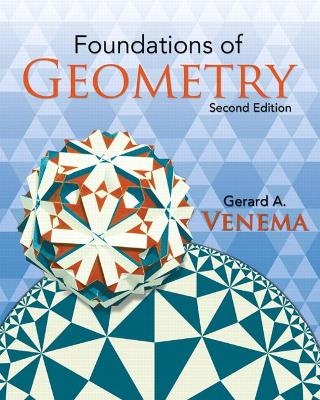
Foundations of Geometry
Pearson (Verlag)
978-0-13-602058-5 (ISBN)
- Titel erscheint in neuer Auflage
- Artikel merken
This text is ideal for an undergraduate course in axiomatic geometry for future high school geometry teachers, or for any student who has not yet encountered upper-level math, such as real analysis or abstract algebra. It assumes calculus and linear algebra as prerequisites.
Gerard Venema earned an A.B. in mathematics from Calvin College and a Ph.D. from the University of Utah. After completing his education, he spent two years in a postdoctoral position at the University of Texas at Austin and another two years as a Member of the Institute for Advanced Study in Princeton, NJ. He then returned to his alma mater, Calvin University, and has been a faculty member there ever since. While on the Calvin University faculty he also held visiting faculty positions at the University of Tennessee, the University of Michigan, and Michigan State University. He also spent two years as Program Director for Topology, Geometry, and Foundations in the Division of Mathematical Sciences at the National Science Foundation and nearly ten years as the Associate Secretary of the Mathematical Association of America. Venema is a member of the American Mathematical Society and the Mathematical Association of America. He is the author of two other books. One is an undergraduate textbook, Exploring Advanced Euclidean Geometry with GeoGebra, published by the Mathematical Association of America. The other is a research monograph, Embeddings in Manifolds, coauthored by Robert J. Daverman, that was published by the American Mathematical Society as volume 106 in its Graduate Studies in Mathematics series. In addition, Venema is author of over thirty research articles in geometric topology.
1. Prologue: Euclid’s Elements
1.1 Geometry before Euclid
1.2 The logical structure of Euclid’s Elements
1.3 The historical significance of Euclid’s Elements
1.4 A look at Book I of the Elements
1.5 A critique of Euclid’s Elements
1.6 Final observations about the Elements
2. Axiomatic Systems and Incidence Geometry
2.1 The structure of an axiomatic system
2.2 An example: Incidence geometry
2.3 The parallel postulates in incidence geometry
2.4 Axiomatic systems and the real world
2.5 Theorems, proofs, and logic
2.6 Some theorems from incidence geometry
3. Axioms for Plane Geometry
3.1 The undefined terms and two fundamental axioms
3.2 Distance and the Ruler Postulate
3.3 Plane separation
3.4 Angle measure and the Protractor Postulate
3.5 The Crossbar Theorem and the Linear Pair Theorem
3.6 The Side-Angle-Side Postulate
3.7 The parallel postulates and models
4. Neutral Geometry
4.1 The Exterior Angle Theorem and perpendiculars
4.2 Triangle congruence conditions
4.3 Three inequalities for triangles
4.4 The Alternate Interior Angles Theorem
4.5 The Saccheri-Legendre Theorem
4.6 Quadrilaterals
4.7 Statements equivalent to the Euclidean Parallel Postulate
4.8 Rectangles and defect
4.9 The Universal Hyperbolic Theorem
5. Euclidean Geometry
5.1 Basic theorems of Euclidean geometry
5.2 The Parallel Projection Theorem
5.3 Similar triangles
5.4 The Pythagorean Theorem
5.5 Trigonometry
5.6 Exploring the Euclidean geometry of the triangle
6. Hyperbolic Geometry
6.1 The discovery of hyperbolic geometry
6.2 Basic theorems of hyperbolic geometry
6.3 Common perpendiculars
6.4 Limiting parallel rays and asymptotically parallel lines
6.5 Properties of the critical function
6.6 The defect of a triangle
6.7 Is the real world hyperbolic?
7. Area
7.1 The Neutral Area Postulate
7.2 Area in Euclidean geometry
7.3 Dissection theory in neutral geometry
7.4 Dissection theory in Euclidean geometry
7.5 Area and defect in hyperbolic geometry
8. Circles
8.1 Basic definitions
8.2 Circles and lines
8.3 Circles and triangles
8.4 Circles in Euclidean geometry
8.5 Circular continuity
8.6 Circumference and area of Euclidean circles
8.7 Exploring Euclidean circles
9. Constructions
9.1 Compass and straightedge constructions
9.2 Neutral constructions
9.3 Euclidean constructions
9.4 Construction of regular polygons
9.5 Area constructions
9.6 Three impossible constructions
10. Transformations
10.1 The transformational perspective
10.2 Properties of isometries
10.3 Rotations, translations, and glide reflections
10.4 Classification of Euclidean motions
10.5 Classification of hyperbolic motions
10.6 Similarity transformations in Euclidean geometry
10.7 A transformational approach to the foundations
10.8 Euclidean inversions in circles
11. Models
11.1 The significance of models for hyperbolic geometry
11.2 The Cartesian model for Euclidean geometry
11.3 The Poincaré disk model for hyperbolic geometry
11.4 Other models for hyperbolic geometry
11.5 Models for elliptic geometry
11.6 Regular Tessellations
12. Polygonal Models and the Geometry of Space
12.1 Curved surfaces
12.2 Approximate models for the hyperbolic plane
12.3 Geometric surfaces
12.4 The geometry of the universe
12.5 Conclusion
12.6 Further study
12.7 Templates
APPENDICES
A. Euclid’s Book I
A.1 Definitions
A.2 Postulates
A.3 Common Notions
A.4 Propositions
B. Systems of Axioms for Geometry
B.1 Filling in Euclid’s gaps
B.2 Hilbert’s axioms
B.3 Birkhoff’s axioms
B.4 MacLane’s axioms
B.5 SMSG axioms
B.6 UCSMP axioms
C. The Postulates Used in this Book
C.1 The undefined terms
C.2 Neutral postulates
C.3 Parallel postulates
C.4 Area postulates
C.5 The reflection postulate
C.6 Logical relationships
D. Set Notation and the Real Numbers
D.1 Some elementary set theory
D.2 Properties of the real numbers
D.3 Functions
E. The van Hiele Model
F. Hints for Selected Exercises
Bibliography
Index
| Erscheint lt. Verlag | 2.11.2011 |
|---|---|
| Sprache | englisch |
| Maße | 206 x 250 mm |
| Gewicht | 650 g |
| Themenwelt | Mathematik / Informatik ► Mathematik ► Geometrie / Topologie |
| ISBN-10 | 0-13-602058-5 / 0136020585 |
| ISBN-13 | 978-0-13-602058-5 / 9780136020585 |
| Zustand | Neuware |
| Informationen gemäß Produktsicherheitsverordnung (GPSR) | |
| Haben Sie eine Frage zum Produkt? |
aus dem Bereich