


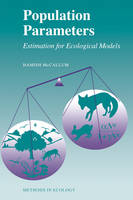
Population Parameters
Estimation for Ecological Models
Seiten
1999
Wiley-Blackwell (Verlag)
9780865427402 (ISBN)
Wiley-Blackwell (Verlag)
9780865427402 (ISBN)
- Titel ist leider vergriffen;
keine Neuauflage - Artikel merken
The fundamental aim of this book is to have less garbage going into models. It covers many of the topics central to ecological modelling - whilst only covering a single aspect of the modelling process, it does so across the entire range of modelling situations that an ecologist may encounter.
Ecologists and environmental managers rely on mathematical models, both to understand ecological systems and to predict future system behavior. In turn, models rely on appropriate estimates of their parameters.
This book brings together a diverse and scattered literature, to provide clear guidance on how to estimate parameters for models of animal populations. It is not a recipe book of statistical procedures. Instead, it concentrates on how to select the best approach to parameter estimation for a particular problem, and how to ensure that the quality estimated is the appropriate one for the specific purpose of the modelling exercise.
Commencing with a toolbox of useful generic approaches to parameter estimation, the book deals with methods for estimating parameters for single populations. These parameters include population size, birth and death rates, and the population growth rate. For such parameters, rigorous statistical theory has been developed, and software is readily available. The problem is to select the optimal sampling design and method of analysis. The second part of the book deals with parameters that describe spatial dynamics, and ecological interactions such as competition, predation and parasitism. Here the principle problems are designing appropriate experiments and ensuring that the quantities measured by the experiments are relevant to the ecological models in which they will be used.
This book will be essential reading for ecological researchers, postgraduate students and environmental managers who need to address an ecological problem through a population model. It is accessible to anyone with an understanding of basic statistical methods and population ecology.
Unique in concentrating on parameter estimation within modelling.
Fills a glaring gap in the literature.
Not too technical, so suitable for the statistically inept.
Methods explained in algebra, but also in worked examples using commonly available computer packages (SAS, GLIM, and some more specialised packages where relvant). Some spreadsheet based examples also included.
Ecologists and environmental managers rely on mathematical models, both to understand ecological systems and to predict future system behavior. In turn, models rely on appropriate estimates of their parameters.
This book brings together a diverse and scattered literature, to provide clear guidance on how to estimate parameters for models of animal populations. It is not a recipe book of statistical procedures. Instead, it concentrates on how to select the best approach to parameter estimation for a particular problem, and how to ensure that the quality estimated is the appropriate one for the specific purpose of the modelling exercise.
Commencing with a toolbox of useful generic approaches to parameter estimation, the book deals with methods for estimating parameters for single populations. These parameters include population size, birth and death rates, and the population growth rate. For such parameters, rigorous statistical theory has been developed, and software is readily available. The problem is to select the optimal sampling design and method of analysis. The second part of the book deals with parameters that describe spatial dynamics, and ecological interactions such as competition, predation and parasitism. Here the principle problems are designing appropriate experiments and ensuring that the quantities measured by the experiments are relevant to the ecological models in which they will be used.
This book will be essential reading for ecological researchers, postgraduate students and environmental managers who need to address an ecological problem through a population model. It is accessible to anyone with an understanding of basic statistical methods and population ecology.
Unique in concentrating on parameter estimation within modelling.
Fills a glaring gap in the literature.
Not too technical, so suitable for the statistically inept.
Methods explained in algebra, but also in worked examples using commonly available computer packages (SAS, GLIM, and some more specialised packages where relvant). Some spreadsheet based examples also included.
Hamish McCallum is the author of Population Parameters: Estimation for Ecological Models, published by Wiley.
1. Introduction. 2. Parameter Estimation Toolbox.
3. Population Size.
4. Vital Statistics: Birth, Death And Growth Rates.
5. Rate Of Increase Of A Population.
6. Density Dependence.
7. Spatial Parameters.
8. Competition.
9. Predator-Prey, Host-Parasitoid And Plant-Herbivore Models.
10. Host-Pathogen And Host-Parasite Models.
11. The State Of The Art.
References.
Index
| Erscheint lt. Verlag | 15.12.1999 |
|---|---|
| Reihe/Serie | Ecological Methods and Concepts |
| Verlagsort | Hoboken |
| Sprache | englisch |
| Maße | 158 x 234 mm |
| Gewicht | 689 g |
| Themenwelt | Mathematik / Informatik ► Mathematik ► Angewandte Mathematik |
| Naturwissenschaften ► Biologie ► Ökologie / Naturschutz | |
| ISBN-13 | 9780865427402 / 9780865427402 |
| Zustand | Neuware |
| Informationen gemäß Produktsicherheitsverordnung (GPSR) | |
| Haben Sie eine Frage zum Produkt? |
Mehr entdecken
aus dem Bereich
aus dem Bereich
Buch | Softcover (2025)
Springer Vieweg (Verlag)
CHF 62,95
Buch | Softcover (2025)
Springer Fachmedien Wiesbaden (Verlag)
CHF 69,95
Buch | Softcover (2024)
Springer Vieweg (Verlag)
CHF 53,15


