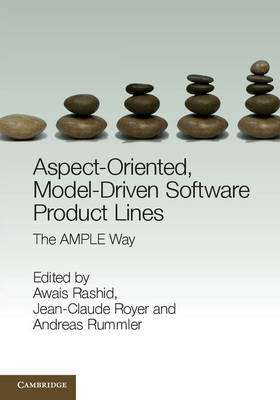
Aspect-Oriented, Model-Driven Software Product Lines
Cambridge University Press (Verlag)
978-0-521-76722-4 (ISBN)
Software product lines provide a systematic means of managing variability in a suite of products. They have many benefits but there are three major barriers that can prevent them from reaching their full potential. First, there is the challenge of scale: a large number of variants may exist in a product line context and the number of interrelationships and dependencies can rise exponentially. Second, variations tend to be systemic by nature in that they affect the whole architecture of the software product line. Third, software product lines often serve different business contexts, each with its own intricacies and complexities. The AMPLE (http://www.ample-project.net/) approach tackles these three challenges by combining advances in aspect-oriented software development and model-driven engineering. The full suite of methods and tools that constitute this approach are discussed in detail in this edited volume and illustrated using three real-world industrial case studies.
Awais Rashid is a Professor of Software Engineering at Lancaster University. Jean-Claude Royer is a Professor of Computer Science at the Ecole des Mines de Nantes – INRIA. Andreas Rummler holds the position of Senior Researcher at SAP Research in Dresden.
Part I. Software Product Line Engineering Challenges: 1. Introduction Awais Rashid, Jean-Claude Royer and Andreas Rummler; 2. Case studies for software product line engineering Andreas Rummler, Ludger Fiege, Catarina Gomes and Rita Ribiero; Part II. Variability Analysis and Modelling: 3. From requirements to feature models Nathan Weston and Phil Greenwood; 4. Variability management Steffen Zschaler, Pablo Sánchez, João Santos, Mauricio Alférez, Ana Moreira, João Araújo, Uirá Kulesza and Lidia Fuentes; 5. Hybrid assessment method for software product line Afonso Pimentel, Rita Ribeiro, Ana Moreira, João Araújo, João Santos, António Costa, Mauricio Alférez and Uirá Kulesza; Part III. Variability Implementation and Traceability: 6. Product line implementation with ECaesarJ Vaidas Gasiunas, Angel Nunez, Jacques Noyé and Mira Mezini; 7. Model-driven engineering support for product line engineering Christoph Elsner, Iris Groher, Ludger Fiege and Markus Völter; 8. Managing information flow in SPL development processes Nicolas Anquetil, Uira Kulesza, Ricardo Mateus, Ralf Mitschke, Ana Moreira, Jean-Claude Royer and Andreas Rummler; 9. Using design rationale to improve SPL traceability Ismênia Galvão, Mehmet Aksit, Pim van den Broek and Michiel Hendriks; Part IV. Product-Driven vs. Solution-Driven Software Product Line Engineering: 10. Product-driven software product line engineering Steffen Zschaler, Pablo Sánchez, Carlos Nebrera, Lidia Fuentes, Vaidas Gasiunas and Ludger Fiege; 11. Solution-driven software product line engineering Iris Groher, Ludger Fiege, Christoph Elsner, Christa Schwanninger and Markus Völter; Part V. Future Trends: 12. Dynamic variability in adaptive systems Ruzanna Chitchyan, Brice Morin, Franck Fleurey, Nelly Bencomo, Arnor Solberg and Thomas Genssler; 13. Imperfect information in software product line engineering Joost Noppen and Pim van den Broek; 14. Empirical research in software product line engineering Phil Greenwood, Vander Alves, John Hutchinson, Christa Schwanninger and Nicolas Anquetil.
| Erscheint lt. Verlag | 8.9.2011 |
|---|---|
| Zusatzinfo | 50 Tables, black and white; 135 Line drawings, unspecified |
| Verlagsort | Cambridge |
| Sprache | englisch |
| Maße | 181 x 255 mm |
| Gewicht | 1050 g |
| Themenwelt | Mathematik / Informatik ► Informatik ► Programmiersprachen / -werkzeuge |
| Mathematik / Informatik ► Informatik ► Software Entwicklung | |
| Mathematik / Informatik ► Informatik ► Theorie / Studium | |
| ISBN-10 | 0-521-76722-9 / 0521767229 |
| ISBN-13 | 978-0-521-76722-4 / 9780521767224 |
| Zustand | Neuware |
| Informationen gemäß Produktsicherheitsverordnung (GPSR) | |
| Haben Sie eine Frage zum Produkt? |
aus dem Bereich