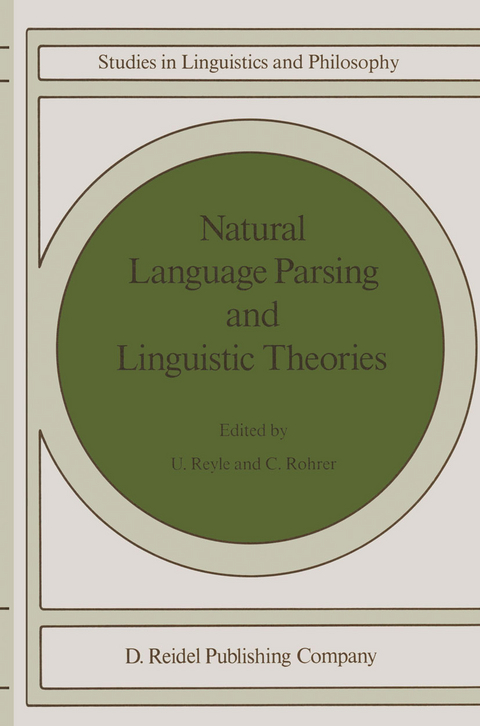
Natural Language Parsing and Linguistic Theories
Kluwer Academic Publishers (Verlag)
978-1-55608-056-2 (ISBN)
presupposition fails, we now give a short introduction into Unification Grammar. Since all implementations discussed in this volume use PROLOG (with the exception of BlockjHaugeneder), we felt that it would also be useful to explain the difference between unification in PROLOG and in UG. After the introduction to UG we briefly summarize the main arguments for using linguistic theories in natural language processing. We conclude with a short summary of the contributions to this volume. UNIFICATION GRAMMAR 3 Feature Structures or Complex Categories. Unification Grammar was developed by Martin Kay (Kay 1979). Martin Kay wanted to give a precise defmition (and implementation) of the notion of 'feature'. Linguists use features at nearly all levels of linguistic description. In phonetics, for instance, the phoneme b is usually described with the features 'bilabial', 'voiced' and 'nasal'. In the case of b the first two features get the value +, the third (nasal) gets the value -. Feature value pairs in phonology are normally represented as a matrix. bilabial: + voiced: + I nasal: - [Feature matrix for b.] In syntax features are used, for example, to distinguish different noun classes. The Latin noun 'murus' would be characterized by the following feature-value pairs: gender: masculin, number: singular, case: nominative, pred: murus. Besides a matrix representation one frequently fmds a graph representation for feature value pairs. The edges of the graph are labelled by features. The leaves denote the value of a feature.
Seperating Linguistic Analyses from Linguistic Theories.- Applicability of Indexed Grammars to Natural Languages.- A Natural Language Toolkit: Reconciling Theory with Practice.- An Extension of LR-Parsing for Lexical Functional Grammar.- An Efficiency-Oriented LFG Parser.- Parsing with a GB-Grammar.- Combining Categorial Grammar and Unification.- A feature-Based Categorial Morpho-Syntax for Japanese.- The Treatment of the French adjectif détaché in Lexical Functional Grammar.- Some Problems of Coordination in German.- German Word Order and Universal Grammar.- Nonlocal-Dependencies and Infinitival Constructions in German.- GPSG and German Word Order.- Nested Cooper Storage: The Proper Treatment of Quantification in Ordinary Noun Phrases.- Compositional Semantics for LFG.
| Erscheint lt. Verlag | 29.2.1988 |
|---|---|
| Reihe/Serie | Studies in Linguistics and Philosophy ; 35 |
| Zusatzinfo | 486 p. |
| Verlagsort | Dordrecht |
| Sprache | englisch |
| Maße | 152 x 229 mm |
| Themenwelt | Geisteswissenschaften ► Sprach- / Literaturwissenschaft ► Sprachwissenschaft |
| Informatik ► Theorie / Studium ► Künstliche Intelligenz / Robotik | |
| ISBN-10 | 1-55608-056-5 / 1556080565 |
| ISBN-13 | 978-1-55608-056-2 / 9781556080562 |
| Zustand | Neuware |
| Informationen gemäß Produktsicherheitsverordnung (GPSR) | |
| Haben Sie eine Frage zum Produkt? |
aus dem Bereich