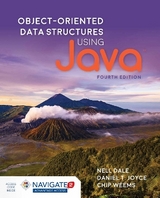
Object-Oriented Data Structures Using Java
Jones and Bartlett Publishers, Inc (Verlag)
978-1-4496-1354-9 (ISBN)
- Titel erscheint in neuer Auflage
- Artikel merken
New and Key Features to the Third Edition:
-Includes the use of generics throughout the text, providing the dual benefits of allowing for a type safe use of data structures plus exposing students to modern approaches.
-This text is among the first data structures textbooks to address the topic of concurrency and synchonization, which are growing in the importance as computer systems move to using more cores and threads to obtain additional performance with each new generation. Concurrency and synchonization are introduced in the new Section 5.7, where it begins with the basics of Java threads.
-Provides numerous case studies and examples of the problem solving process. Each case study includes problem description, an analysis of the problem input and required output, and a discussion of the appropriate data structures to use.
-Expanded chapter exercises allow you as the instructor to reinforce topics for your students using both theoretical and practical questions.
-Chapters conclude with a chapter summary that highlights the most important topics of the chapter and ties together related topics.
Instructor Resources:
-Answers to the exercises in the text
-Glossary of terms
-PowerPoint Lecture Outlines
-Test bank
Nell Dale received a B.S. in Mathematics and Psychology from the University of Houston, a M.A. in Mathematics, from the University of Texas at Austin, and a Ph.D. in Computer Sciences from the University of Texas at Austin. Nell Dale has been on the faculty at the University of Texas, Austin since 1975. She teaches occasionally but concentrates on computer science education, writing, traveling, tennis, and bridge -- and her family of course. Daniel Joyce is an Associate Professor with the Computing Science department at Villanova University. He enjoys managing the departments' project-based courses. Joyce's research interests are in software engineering with a focus in software requirements identification. He is also active in the computer science education community. Chip Weems is an Associate Professor of computer science at the University of Massachusetts at Amherst. He received his Bachelor's and Master's degrees from Oregon State University in 1977 and 1979, respectively. He received a Ph.D. from the University of Massachusetts in 1984. Over the last 23 years, he has taught courses in introductory programming, software engineering, computer architecture, and parallel processing. Since 1986 he has co-authored 13 textbooks that have helped over a million students learn to program computers. His books have been translated into French, Spanish, and Russian. He conducts research in computer architecture, compilers, parallel processing, and compiler-architecture co-optimization.
| Erscheint lt. Verlag | 11.3.2011 |
|---|---|
| Verlagsort | Sudbury |
| Sprache | englisch |
| Gewicht | 1531 g |
| Themenwelt | Mathematik / Informatik ► Informatik ► Netzwerke |
| Informatik ► Software Entwicklung ► Objektorientierung | |
| Mathematik / Informatik ► Informatik ► Theorie / Studium | |
| ISBN-10 | 1-4496-1354-3 / 1449613543 |
| ISBN-13 | 978-1-4496-1354-9 / 9781449613549 |
| Zustand | Neuware |
| Informationen gemäß Produktsicherheitsverordnung (GPSR) | |
| Haben Sie eine Frage zum Produkt? |
aus dem Bereich