


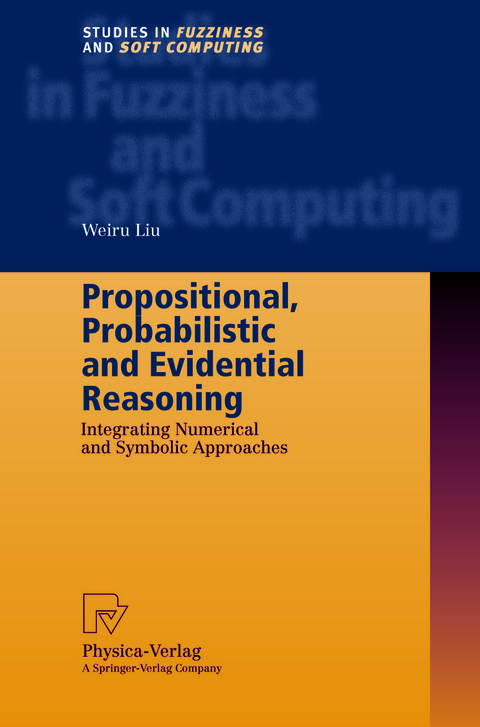
Propositional, Probabilistic and Evidential Reasoning
Integrating Numerical and Symbolic Approaches
Seiten
2010
Physica (Verlag)
978-3-7908-2493-3 (ISBN)
Physica (Verlag)
978-3-7908-2493-3 (ISBN)
How to draw plausible conclusions from uncertain and conflicting sources of evidence is one of the major intellectual challenges of Artificial Intelligence. It is a prerequisite of the smart technology needed to help humans cope with the information explosion of the modern world. In addition, computational modelling of uncertain reasoning is a key to understanding human rationality. Previous computational accounts of uncertain reasoning have fallen into two camps: purely symbolic and numeric. This book represents a major advance by presenting a unifying framework which unites these opposing camps. The Incidence Calculus can be viewed as both a symbolic and a numeric mechanism. Numeric values are assigned indirectly to evidence via the possible worlds in which that evidence is true. This facilitates purely symbolic reasoning using the possible worlds and numeric reasoning via the probabilities of those possible worlds. Moreover, the indirect assignment solves some difficult technical problems, like the combinat ion of dependent sources of evidcence, which had defeated earlier mechanisms. Weiru Liu generalises the Incidence Calculus and then compares it to a succes sion of earlier computational mechanisms for uncertain reasoning: Dempster-Shafer Theory, Assumption-Based Truth Maintenance, Probabilis tic Logic, Rough Sets, etc. She shows how each of them is represented and interpreted in Incidence Calculus. The consequence is a unified mechanism which includes both symbolic and numeric mechanisms as special cases. It provides a bridge between symbolic and numeric approaches, retaining the advantages of both and overcoming some of their disadvantages.
1 Introduction.- 2 Incidence Calculus.- 3 Generalizing Incidence Calculus.- 4 From Numerical to Symbolic Assignments.- 5 Combining Multiple Pieces of Evidence.- 6 The Dempster-Shafer Theory of Evidence.- 7 A Comprehensive Comparison of Generalized Incidence Calculus and Dempster-Shafer Theory.- 8 Assumption-Based Truth Maintenance Systems.- 9 Relations Between Extended Incidence Calculus and Assumption-Based Truth Maintenance System.- 10 Conclusion.- Mathematical Notation.- List of Figures.- List of Tables.
| Erscheint lt. Verlag | 21.10.2010 |
|---|---|
| Reihe/Serie | Studies in Fuzziness and Soft Computing |
| Zusatzinfo | XIV, 274 p. |
| Verlagsort | Heidelberg |
| Sprache | englisch |
| Maße | 155 x 235 mm |
| Gewicht | 436 g |
| Themenwelt | Informatik ► Theorie / Studium ► Künstliche Intelligenz / Robotik |
| Schlagworte | Artificial Intelligence • Evidential Reasoning • Intelligence • Knowledge Representation • Non-monotonic Reasoning • Nonmonotonic Reasoning • Probabilistic Logic • Propositional Reasoning • Reasoning under Uncertainty • Sets • Symbol • Uncertainty |
| ISBN-10 | 3-7908-2493-3 / 3790824933 |
| ISBN-13 | 978-3-7908-2493-3 / 9783790824933 |
| Zustand | Neuware |
| Informationen gemäß Produktsicherheitsverordnung (GPSR) | |
| Haben Sie eine Frage zum Produkt? |
Mehr entdecken
aus dem Bereich


aus dem Bereich
Eine praxisorientierte Einführung
Buch | Softcover (2025)
Springer Vieweg (Verlag)
CHF 53,15
Künstliche Intelligenz, Macht und das größte Dilemma des 21. …
Buch | Softcover (2025)
C.H.Beck (Verlag)
CHF 25,20
Buch | Softcover (2025)
Reclam, Philipp (Verlag)
CHF 11,20


