


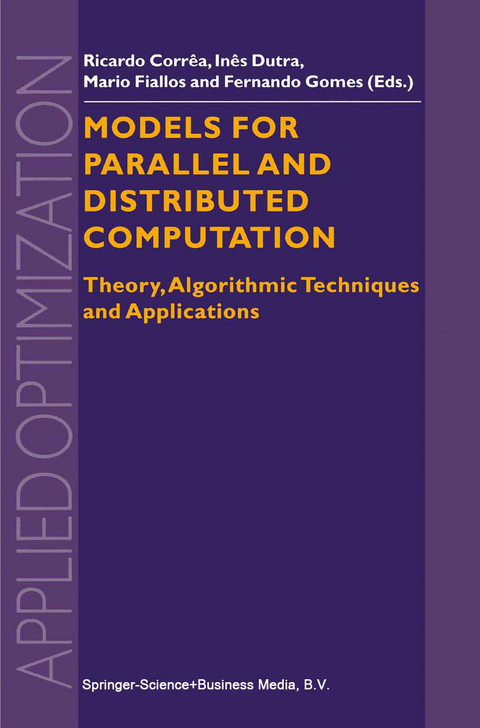
Models for Parallel and Distributed Computation
Theory, Algorithmic Techniques and Applications
Seiten
2010
|
1st ed. Softcover of orig. ed. 2002
Springer-Verlag New York Inc.
978-1-4419-5219-6 (ISBN)
Springer-Verlag New York Inc.
978-1-4419-5219-6 (ISBN)
Parallel and distributed computation has been gaining a great lot of attention in the last decades. Parallel and distributed computation differs from dassical sequential compu tation in some of the following major aspects: the number of processing units, independent local dock for each unit, the number of memory units, and the programming model.
Parallel and distributed computation has been gaining a great lot of attention in the last decades. During this period, the advances attained in computing and communication technologies, and the reduction in the costs of those technolo gies, played a central role in the rapid growth of the interest in the use of parallel and distributed computation in a number of areas of engineering and sciences. Many actual applications have been successfully implemented in various plat forms varying from pure shared-memory to totally distributed models, passing through hybrid approaches such as distributed-shared memory architectures. Parallel and distributed computation differs from dassical sequential compu tation in some of the following major aspects: the number of processing units, independent local dock for each unit, the number of memory units, and the programming model. For representing this diversity, and depending on what level we are looking at the problem, researchers have proposed some models to abstract the main characteristics or parameters (physical components or logical mechanisms) of parallel computers. The problem of establishing a suitable model is to find a reasonable trade-off among simplicity, power of expression and universality. Then, be able to study and analyze more precisely the behavior of parallel applications.
Parallel and distributed computation has been gaining a great lot of attention in the last decades. During this period, the advances attained in computing and communication technologies, and the reduction in the costs of those technolo gies, played a central role in the rapid growth of the interest in the use of parallel and distributed computation in a number of areas of engineering and sciences. Many actual applications have been successfully implemented in various plat forms varying from pure shared-memory to totally distributed models, passing through hybrid approaches such as distributed-shared memory architectures. Parallel and distributed computation differs from dassical sequential compu tation in some of the following major aspects: the number of processing units, independent local dock for each unit, the number of memory units, and the programming model. For representing this diversity, and depending on what level we are looking at the problem, researchers have proposed some models to abstract the main characteristics or parameters (physical components or logical mechanisms) of parallel computers. The problem of establishing a suitable model is to find a reasonable trade-off among simplicity, power of expression and universality. Then, be able to study and analyze more precisely the behavior of parallel applications.
1 Introduction to the Complexity of Parallel Algorithms.- 2 The Combinatorics of Resource Sharing.- 3 On Solving the Static Task Scheduling Problem for Real Machines.- 4 Predictable Parallel Performance: The BSP Model.- 5 Discrete computing with CGM.- 6 Parallel Graph Algorithms for Coarse-Grained Multicomputers.- 7 Parallel metaheuristics for combinatorial optimization.- 8 Parallelism in Logic Programming and Scheduling Issues.- 9 Parallel Asynchronous Team Algorithms.- 10 Parallel Numerical Methods for Differential Equations.
| Erscheint lt. Verlag | 10.12.2010 |
|---|---|
| Reihe/Serie | Applied Optimization ; 67 |
| Zusatzinfo | XX, 323 p. |
| Verlagsort | New York, NY |
| Sprache | englisch |
| Maße | 160 x 240 mm |
| Themenwelt | Informatik ► Theorie / Studium ► Algorithmen |
| Mathematik / Informatik ► Mathematik ► Angewandte Mathematik | |
| Mathematik / Informatik ► Mathematik ► Graphentheorie | |
| ISBN-10 | 1-4419-5219-5 / 1441952195 |
| ISBN-13 | 978-1-4419-5219-6 / 9781441952196 |
| Zustand | Neuware |
| Informationen gemäß Produktsicherheitsverordnung (GPSR) | |
| Haben Sie eine Frage zum Produkt? |
Mehr entdecken
aus dem Bereich


aus dem Bereich
Buch | Softcover (2025)
Lehmanns Media (Verlag)
CHF 62,95
die Welt der generativen KI verstehen
Buch | Hardcover (2025)
Hanser (Verlag)
CHF 48,95
IT zum Anfassen für alle von 9 bis 99 – vom Navi bis Social Media
Buch | Softcover (2021)
Springer (Verlag)
CHF 46,15


