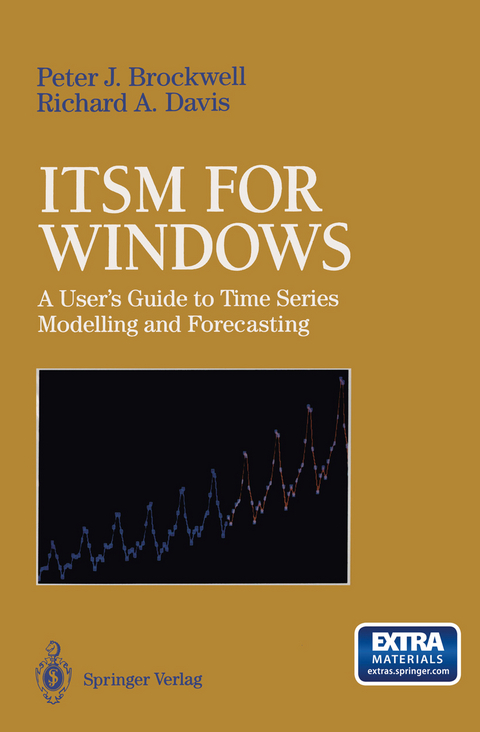
ITSM for Windows
Springer-Verlag New York Inc.
978-0-387-94337-4 (ISBN)
1 Introduction.- 1.1 The Programs.- 1.2 System Requirements.- 1.3 Creating Data Files.- 2 PEST.- 2.1 Getting Started.- 2.2 Preparing Your Data for Modelling.- 2.3 Finding a Model for Your Data.- 2.4 Testing Your Model.- 2.5 Prediction.- 2.6 Model Properties.- 2.7 Nonparametric Spectral Estimation.- 3 SMOOTH.- 3.1 Introduction.- 3.2 Moving Average Smoothing.- 3.3 Exponential Smoothing.- 3.4 Removing High Frequency Components.- 4 SPEC.- 4.1 Introduction.- 4.2 Bivariate Spectral Analysis.- 5 TRANS.- 5.1 Introduction.- 5.2 Computing Cross Correlations.- 5.3 An Overview of Transfer Function Modelling.- 5.4 Fitting a Preliminary Transfer Function Model.- 5.5 Calculating Residuals from a Transfer Function Model.- 5.6 LS Estimation and Prediction with Transfer Function Models.- 6 ARVEC.- 6.1 Introduction.- 6.2 Model Selection with the AICC Criterion.- 6.3 Forecasting with the Fitted Model.- 7 BURG.- 7.1 Introduction.- 8 ARAR.- 8.1 Introduction.- 8.2 Running the Program.- 9 LONGMEM.- 9.1 Introduction.- 9.2 Parameter Estimation.- 9.3 Prediction.- 9.4 Simulation.- 9.5 Plotting the Model and Sample ACVF.- Appendix A: The Screen Editor WORD6.- A.1 Basic Editing.- A.2 Alternate Keys.- A.3 Printing a File.- A.4 Merging Two or More Files.- A.5 Margins and Left and Centre Justification.- A.6 Tab Settings.- A.7 Block Commands.- A.8 Searching.- A.9 Special Characters.- A.10 Function Keys.- A. 11 Editing Information.- Appendix B: Data Sets.
" Although it has such an easy-to use appearance and a menu driven structure, the programs are surprisingly flexible and many sophisticated time series analyses can be carried out with the package." (Journal of the American Statistical Association)
| Mitarbeit |
Assistent: R.J. Hyndman |
|---|---|
| Zusatzinfo | 50 Illustrations, black and white; IX, 118 p. 50 illus. With online files/update. |
| Verlagsort | New York, NY |
| Sprache | englisch |
| Maße | 155 x 235 mm |
| Themenwelt | Informatik ► Grafik / Design ► Digitale Bildverarbeitung |
| Mathematik / Informatik ► Informatik ► Theorie / Studium | |
| Mathematik / Informatik ► Mathematik ► Computerprogramme / Computeralgebra | |
| Mathematik / Informatik ► Mathematik ► Wahrscheinlichkeit / Kombinatorik | |
| ISBN-10 | 0-387-94337-4 / 0387943374 |
| ISBN-13 | 978-0-387-94337-4 / 9780387943374 |
| Zustand | Neuware |
| Informationen gemäß Produktsicherheitsverordnung (GPSR) | |
| Haben Sie eine Frage zum Produkt? |
aus dem Bereich