


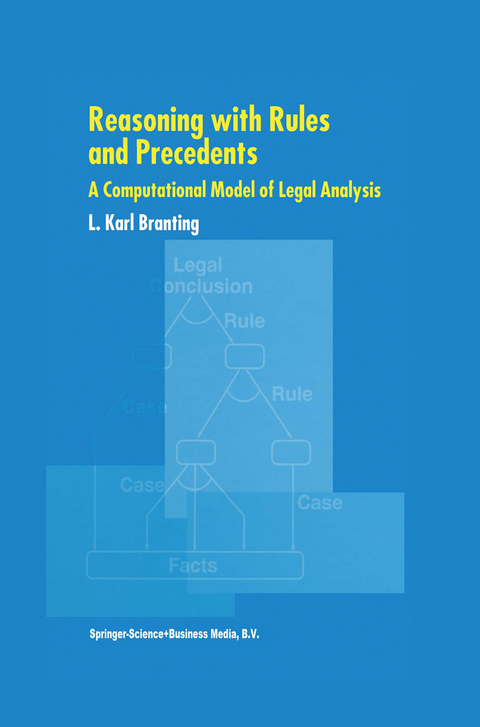
Reasoning with Rules and Precedents
A Computational Model of Legal Analysis
Seiten
2010
|
Softcover reprint of hardcover 1st ed. 2000
Springer (Verlag)
978-90-481-5374-9 (ISBN)
Springer (Verlag)
978-90-481-5374-9 (ISBN)
The book uses the framework for integrating cases and rules as a basis for a new model of legal precedents. The book presents techniques for representing, indexing, and comparing complex cases and for converting justification structures based on rules and case into natural-language text.
Few areas of human expertise are so well understood that they can be completely reduced to general principles. Similarly, there are few domains in which experience is so extensive that every new problem precisely matches a previous problem whose solution is known. When neither rules nor examples are individually sufficient, problem-solving expertise depends on integrating both. This book presents a computational framework for the integration of rules and cases for analytic tasks typified by legal analysis. The book uses the framework for integrating cases and rules as a basis for a new model of legal precedents. This model explains how the theory under which a case is decided controls the case's precedential effect. The framework for integrating rules and cases is implemented in GREBE, a system for legal analysis. The book presents techniques for representing, indexing, and comparing complex cases and for converting justification structures based on rules and case into natural-language text.
This book will interest researchers in artificial intelligence, particularly those involved in case-based reasoning, artificial intelligence and law, and formal models of argumentation, and to scholars in legal philosophy, jurisprudence, and analogical reasoning.
Few areas of human expertise are so well understood that they can be completely reduced to general principles. Similarly, there are few domains in which experience is so extensive that every new problem precisely matches a previous problem whose solution is known. When neither rules nor examples are individually sufficient, problem-solving expertise depends on integrating both. This book presents a computational framework for the integration of rules and cases for analytic tasks typified by legal analysis. The book uses the framework for integrating cases and rules as a basis for a new model of legal precedents. This model explains how the theory under which a case is decided controls the case's precedential effect. The framework for integrating rules and cases is implemented in GREBE, a system for legal analysis. The book presents techniques for representing, indexing, and comparing complex cases and for converting justification structures based on rules and case into natural-language text.
This book will interest researchers in artificial intelligence, particularly those involved in case-based reasoning, artificial intelligence and law, and formal models of argumentation, and to scholars in legal philosophy, jurisprudence, and analogical reasoning.
1. Introduction.- 2. A Framework for Integrating Rules and Exemplars.- 3. A Formal Model of Ratio Decidendi.- 4. Grebe: Integrating Rules and Precedents for Legal Analysis.- 5. Examples of GREBE’s Legal Analysis.- 6. Evaluation.- 7. Related Work.- 8. Research Contributions.- References.- Appendices.- A—GREBE’s Analysis of 7 Worker’s Compensation Hypotheticals.- B—Legal Precedents in the Worker’s Compensation Knowledge Base.- C—Predicates Having Precedents as Warrants.- D—21 Hypothetical Cases.- E—GREBE’s Relation Vocabulary.- F—GREBE’s Structure Matching Algorithm.
| Erscheint lt. Verlag | 5.12.2010 |
|---|---|
| Zusatzinfo | XIII, 219 p. |
| Verlagsort | Dordrecht |
| Sprache | englisch |
| Maße | 155 x 235 mm |
| Themenwelt | Informatik ► Theorie / Studium ► Künstliche Intelligenz / Robotik |
| Recht / Steuern ► Allgemeines / Lexika | |
| Recht / Steuern ► EU / Internationales Recht | |
| ISBN-10 | 90-481-5374-3 / 9048153743 |
| ISBN-13 | 978-90-481-5374-9 / 9789048153749 |
| Zustand | Neuware |
| Informationen gemäß Produktsicherheitsverordnung (GPSR) | |
| Haben Sie eine Frage zum Produkt? |
Mehr entdecken
aus dem Bereich


aus dem Bereich
Eine praxisorientierte Einführung
Buch | Softcover (2025)
Springer Vieweg (Verlag)
CHF 53,15
Künstliche Intelligenz, Macht und das größte Dilemma des 21. …
Buch | Softcover (2025)
C.H.Beck (Verlag)
CHF 25,20
Buch | Softcover (2025)
Reclam, Philipp (Verlag)
CHF 11,20


