


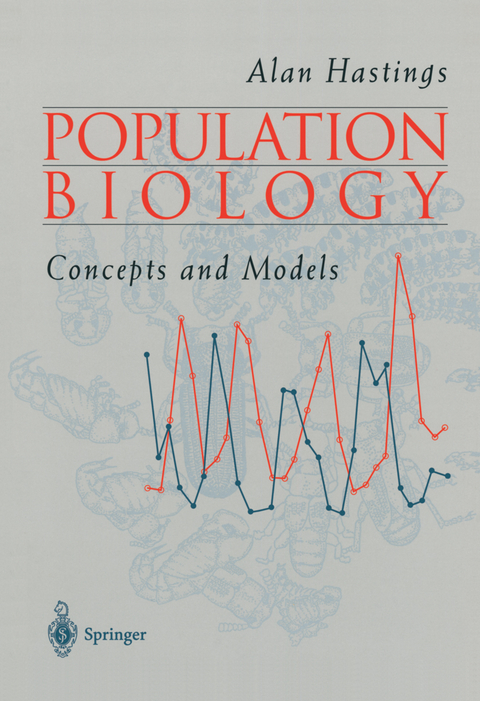
Population Biology
Concepts and Models
Seiten
1996
|
1997. Corr. 2nd Printing ed.
Springer-Verlag New York Inc.
978-0-387-94853-9 (ISBN)
Springer-Verlag New York Inc.
978-0-387-94853-9 (ISBN)
- Titel erscheint in neuer Auflage
- Artikel merken
Zu diesem Artikel existiert eine Nachauflage
Population biology has been investigated quantitatively for many decades, resulting in a rich body of scientific literature. Examples, problems, extensive marginal notes and numerous graphs enhance the book's value to students in classes ranging from population biology and population ecology to mathematical biology and mathematical ecology.
Population biology has been investigated quantitatively for many decades, resulting in a rich body of scientific literature. Ecologists often avoid this literature, put off by its apparently formidable mathematics. This textbook provides an introduction to the biology and ecology of populations by emphasizing the roles of simple mathematical models in explaining the growth and behavior of populations. The author only assumes acquaintance with elementary calculus, and provides tutorial explanations where needed to develop mathematical concepts. Examples, problems, extensive marginal notes and numerous graphs enhance the book's value to students in classes ranging from population biology and population ecology to mathematical biology and mathematical ecology. The book will also be useful as a supplement to introductory courses in ecology.
Population biology has been investigated quantitatively for many decades, resulting in a rich body of scientific literature. Ecologists often avoid this literature, put off by its apparently formidable mathematics. This textbook provides an introduction to the biology and ecology of populations by emphasizing the roles of simple mathematical models in explaining the growth and behavior of populations. The author only assumes acquaintance with elementary calculus, and provides tutorial explanations where needed to develop mathematical concepts. Examples, problems, extensive marginal notes and numerous graphs enhance the book's value to students in classes ranging from population biology and population ecology to mathematical biology and mathematical ecology. The book will also be useful as a supplement to introductory courses in ecology.
1 Introduction.- I Single species.- 2 Density-Independent Population Growth.- 3 Population Genetics.- 4 Density-Dependent Population Growth.- 5 Evolution of Life Histories.- II Interacting Species.- 6 Interactions Between Species.- 7 Competition.- 8 Predator—Prey Interactions.- 9 Host—Parasitoid Interactions.- 10 Diseases and Pathogens.- Coda.
| Zusatzinfo | 8 Illustrations, black and white; XVI, 220 p. 8 illus. |
|---|---|
| Verlagsort | New York, NY |
| Sprache | englisch |
| Maße | 178 x 254 mm |
| Themenwelt | Mathematik / Informatik ► Mathematik ► Angewandte Mathematik |
| Naturwissenschaften ► Biologie ► Ökologie / Naturschutz | |
| Sozialwissenschaften ► Ethnologie | |
| Sozialwissenschaften ► Soziologie | |
| ISBN-10 | 0-387-94853-8 / 0387948538 |
| ISBN-13 | 978-0-387-94853-9 / 9780387948539 |
| Zustand | Neuware |
| Informationen gemäß Produktsicherheitsverordnung (GPSR) | |
| Haben Sie eine Frage zum Produkt? |
Mehr entdecken
aus dem Bereich
aus dem Bereich
Buch | Softcover (2025)
Springer Vieweg (Verlag)
CHF 62,95
Buch | Softcover (2025)
Springer Fachmedien Wiesbaden (Verlag)
CHF 69,95
Buch | Softcover (2024)
Springer Vieweg (Verlag)
CHF 53,15


