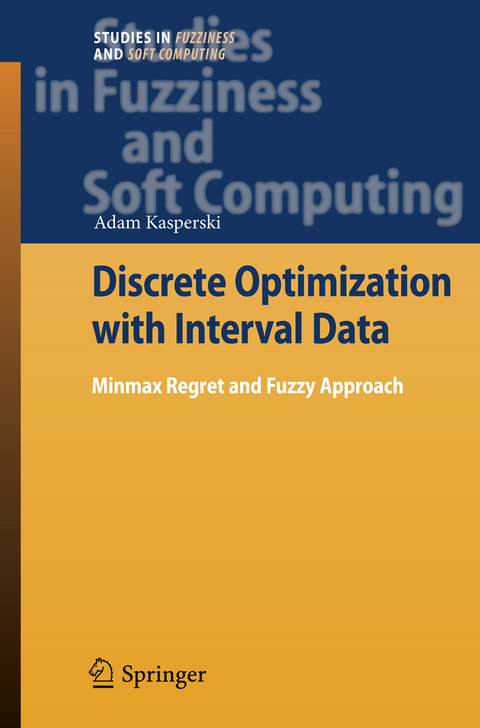
Discrete Optimization with Interval Data
Springer Berlin (Verlag)
9783642097201 (ISBN)
Operations research often solves deterministic optimization problems based on elegantand conciserepresentationswhereall parametersarepreciselyknown. In the face of uncertainty, probability theory is the traditional tool to be appealed for, and stochastic optimization is actually a signi?cant sub-area in operations research. However, the systematic use of prescribed probability distributions so as to cope with imperfect data is partially unsatisfactory. First, going from a deterministic to a stochastic formulation, a problem may becomeintractable. Agoodexampleiswhengoingfromdeterministictostoch- tic scheduling problems like PERT. From the inception of the PERT method in the 1950's, it was acknowledged that data concerning activity duration times is generally not perfectly known and the study of stochastic PERT was launched quite early. Even if the power of today's computers enables the stochastic PERT to be addressed to a large extent, still its solutions often require simplifying assumptions of some kind. Another di?culty is that stochastic optimization problems produce solutions in the average. For instance, the criterion to be maximized is more often than not expected utility. This is not always a meaningful strategy. In the case when the underlying process is not repeated a lot of times, let alone being one-shot, it is not clear if this criterion is realistic, in particular if probability distributions are subjective. Expected utility was proposed as a rational criterion from ?rst principles by Savage. In his view, the subjective probability distribution was - sically an artefact useful to implement a certain ordering of solutions.
Minmax Regret Combinatorial Optimization Problems with Interval Data.- Problem Formulation.- Evaluation of Optimality of Solutions and Elements.- Exact Algorithms.- Approximation Algorithms.- Minmax Regret Minimum Selecting Items.- Minmax Regret Minimum Spanning Tree.- Minmax Regret Shortest Path.- Minmax Regret Minimum Assignment.- Minmax Regret Minimum s???t Cut.- Fuzzy Combinatorial Optimization Problem.- Conclusions and Open Problems.- Minmax Regret Sequencing Problems with Interval Data.- Problem Formulation.- Sequencing Problem with Maximum Lateness Criterion.- Sequencing Problem with Weighted Number of Late Jobs.- Sequencing Problem with the Total Flow Time Criterion.- Conclusions and Open Problems.- Discrete Scenario Representation of Uncertainty.
| Erscheint lt. Verlag | 23.11.2010 |
|---|---|
| Reihe/Serie | Studies in Fuzziness and Soft Computing |
| Zusatzinfo | XVI, 220 p. |
| Verlagsort | Berlin |
| Sprache | englisch |
| Maße | 155 x 235 mm |
| Gewicht | 362 g |
| Themenwelt | Informatik ► Theorie / Studium ► Künstliche Intelligenz / Robotik |
| Mathematik / Informatik ► Mathematik ► Angewandte Mathematik | |
| Technik | |
| Schlagworte | algorithm • algorithms • combinatorial optimization • Fuzziness • fuzzy • minmax • Operations Research • Optimization • Robust optimization minmax |
| ISBN-13 | 9783642097201 / 9783642097201 |
| Zustand | Neuware |
| Informationen gemäß Produktsicherheitsverordnung (GPSR) | |
| Haben Sie eine Frage zum Produkt? |
aus dem Bereich