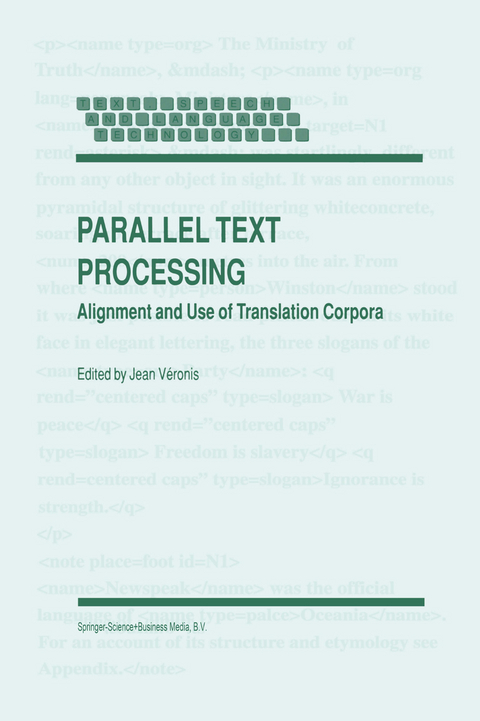
Parallel Text Processing
Springer (Verlag)
9789048155552 (ISBN)
1. From the Rosetta stone to the information society A survey of parallel text processing.- Alignment Methodology.- 2. Pattern recognition for mapping bitext correspondence.- 3. Multilingual text alignment Aligning three or more versions of a text.- 4. A comprehensive bilingual word alignment system Application to disparate languages: Hebrew and English.- 5. A knowledge-lite approach to word alignment.- 6. From sentences to words and clauses.- 7. Bracketing and aligning words and constituents in parallel text using Stochastic Inversion Transduction Grammars.- 8. The translation network A model for a fine-grained description of translations.- 9. Parallel text alignment using crosslingual information retrieval techniques.- 10. Parallel alignment of structured documents.- Applications.- 11. A statistical view on bilingual lexicon extraction From parallel corpora to non-parallel corpora.- 12. Terminology extraction from parallel technical texts.- 13. Term alignment in use Machine-aided human translation.- 14. Automatic dictionary extraction for cross-language information retrieval.- 15. Parallel texts in computer-assisted language learning.- Resources and Evaluation.- 16. Japanese-English aligned bilingual corpora.- 17. Building a parallel corpus of English/Panjabi.- 18. Sharing of translation memory databases derived from aligned parallel text.- 19. Evaluation of parallel text alignment systems The ARCADE project.- Index of terms.- Index of authors.- Index of languages and writing systems.
| Erscheint lt. Verlag | 9.12.2010 |
|---|---|
| Reihe/Serie | Text, Speech and Language Technology ; 13 |
| Zusatzinfo | XXIII, 403 p. |
| Verlagsort | Dordrecht |
| Sprache | englisch |
| Maße | 155 x 235 mm |
| Themenwelt | Geisteswissenschaften ► Sprach- / Literaturwissenschaft ► Sprachwissenschaft |
| Informatik ► Theorie / Studium ► Künstliche Intelligenz / Robotik | |
| ISBN-13 | 9789048155552 / 9789048155552 |
| Zustand | Neuware |
| Informationen gemäß Produktsicherheitsverordnung (GPSR) | |
| Haben Sie eine Frage zum Produkt? |
aus dem Bereich