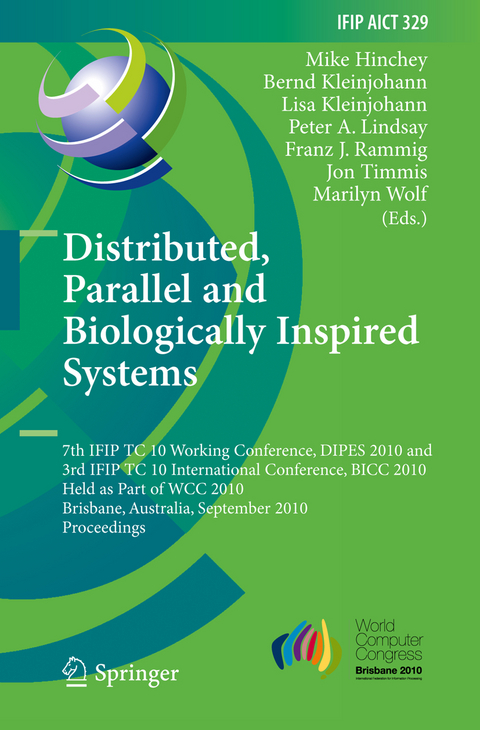
Distributed, Parallel and Biologically Inspired Systems
Springer Berlin (Verlag)
978-3-642-15233-7 (ISBN)
Distributed and Parallel Embedded Systems (DIPES 2010).- Preface.- Opening and Keynote.- Safety, Efficiency and Autonomy - Mastering Conflicting Trends in Embedded Systems Design.- Specification and Modeling.- Rialto 2.0: A Language for Heterogeneous Computations.- Scenario-Based Modeling in Industrial Information Systems.- An Entirely Model-Based Framework for Hardware Design and Simulation.- Extending the Standard Execution Model of UML for Real-Time Systems.- Fault Tolerance.- Task Migration for Fault-Tolerant FlexRay Networks.- Flexible and Dynamic Replication Control for Interdependent Distributed Real-Time Embedded Systems.- Verification and Validation.- Generation of Executable Testbenches from Natural Language Requirement Specifications for Embedded Real-Time Systems.- Model Checking of Concurrent Algorithms: From Java to C.- Integrate Online Model Checking into Distributed Reconfigurable System on Chip with Adaptable OS Services.- Efficient Mutation-Analysis Coverage for Constrained Random Verification.- Code-Generation, Simulation and Timing Analysis.- Generating VHDL Source Code from UML Models of Embedded Systems.- RACE: A Rapid, ArChitectural Simulation and Synthesis Framework for Embedded Processors.- A Mixed Level Simulation Environment for Stepwise RTOS Software Refinement.- Global Best-Case Response Time for Improving the Worst-Case Response Times in Distributed Real-Time Systems.- Distributed Architectures and Design Support.- Dependency-Driven Distribution of Synchronous Programs.- Distributed Resource-Aware Scheduling for Multi-core Architectures with SystemC.- Robust Partitioned Scheduling for Real-Time Multiprocessor Systems.- An Infrastructure for Flexible Runtime Reconfigurable Multi-microcontroller Systems.- Biologically-Inspired Collaborative Computing (BICC 2010).- Preface.- Ants and Adaptive Systems.- Model Checking the Ant Colony Optimisation.- Feature Selection for Classification Using an Ant System Approach.- Novelty-Aware Attack Recognition - Intrusion Detection with Organic Computing Techniques.- Evolutionary-Computation Based Risk Assessment of Aircraft Landing Sequencing Algorithms.- Learning Classifier Systems and Collaborative Systems.- A Collaborative Decision Support Model for Marine Safety and Security Operations.- Combining Software and Hardware LCS for Lightweight On-Chip Learning.- Collaborating and Learning Predators on a Pursuit Scenario.- SelSta - A Biologically Inspired Approach for Self-Stabilizing Humanoid Robot Walking.
| Erscheint lt. Verlag | 13.8.2010 |
|---|---|
| Reihe/Serie | IFIP Advances in Information and Communication Technology |
| Zusatzinfo | XIX, 297 p. |
| Verlagsort | Berlin |
| Sprache | englisch |
| Maße | 155 x 235 mm |
| Gewicht | 660 g |
| Themenwelt | Mathematik / Informatik ► Informatik ► Software Entwicklung |
| Schlagworte | Biologically Inspired • Communication Networks • Design • Design Methodology • Embedded Systems • fault tolerance • Modeling • Multicore • organic computing • power-efficiency • real-time operation systems • Robotics • self-organizing system • Self-Organizing Systems • Simulation • supply-chain management • Validation • verification |
| ISBN-10 | 3-642-15233-3 / 3642152333 |
| ISBN-13 | 978-3-642-15233-7 / 9783642152337 |
| Zustand | Neuware |
| Informationen gemäß Produktsicherheitsverordnung (GPSR) | |
| Haben Sie eine Frage zum Produkt? |
aus dem Bereich