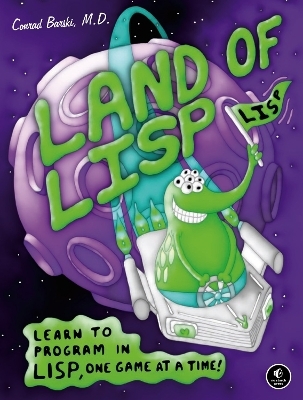
Land Of Lisp


No Starch Press,US (Verlag)
978-1-59327-281-4 (ISBN)
- Titel wird nachgedruckt
- Versandkostenfrei
- Auch auf Rechnung
- Artikel merken
Conrad Barski has an M.D. from the University of Miami, and nearly 20 years of programming experience. This includes a stint developing an obscure Atari Jaguar game, and working on many medical software projects. Barski is also an avid cartoonist, having created the popular alien Lisp mascot and many graphical tutorials. He currently develops cardiology software and lives in Washington, D.C.
Dedication; Acknowledgments; Introduction; What Makes Lisp So Cool and Unusual?; If Lisp Is So Great, Why Don't More People Use It?; Where Did Lisp Come From?; Where Does Lisp Get Its Power?; Lisp is Power; Chapter 1: Getting Started with Lisp; 1.1 Lisp Dialects; 1.2 Getting Started with CLISP; 1.3 What You've Learned; Chapter 2: Creating Your First Lisp Program; 2.1 The Guess-My-Number Game; 2.2 Defining Global Variables in Lisp; 2.3 Basic Lisp Etiquette; 2.4 Defining Global Functions in Lisp; 2.5 Defining Local Variables in Lisp; 2.6 Defining Local Functions in Lisp; 2.7 What You've Learned; Chapter 3: Exploring the Syntax of Lisp Code; 3.1 Syntax and Semantics; 3.2 The Building Blocks of Lisp Syntax; 3.3 How Lisp Distinguishes Between Code and Data; 3.4 Lists in Lisp; 3.5 What You've Learned; Lisp is Symmetry; Chapter 4: Making Decisions with Conditions; 4.1 The Symmetry of nil and (); 4.2 The Conditionals: if and Beyond; 4.3 Cool Tricks with Conditions; 4.4 Comparing Stuff: eq, equal, and More; 4.5 What You've Learned; Chapter 5: Building a Text Game Engine; 5.1 The Wizard's Adventure Game; 5.2 Describing the Scenery with an Association List; 5.3 Describing the Location; 5.4 Describing the Paths; 5.5 Describing Objects at a Specific Location; 5.6 Describing It All; 5.7 Walking Around in Our World; 5.8 Picking Up Objects; 5.9 Checking Our Inventory; 5.10 What You've Learned; Chapter 6: Interacting with the World: Reading and Printing in Lisp; 6.1 Printing and Reading Text; 6.2 The Symmetry Between Code and Data in Lisp; 6.3 Adding a Custom Interface to Our Game Engine; 6.4 Trying Out Our Fancy New Game Interface; 6.5 The Dangers of read and eval; 6.6 What You've Learned; Chapter 6.5: lambda: A Function So Important It Deserves Its Own Chapter; 7.1 What lambda Does; 7.2 Why lambda Is So Important; 7.3 What You've Learned; Chapter 7: Going Beyond Basic Lists; 8.1 Exotic Lists; 8.2 Coping with Complicated Data; 8.3 Creating a Graph; 8.4 Creating Undirected Graphs; 8.5 What You've Learned; Chapter 8: This Ain't Your Daddy's Wumpus; 9.1 The Grand Theft Wumpus Game; 9.2 Defining the Edges of Congestion City; 9.3 Building the Nodes for Congestion City; 9.4 Initializing a New Game of Grand Theft Wumpus; 9.5 Drawing a Map of Our City; 9.6 Let's Hunt Some Wumpus!; 9.7 What You've Learned; Chapter 9: Advanced Datatypes and Generic Programming; 10.1 Arrays; 10.2 Hash Tables; 10.3 Common Lisp Structures; 10.4 Handling Data in a Generic Way; 10.5 The Orc Battle Game; 10.6 What You've Learned; Lisp is Hacking; Chapter 10: Looping with the loop Command; 11.1 The loop Macro; 11.2 Using loop to Evolve!; 11.3 What You've Learned; Chapter 11: Printing Text with the format Function; 12.1 Anatomy of the format Function; 12.2 Control Sequences for Printing Lisp Values; 12.3 Control Sequences for Formatting Numbers; 12.4 Printing Multiple Lines of Output; 12.5 Justifying Output; 12.6 Iterating Through Lists Using Control Sequences; 12.7 A Crazy Formatting Trick for Creating Pretty Tables of Data; 12.8 Attack of the Robots!; 12.9 What You've Learned; Chapter 12: Working with Streams; 13.1 Types of Streams; 13.2 Working with Files; 13.3 Working with Sockets; 13.4 String Streams: The Oddball Type; 13.5 What You've Learned; Chapter 13: Let's Create a Web Server!; 14.1 Error Handling in Common Lisp; 14.2 Writing a Web Server from Scratch; 14.3 Building a Dynamic Website; 14.4 What You've Learned; Chapter 13.5: Functional Programming Is Beautiful; Lisp is Science; Chapter 14: Ramping Lisp Up a Notch with Functional Programming; 16.1 What Is Functional Programming?; 16.2 Anatomy of a Program Written in the Functional Style; 16.3 Higher-Order Programming; 16.4 Why Functional Programming Is Crazy; 16.5 Why Functional Programming Is Fantastic; 16.6 What You've Learned; Chapter 15: Dice of Doom, a Game Written in the Functional Style; 17.1 The Rules of Dice of Doom; 17.2 A Sample Game of Dice of Doom; 17.3 Implementing Dice of Doom, Version 1; 17.4 Creating an Intelligent Computer Opponent; 17.5 Making Dice of Doom Faster; 17.6 What You've Learned; Chapter 16: The Magic of Lisp Macros; 18.1 A Simple Lisp Macro; 18.2 More Complex Macros; 18.3 Macros: Dangers and Alternatives; 18.4 What You've Learned; Chapter 17: Domain-Specific Languages; 19.1 What Is a Domain?; 19.2 Writing SVG Files; 19.3 Creating Custom Game Commands for Wizard's Adventure Game; 19.4 What You've Learned; Chapter 18: Lazy Programming; 20.1 Adding Lazy Evaluation to Lisp; 20.2 Dice of Doom, Version 2; 20.3 Making Our AI Work onnnnnn Larger Game Boards; 20.4 What You've Learned; Chapter 19: Creating a Graphical, Web-Based Version of Dice of Doom; 21.1 Drawing the Game Board Using the SVG Format; 21.2 Building the Web Server Interface; 21.3 Playing Version 3 of Dice of Doom; 21.4 What You've Learned; Chapter 20: Making Dice of Doom More Fun; 22.1 Increasing the Number of Players; 22.2 Rolling the Dice; 22.3 Improving the Dice of Doom Reinforcement Rules; 22.4 Conclusion; Epilogue; Functional Guild Cruiser; Macro Guild Melee Fighters; Restart Guild Armored Fighter; Generic Setter Guild Supply Ship; DSL Guild Hot Rods; CLOS Guild Battleship; The Continuation Guild Rocket Pods; Brevity Guild Micro Fighter; Multicore Guild Formation Fighters; The Lazy Guild Frigate; Updates;
| Verlagsort | San Francisco |
|---|---|
| Sprache | englisch |
| Maße | 178 x 234 mm |
| Themenwelt | Mathematik / Informatik ► Informatik ► Programmiersprachen / -werkzeuge |
| Mathematik / Informatik ► Informatik ► Software Entwicklung | |
| ISBN-10 | 1-59327-281-2 / 1593272812 |
| ISBN-13 | 978-1-59327-281-4 / 9781593272814 |
| Zustand | Neuware |
| Informationen gemäß Produktsicherheitsverordnung (GPSR) | |
| Haben Sie eine Frage zum Produkt? |
aus dem Bereich