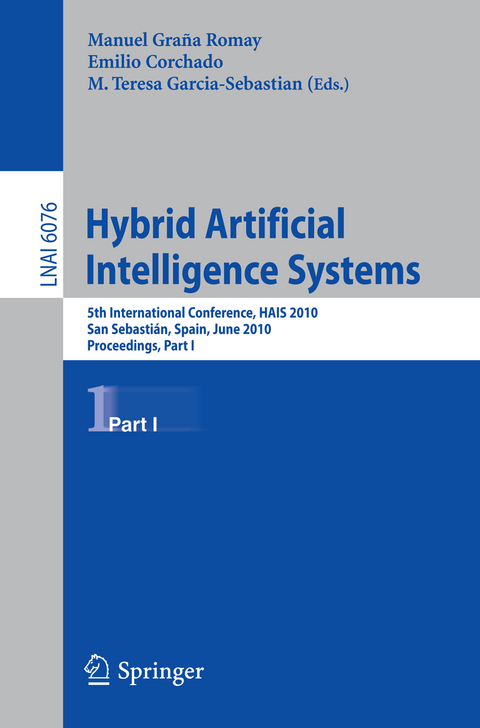
Hybrid Artificial Intelligent Systems, Part I
Springer Berlin (Verlag)
978-3-642-13768-6 (ISBN)

Y-Means: An Autonomous Clustering Algorithm.- A Survey and Analysis of Frameworks and Framework Issues for Information Fusion Applications.- A Regular Tetrahedron Formation Strategy for Swarm Robots in Three-Dimensional Environment.- Markovian Ants in a Queuing System.- A Parametric Method Applied to Phase Recovery from a Fringe Pattern Based on a Particle Swarm Optimization.- Automatic PSO-Based Deformable Structures Markerless Tracking in Laparoscopic Cholecystectomy.- A Framework for Optimization of Genetic Programming Evolved Classifier Expressions Using Particle Swarm Optimization.- Developing an Intelligent Parking Management Application Based on Multi-agent Systems and Semantic Web Technologies.- Linked Multicomponent Robotic Systems: Basic Assessment of Linking Element Dynamical Effect.- Social Simulation for AmI Systems Engineering.- Automatic Behavior Pattern Classification for Social Robots.- Healthcare Information Fusion Using Context-Aware Agents.- Multivariate Discretization for Associative Classification in a Sparse Data Application Domain.- Recognition of Turkish Vowels by Probabilistic Neural Networks Using Yule-Walker AR Method.- A Dynamic Bayesian Network Based Structural Learning towards Automated Handwritten Digit Recognition.- A Dual Network Adaptive Learning Algorithm for Supervised Neural Network with Contour Preserving Classification for Soft Real Time Applications.- The Abnormal vs. Normal ECG Classification Based on Key Features and Statistical Learning.- Classification of Wood Pulp Fibre Cross-Sectional Shapes.- A Hybrid Cluster-Lift Method for the Analysis of Research Activities.- Protein Fold Recognition with Combined SVM-RDA Classifier.- Data Processing on Database Management Systems with Fuzzy Query.- A Hybrid Approach for Process Mining:Using From-to Chart Arranged by Genetic Algorithms.- Continuous Pattern Mining Using the FCPGrowth Algorithm in Trajectory Data Warehouses.- Hybrid Approach for Language Identification Oriented to Multilingual Speech Recognition in the Basque Context.- An Approach of Bio-inspired Hybrid Model for Financial Markets.- Interactive and Stereoscopic Hybrid 3D Viewer of Radar Data with Gesture Recognition.- Recognition of Manual Actions Using Vector Quantization and Dynamic Time Warping.- Protecting Web Services against DoS Attacks: A Case-Based Reasoning Approach.- Ranked Tag Recommendation Systems Based on Logistic Regression.- A Hybrid Robotic Control System Using Neuroblastoma Cultures.- Image Segmentation with a Hybrid Ensemble of One-Class Support Vector Machines.- Power Prediction in Smart Grids with Evolutionary Local Kernel Regression.- Automatic Quality Inspection of Percussion Cap Mass Production by Means of 3D Machine Vision and Machine Learning Techniques.- Speaker Verification and Identification Using Principal Component Analysis Based on Global Eigenvector Matrix.- Hybrid Approach for Automatic Evaluation of Emotion Elicitation Oriented to People with Intellectual Disabilities.- Fusion of Fuzzy Spatial Relations.- Reducing Artifacts in TMS-Evoked EEG.- Model Driven Image Segmentation Using a Genetic Algorithm for Structured Data.- Stamping Line Optimization Using Genetic Algorithms and Virtual 3D Line Simulation.- Evolutionary Industrial Physical Model Generation.- Evolving Neural Networks with Maximum AUC for Imbalanced Data Classification.- A Neuro-genetic Control Scheme Application for Industrial R 3 Workspaces.- Memetic Feature Selection: Benchmarking Hybridization Schemata.- A Hybrid Cellular Genetic Algorithm for Multi-objective Crew Scheduling Problem.-GENNET-Toolbox: An Evolving Genetic Algorithm for Neural Network Training.- An Evolutionary Feature-Based Visual Attention Model Applied to Face Recognition.- Efficient Plant Supervision Strategy Using NN Based Techniques.- FDI and Accommodation Using NN Based Techniques.- A Hybrid ACO Approach to the Matrix Bandwidth Minimization Problem.- Machine-Learning Based Co-adaptive Calibration: A Perspect
| Erscheint lt. Verlag | 11.6.2010 |
|---|---|
| Reihe/Serie | Lecture Notes in Artificial Intelligence | Lecture Notes in Computer Science |
| Zusatzinfo | XXXIV, 606 p. 227 illus. |
| Verlagsort | Berlin |
| Sprache | englisch |
| Themenwelt | Informatik ► Theorie / Studium ► Künstliche Intelligenz / Robotik |
| Schlagworte | Agents • Algorithm analysis and problem complexity • Artificial Neural Network • Case-Based Reasoning • classification • Evolution • genetic programming • HAIS • hybrid algorithms • hybrid reasoning • Knowledge Discovery • lattice theory • multi-agent system • robot • Scheduling • semantic web |
| ISBN-10 | 3-642-13768-7 / 3642137687 |
| ISBN-13 | 978-3-642-13768-6 / 9783642137686 |
| Zustand | Neuware |
| Informationen gemäß Produktsicherheitsverordnung (GPSR) | |
| Haben Sie eine Frage zum Produkt? |
aus dem Bereich