


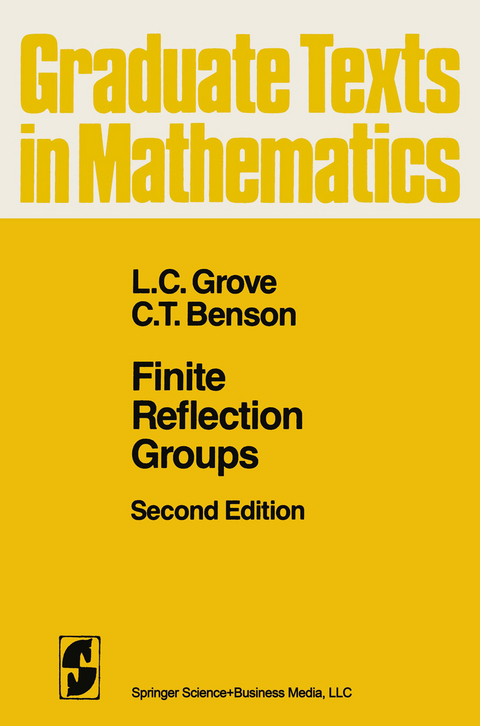
Finite Reflection Groups
Seiten
1985
|
Second Edition 1985
Springer-Verlag New York Inc.
978-0-387-96082-1 (ISBN)
Springer-Verlag New York Inc.
978-0-387-96082-1 (ISBN)
Chapter 1 introduces some of the terminology and notation used later and indicates prerequisites. Throughout most of Chapter 2 we do not distinguish between groups that are "geo metrically indistinguishable," that is, conjugate in the orthogonal group.
Chapter 1 introduces some of the terminology and notation used later and indicates prerequisites. Chapter 2 gives a reasonably thorough account of all finite subgroups of the orthogonal groups in two and three dimensions. The presentation is somewhat less formal than in succeeding chapters. For instance, the existence of the icosahedron is accepted as an empirical fact, and no formal proof of existence is included. Throughout most of Chapter 2 we do not distinguish between groups that are "geo metrically indistinguishable," that is, conjugate in the orthogonal group. Very little of the material in Chapter 2 is actually required for the sub sequent chapters, but it serves two important purposes: It aids in the development of geometrical insight, and it serves as a source of illustrative examples. There is a discussion offundamental regions in Chapter 3. Chapter 4 provides a correspondence between fundamental reflections and funda mental regions via a discussion of root systems. The actual classification and construction of finite reflection groups takes place in Chapter 5. where we have in part followed the methods of E. Witt and B. L. van der Waerden. Generators and relations for finite reflection groups are discussed in Chapter 6. There are historical remarks and suggestions for further reading in a Post lude.
Chapter 1 introduces some of the terminology and notation used later and indicates prerequisites. Chapter 2 gives a reasonably thorough account of all finite subgroups of the orthogonal groups in two and three dimensions. The presentation is somewhat less formal than in succeeding chapters. For instance, the existence of the icosahedron is accepted as an empirical fact, and no formal proof of existence is included. Throughout most of Chapter 2 we do not distinguish between groups that are "geo metrically indistinguishable," that is, conjugate in the orthogonal group. Very little of the material in Chapter 2 is actually required for the sub sequent chapters, but it serves two important purposes: It aids in the development of geometrical insight, and it serves as a source of illustrative examples. There is a discussion offundamental regions in Chapter 3. Chapter 4 provides a correspondence between fundamental reflections and funda mental regions via a discussion of root systems. The actual classification and construction of finite reflection groups takes place in Chapter 5. where we have in part followed the methods of E. Witt and B. L. van der Waerden. Generators and relations for finite reflection groups are discussed in Chapter 6. There are historical remarks and suggestions for further reading in a Post lude.
1 Preliminaries.- 2 Finite Groups in Two and Three Dimensions.- 3 Fundamental Regions.- 4 Coxeter Groups.- 5 Classification of Coxeter Groups.- 6 Generators and Relations for Coxeter Groups.- 7 Invariants.- Postlude.- Crystallographic Point Groups.- References.
| Reihe/Serie | Graduate Texts in Mathematics ; 99 |
|---|---|
| Zusatzinfo | X, 136 p. |
| Verlagsort | New York, NY |
| Sprache | englisch |
| Maße | 178 x 254 mm |
| Themenwelt | Mathematik / Informatik ► Mathematik |
| ISBN-10 | 0-387-96082-1 / 0387960821 |
| ISBN-13 | 978-0-387-96082-1 / 9780387960821 |
| Zustand | Neuware |
| Informationen gemäß Produktsicherheitsverordnung (GPSR) | |
| Haben Sie eine Frage zum Produkt? |
Mehr entdecken
aus dem Bereich

aus dem Bereich
Von Logik und Mengenlehre bis Zahlen, Algebra, Graphen und …
Buch | Softcover (2024)
De Gruyter Oldenbourg (Verlag)
CHF 104,90
Grundlagen für das Bachelor-Studium
Buch | Hardcover (2023)
Hanser (Verlag)
CHF 55,95
Analysis und Lineare Algebra mit Querverbindungen
Buch | Hardcover (2022)
Springer Spektrum (Verlag)
CHF 97,95


