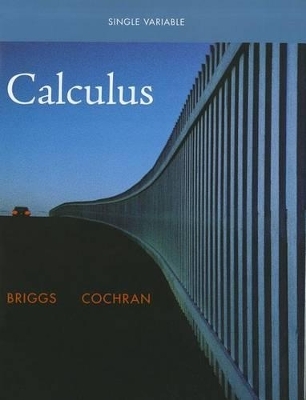
Single Variable Calculus Plus MyMathLab -- Access Card Package
Pearson
9780321665249 (ISBN)
- Titel ist leider vergriffen;
keine Neuauflage - Artikel merken
Drawing on their decades of teaching experience, William Briggs and Lyle Cochran have created a calculus text that carries the teacher’s voice beyond the classroom. That voice–evident in the narrative, the figures, and the questions interspersed in the narrative–is a master teacher leading readers to deeper levels of understanding. The authors appeal to readers’ geometric intuition to introduce fundamental concepts and lay the foundation for the more rigorous development that follows. Comprehensive exercise sets have received praise for their creativity, quality, and scope.
To further support student learning, the ebook for the text features Interactive Figures that can be manipulated to shed light on difficult-to-convey concepts.
MyMathLab provides a wide range of homework, tutorial, and assessment tools that make it easy to manage your course online.
William Briggs has been on the mathematics faculty at the University of Colorado at Denver for twenty-three years. He received his BA in mathematics from the University of Colorado and his MS and PhD in applied mathematics from Harvard University. He teaches undergraduate and graduate courses throughout the mathematics curriculum with a special interest in mathematical modeling and differential equations as it applies to problems in the biosciences. He has written a quantitative reasoning textbook, Using and Understanding Mathematics; an undergraduate problem solving book, Ants, Bikes, and Clocks; and two tutorial monographs, The Multigrid Tutorial and The DFT: An Owner’s Manual for the Discrete Fourier Transform. He is the Society for Industrial and Applied Mathematics (SIAM) Vice President for Education, a University of Colorado President’s Teaching Scholar, a recipient of the Outstanding Teacher Award of the Rocky Mountain Section of the Mathematical Association of America (MAA), and the recipient of a Fulbright Fellowship to Ireland. Lyle Cochran is a professor of mathematics at Whitworth University in Spokane, Washington. He holds BS degrees in mathematics and mathematics education from Oregon State University and a MS and PhD in mathematics from Washington State University. He has taught a wide variety of undergraduate mathematics courses at Washington State University, Fresno Pacific University, and, since 1995, at Whitworth University. His expertise is in mathematical analysis, and he has a special interest in the integration of technology and mathematics education. He has written technology materials for leading calculus and linear algebra textbooks including the Instructor’s Mathematica Manual for Linear Algebra and Its Applications by David C. Lay and the Mathematica Technology Resource Manual for Thomas’ Calculus. He is a member of the MAA and a former chair of the Department of Mathematics and Computer Science at Whitworth University.
Chapter 1: Functions
1.1 Review of Functions
1.2 Representing Functions
1.3 Trigonometric Functions and Their Inverses
Chapter 2: Limits
2.1 The Idea of Limits
2.2 Definitions of Limits
2.3 Techniques for Computing Limits
2.4 Infinite Limits
2.5 Limits at Infinity
2.6 Continuity
2.7 Precise Definitions of Limits
Chapter 3: Derivatives
3.1 Introducing the Derivative
3.2 Rules of Differentiation
3.3 The Product and Quotient Rules
3.4 Derivatives of Trigonometric Functions
3.5 Derivatives as Rates of Change
3.6 The Chain Rule
3.7 Implicit Differentiation
3.8 Derivatives of Inverse Trigonometric Functions
3.9 Related Rates
Chapter 4: Applications of the Derivative
4.1 Maxima and Minima
4.2 What Derivatives Tell Us
4.3 Graphing Functions
4.4 Optimization Problems
4.5 Linear Approximation and Differentials
4.6 Mean Value Theorem
4.7 L’Hôpital’s Rule
4.8 Antiderivatives
Chapter 5: Integration
5.1 Approximating Areas Under Curves
5.2 Definite Integrals
5.3 Fundamental Theorem of Calculus
5.4 Working with Integrals
5.5 Substitution Rule
Chapter 6: Applications of Integration
6.1 Velocity and Net Change
6.2 Regions Between Curves
6.3 Volume by Slicing
6.4 Volume by Shells
6.5 Length of Curves
6.6 Physical Applications
6.7 Logarithmic and Exponential Functions Revisited
6.8 Exponential Models
Chapter 7: Logarithmic and Exponential Functions
7.1 A Short Review
7.2 Inverse Functions
7.3 The Natural Logarithm
7.4 The Exponential Function
7.5 Exponential Models
7.6 Inverse Trigonometric Functions
7.7 L’Hôpital’s Rule Revisited and Growth Rates of Functions
Chapter 8: Integration Techniques
8.1 Integration by Parts
8.2 Trigonometric Integrals
8.3 Trigonometric Substitutions
8.4 Partial Fractions
8.5 Other Integration Strategies
8.6 Numerical Integration
8.7 Improper Integrals
8.8 Introduction to Differential Equations
Chapter 9: Sequences and Infinite Series
9.1 An Overview
9.2 Sequences
9.3 Infinite Series
9.4 The Divergence and Integral Tests
9.5 The Ratio and Comparison Tests
9.6 Alternating Series
Review
Chapter 10: Power Series
10.1 Approximating Functions with Polynomials
10.2 Power Series
10.3 Taylor Series
10.4 Working with Taylor Series
Chapter 11: Parametric and Polar Curves
11.1 Parametric Equations
11.2 Polar Coordinates
11.3 Calculus in Polar Coordinates
11.4 Conic Sections
| Erscheint lt. Verlag | 15.7.2010 |
|---|---|
| Sprache | englisch |
| Gewicht | 1451 g |
| Themenwelt | Mathematik / Informatik ► Mathematik ► Analysis |
| ISBN-13 | 9780321665249 / 9780321665249 |
| Zustand | Neuware |
| Informationen gemäß Produktsicherheitsverordnung (GPSR) | |
| Haben Sie eine Frage zum Produkt? |
aus dem Bereich