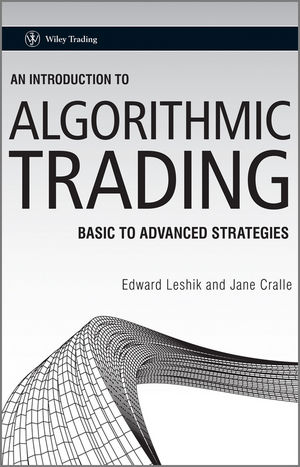
An Introduction to Algorithmic Trading
John Wiley & Sons Inc (Verlag)
978-0-470-68954-7 (ISBN)
- Titel ist leider vergriffen;
keine Neuauflage - Artikel merken
Interest in algorithmic trading is growing massively – it’s cheaper, faster and better to control than standard trading, it enables you to ‘pre-think’ the market, executing complex math in real time and take the required decisions based on the strategy defined. We are no longer limited by human ‘bandwidth’. The cost alone (estimated at 6 cents per share manual, 1 cent per share algorithmic) is a sufficient driver to power the growth of the industry. According to consultant firm, Aite Group LLC, high frequency trading firms alone account for 73% of all US equity trading volume, despite only representing approximately 2% of the total firms operating in the US markets. Algorithmic trading is becoming the industry lifeblood. But it is a secretive industry with few willing to share the secrets of their success. The book begins with a step-by-step guide to algorithmic trading, demystifying this complex subject and providing readers with a specific and usable algorithmic trading knowledge. It provides background information leading to more advanced work by outlining the current trading algorithms, the basics of their design, what they are, how they work, how they are used, their strengths, their weaknesses, where we are now and where we are going.
The book then goes on to demonstrate a selection of detailed algorithms including their implementation in the markets. Using actual algorithms that have been used in live trading readers have access to real time trading functionality and can use the never before seen algorithms to trade their own accounts.
The markets are complex adaptive systems exhibiting unpredictable behaviour. As the markets evolve algorithmic designers need to be constantly aware of any changes that may impact their work, so for the more adventurous reader there is also a section on how to design trading algorithms.
All examples and algorithms are demonstrated in Excel on the accompanying CD ROM, including actual algorithmic examples which have been used in live trading.
Edward Leshik has spent the last 12 years trading his own account and researching the microeconomics of the NASDAQ and New York Stock Exchange markets. Previously he was CEO of an electronics company, supplying point of sale electronics to major retailers such as Sears and Sunoco in Canada and Allied Breweries in the UK, where he gained considerable electronics experience and was the first to automate an assembly line using electronics in the UK. His main academic background is in mathematics and physics and he has a great interest in the theories of Universality and Complexity as applied to the markets. He is currently developing a fully automated algorithmic trading system with his co-author Jane Cralle. Jane Cralle began her career in stockbrokerage at PaineWebber, and later spent 22 years at Linker Capital Management Inc. managing the accounts of high net worth individuals. She has a wide knowledge of the markets and is an expert trader and investor - her extensive experience is invaluable gauging the ‘long run' of market evolution. She is currently researching and developing an automated algorithmic trading system with Edward, and her specialty of cluster analysis of the S&P index components is a work in progress background for a proposed book titled Stocks and their Personalities. Jane lives in Louisville with her husband, Rick Kremer, and three children, Sarah, Morgan and Jack.
Acknowledgments vii
Mission Statement viii
PART I INTRODUCTION TO TRADING ALGORITHMS
Preface to Part I 3
1 History 7
2 All About Trading Algorithms You Ever Wanted to Know . . . 9
3 Algos Defined and Explained 11
4 Who Uses and Provides Algos 13
5 Why Have They Become Mainstream so Quickly? 17
6 Currently Popular Algos 19
7 A Perspective View From a Tier 1 Company 25
8 How to Use Algos for Individual Traders 29
9 How to Optimize Individual Trader Algos 33
10 The Future – Where Do We Go from Here? 37
PART II THE LESHIK-CRALLE TRADING METHODS
Preface to Part II 41
11 Our Nomenclature 49
12 Math Toolkit 53
13 Statistics Toolbox 61
14 Data – Symbol, Date, Timestamp, Volume, Price 67
15 Excel Mini Seminar 69
16 Excel Charts: How to Read Them and How to Build Them 75
17 Our Metrics – Algometrics 81
18 Stock Personality Clusters 85
19 Selecting a Cohort of Trading Stocks 89
20 Stock Profiling 91
21 Stylistic Properties of Equity Markets 93
22 Volatility 97
23 Returns – Theory 101
24 Benchmarks and Performance Measures 103
25 Our Trading Algorithms Described – The ALPHA ALGO Strategies 107
1. ALPHA-1 (DIFF) 107
1a. The ALPHA-1 Algo Expressed in Excel Function Language 109
2. ALPHA-2 (EMA PLUS) V1 And V2 110
3. ALPHA-3 (The Leshik-Cralle Oscillator) 112
4. ALPHA-4 (High Frequency Real-Time Matrix) 112
5. ALPHA-5 (Firedawn) 113
6. ALPHA-6 (General Pawn) 113
7. The LC Adaptive Capital Protection Stop 114
26 Parameters and How to Set Them 115
27 Technical Analysis (TA) 117
28 Heuristics, AI, Artificial Neural Networks and Other Avenues to be Explored 125
29 How We Design a Trading Alpha Algo 127
30 From the Efficient Market Hypothesis to Prospect Theory 133
31 The Road to Chaos (or Nonlinear Science) 139
32 Complexity Economics 143
33 Brokerages 147
34 Order Management Platforms and Order Execution Systems 149
35 Data Feed Vendors, Real-Time, Historical 151
36 Connectivity 153
37 Hardware Specification Examples 155
38 Brief Philosophical Digression 157
39 Information Sources 159
APPENDICES
Appendix A ‘The List’ of Algo Users and Providers 165
Appendix B Our Industry Classification SECTOR Definitions 179
Appendix C The Stock Watchlist 183
Appendix D Stock Details Snapshot 185
CD Files List 243
Bibliography 245
Index 249
| Erscheint lt. Verlag | 1.3.2011 |
|---|---|
| Reihe/Serie | Wiley Trading Series |
| Verlagsort | New York |
| Sprache | englisch |
| Maße | 160 x 236 mm |
| Gewicht | 562 g |
| Themenwelt | Mathematik / Informatik ► Mathematik ► Angewandte Mathematik |
| Wirtschaft ► Betriebswirtschaft / Management ► Finanzierung | |
| ISBN-10 | 0-470-68954-4 / 0470689544 |
| ISBN-13 | 978-0-470-68954-7 / 9780470689547 |
| Zustand | Neuware |
| Informationen gemäß Produktsicherheitsverordnung (GPSR) | |
| Haben Sie eine Frage zum Produkt? |
aus dem Bereich