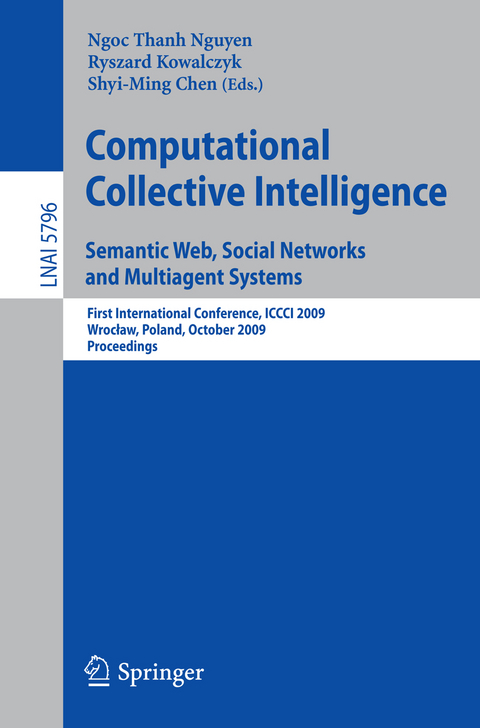
Computational Collective Intelligence. Semantic Web, Social Networks and Multiagent Systems
Springer Berlin (Verlag)
9783642044403 (ISBN)

Keynote Speeches.- Rough Set Approach to Knowledge Discovery about Preferences.- Toward a Self-referential Collective Intelligence Some Philosophical Background of the IEML Research Program.- A-Teams and Their Applications.- Collective Decision Making.- Local Search Algorithms for Core Checking in Hedonic Coalition Games.- Information Foraging Theory as a Form of Collective Intelligence for Social Search.- SAM: Semantic Argumentation Based Model for Collaborative Knowledge Creation and Sharing System.- A Conception for Modification of Learning Scenario in an Intelligent E-learning System.- Firefly Algorithm for Continuous Constrained Optimization Tasks.- Distributed Data Mining Methodology with Classification Model Example.- A Token-Based Mutual Exclusion Approach to Improve Collaboration in Distributed Environments.- Discovering Medical Knowledge from Data in Patients' Files.- Towards an Increase of Collective Intelligence within Organizations Using Trust and Reputation Models.- A New Ant Colony Optimization Algorithm with an Escape Mechanism for Scheduling Problems.- Recognizing Team Formations in Multiagent Systems: Applications in Robotic Soccer.- Semi-traces and Their Application in Concurrency Control Problem.- Design of the Directory Facilitator Supporting Fault-Tolerance in Multi-OSGi Agent System.- Multiagent Systems.- Agent-Based Provisioning of Group-Oriented Non-linear Telecommunication Services.- A Multi-agent Model of Deceit and Trust in Intercultural Trade.- Implementation of Epistemic Operators for Model Checking Multi-agent Systems.- Meta-game HOLOS as a Multi-agent Decision-Making Laboratory.- Agent-Based Computational Modeling of Emergent Collective Intelligence.- Fuzzy Cognitive and Social Negotiation Agent Strategy for Computational CollectiveIntelligence.- A Multi-agent Architecture for Multi-robot Surveillance.- Designing Social Agents with Empathic Understanding.- Multi-agent Systems in Pedestrian Dynamics Modeling.- Towards a Model for Extraction of Possible Worlds and Accessibility Relation from Cognitive Agent's Experience.- Social Networks.- On Deriving Tagsonomies: Keyword Relations Coming from Crowd.- d 2 isco: Distributed Deliberative CBR Systems with jCOLIBRI.- Model of a Collaboration Environment for Knowledge Management in Competence-Based Learning.- PlWiki - A Generic Semantic Wiki Architecture.- Properties of Bridge Nodes in Social Networks.- Semantic Web.- Use of Semantic Principles in a Collaborative System in Order to Support Effective Information Retrieval.- Assessing Semantic Quality of Web Directory Structure.- Computer Aided Requirements Management.- BizKB: A Conceptual Framework for Dynamic Cross-Enterprise Collaboration.- A Simple Parallel Reasoning System for the Description Logic.- SemCards: A New Representation for Realizing the Semantic Web.- ExpTime Tableaux for Checking Satisfiability of a Knowledge Base in the Description Logic .- Semantically Enhanced Intellectual Property Protection System - SEIPro2S.- Semantic Knowledge Representation in Terrorist Threat Analysis for Crisis Management Systems.- Consensus Choice for Reconciling Social Collaborations on Semantic Wikis.- Ontology Management.- Ontology Mapping Composition for Query Transformation in Distributed Environment.- Algebra of Ontology Modules for Semantic Agents.- Grouping Results of Queries to Ontological Knowledge Bases by Conceptual Clustering.- Applying the c.DnS Design Pattern to Obtain an Ontology for Investigation Management System.- Ontology Applications for Achieving Situation Awareness inMilitary Decision Support Systems.- A Collaborative Ontology-Based User Profiles System.- Ontology-Based Intelligent Agent for Grid Resource Management.- Special Session: Dynamics of Real-World Social Networks.- The Norm Game on a Model Network: A Critical Line.- Model for Trust Dynamics in Service Oriented Information Systems.- Collective Prisoner's Dilemma Model of Artificial Society.- Special Session: Nature-Ins
| Erscheint lt. Verlag | 23.9.2009 |
|---|---|
| Reihe/Serie | Lecture Notes in Artificial Intelligence | Lecture Notes in Computer Science |
| Zusatzinfo | XVII, 860 p. |
| Verlagsort | Berlin |
| Sprache | englisch |
| Maße | 155 x 235 mm |
| Themenwelt | Informatik ► Theorie / Studium ► Künstliche Intelligenz / Robotik |
| Schlagworte | Artificial Intelligence • collective intelligence • consensus theory • evolutionary computation • Fuzzy Systems • Hardcover, Softcover / Informatik, EDV/Informatik • Multiagent Systems • Neural systems • Ontologies • semantic web • Social Networks |
| ISBN-13 | 9783642044403 / 9783642044403 |
| Zustand | Neuware |
| Informationen gemäß Produktsicherheitsverordnung (GPSR) | |
| Haben Sie eine Frage zum Produkt? |
aus dem Bereich