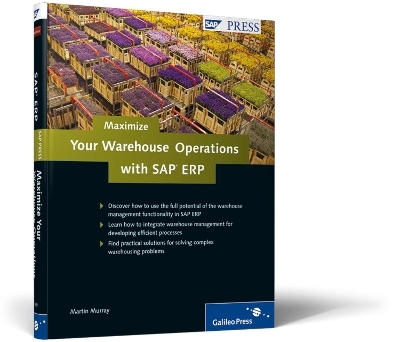
Maximize Your Warehouse Operations with SAP ERP
SAP Press (Verlag)
978-1-59229-309-4 (ISBN)
- Titel ist leider vergriffen;
keine Neuauflage - Artikel merken
Real-World Examples and Tips Use the expert advice and insight provided throughout to help you with your own warehouse operations.
A native of London, England, Martin Murray joined the computer industry upon his graduation from Middlesex University in 1986. In 1991, he began working with SAP R/2 in the Materials Management area for a London-based multi-national beverage company. In 1994, he moved to the United States to work as an SAP R/3 consultant. Since then, he's been implementing the Materials Management (MM) and Warehouse Management (WM) functionality in projects throughout the world. He works for IBM Global Business Services.Martin is the author of six best-selling books from SAP PRESS: Materials Management with SAP ERP, Warehouse Management with SAP ERP, Discover Logistics with SAP ERP, Maximize Your Warehouse Operations with SAP ERP, Understanding the SAP Logistics Information System, and SAP Transaction Codes: Your Quick Reference to T-Codes in SAP ERP.
* ... Acknowledgments ... 15 * ... Preface ... 17 * 1 ... Introduction ... 21 * 1.1 ... The Importance of Warehouse Operations ... 21 * 1.1.1 ... Transport Consolidation ... 22 * 1.1.2 ... Product Mixing ... 22 * 1.1.3 ... Process Improvements ... 24 * 1.2 ... Understanding Warehouse Management in SAP ERP ... 24 * 1.2.1 ... Company Code ... 25 * 1.2.2 ... Plant ... 27 * 1.2.3 ... Storage Location ... 29 * 1.2.4 ... Warehouse ... 30 * 1.2.5 ... Storage Type ... 32 * 1.2.6 ... Storage Section ... 33 * 1.2.7 ... Storage Bin ... 34 * 1.3 ... Understanding the Physical Warehouse ... 35 * 1.3.1 ... Receiving, Shipping, and Storage ... 35 * 1.3.2 ... Inventory Accuracy ... 36 * 1.3.3 ... Value-Added Processes ... 36 * 1.3.4 ... Warehouse Safety ... 36 * 1.3.5 ... Delivery Process ... 36 * 1.3.6 ... Inspection and Quality Process ... 37 * 1.4 ... Defining the Warehouse Layout ... 37 * 1.4.1 ... Design Principles for Warehouse Layout ... 37 * 1.4.2 ... Warehouse Layout Objectives ... 39 * 1.5 ... How This Book Is Organized ... 40 * 1.6 ... Summary ... 40 * 2 ... Effective Inbound Execution ... 41 * 2.1 ... Inbound Delivery Process ... 41 * 2.1.1 ... Create a Purchase Order or Scheduling Agreement ... 42 * 2.1.2 ... Determine the Goods Receiving Point ... 42 * 2.1.3 ... Create a Manual Inbound Delivery for a Purchase Order ... 43 * 2.1.4 ... Create an Inbound Delivery for a Purchase Order Using EDI ... 45 * 2.1.5 ... Repacking the Inbound Delivery ... 51 * 2.1.6 ... Automatic Putaway for Inbound Deliveries ... 51 * 2.2 ... Packing Items for Inbound Deliveries ... 57 * 2.2.1 ... Using Handling Units ... 57 * 2.2.2 ... Creating a Handling Unit ... 58 * 2.2.3 ... Packing Materials in a Handling Unit ... 59 * 2.2.4 ... Nesting Handling Units ... 60 * 2.2.5 ... Unpacking a Handling Unit ... 62 * 2.3 ... Inbound Delivery Monitor ... 63 * 2.3.1 ... Basic Functionality of the Inbound Delivery Monitor ... 63 * 2.3.2 ... List Inbound Deliveries ... 65 * 2.4 ... Business Examples Efficient Inbound Deliveries ... 66 * 2.4.1 ... Purchasing Process ... 67 * 2.4.2 ... Inbound Deliveries ... 67 * 2.4.3 ... Automatic Putaway ... 68 * 2.4.4 ... Use of Handling Units ... 68 * 2.5 ... Summary ... 69 * 3 ... Enhancing Your Managed Putaway and Quality Inspection Processes ... 71 * 3.1 ... Managing the Putaway Process ... 71 * 3.1.1 ... Putaway Strategies ... 72 * 3.1.2 ... Fixed Bin Storage Strategy ... 72 * 3.1.3 ... Open Storage Strategy ... 74 * 3.1.4 ... Next Empty Storage Bin Strategy ... 76 * 3.1.5 ... Addition to Existing Stock Strategy ... 77 * 3.1.6 ... Using the Storage Type Search ... 81 * 3.1.7 ... Storage Section Search ... 85 * 3.2 ... Quality Inspection in the Warehouse ... 87 * 3.2.1 ... Interface Warehouse Management to Quality Management ... 87 * 3.2.2 ... Inspection Lots ... 89 * 3.2.3 ... Usage Decision ... 90 * 3.2.4 ... Finding Inspection Lots in the Warehouse ... 91 * 3.3 ... Business Example Effective Putaway Strategies ... 93 * 3.3.1 ... Fixed Bin Storage ... 93 * 3.3.2 ... Open Storage ... 94 * 3.3.3 ... Next Empty Storage Bin ... 94 * 3.3.4 ... Addition to Existing Stock ... 95 * 3.4 ... Summary ... 95 * 4 ... Improving Internal Warehouse Operations ... 97 * 4.1 ... Materials Movement Concepts ... 98 * 4.1.1 ... Integration Between Inventory Management and Warehouse Management in SAP ERP ... 98 * 4.1.2 ... Interim Storage Types ... 99 * 4.1.3 ... Interim Storage Bins ... 100 * 4.1.4 ... Stock Comparison ... 105 * 4.2 ... Goods Movements in the Warehouse ... 107 * 4.2.1 ... Transfer Requirement ... 107 * 4.2.2 ... Transfer Order ... 111 * 4.3 ... Posting Changes in the Warehouse ... 117 * 4.3.1 ... Reviewing Posting Changes ... 118 * 4.3.2 ... Automatic Processing of Posting Change Notices ... 119 * 4.4 ... Business Examples Efficient Internal Movements ... 120 * 4.4.1 ... Materials Movement Concepts ... 120 * 4.4.2 ... Goods Movements ... 122 * 4.4.3 ... Posting Changes ... 123 * 4.5 ... Summary ... 123 * 5 ... Effective Picking Operations and Storage Unit Management ... 125 * 5.1 ... Defining Picking Operations ... 126 * 5.1.1 ... First In, First Out (FIFO) ... 126 * 5.1.2 ... Picking Using Stringent FIFO ... 127 * 5.1.3 ... Last In, First Out (LIFO) ... 129 * 5.1.4 ... Partial Quantity Picking ... 130 * 5.1.5 ... Picking According to Quantity ... 132 * 5.1.6 ... Picking by Shelf Life Expiration Date ... 134 * 5.1.7 ... Fixed Bin Picking Strategy ... 136 * 5.2 ... Business Example Effective Picking Strategies ... 137 * 5.2.1 ... FIFO ... 138 * 5.2.2 ... Partial Quantity Picking ... 138 * 5.2.3 ... Picking According to Quantity ... 139 * 5.2.4 ... Picking by Shelf Life Expiration Date ... 139 * 5.3 ... Using Storage Unit Management ... 140 * 5.3.1 ... Activate Storage Unit Management ... 140 * 5.3.2 ... Activate Storage Unit Management for a Storage Type ... 141 * 5.3.3 ... Storage Unit Type ... 142 * 5.3.4 ... Storage Unit Record ... 143 * 5.4 ... Business Examples Benefits of Storage Unit Management ... 146 * 5.5 ... Summary ... 147 * 6 ... Efficient Shipment Completion ... 149 * 6.1 ... Defining Your Shipment Completion Process ... 149 * 6.1.1 ... Creating an Outbound Delivery ... 149 * 6.1.2 ... Review an Outbound Delivery ... 152 * 6.1.3 ... Outbound Delivery Monitor ... 155 * 6.1.4 ... Grouping Outbound Deliveries ... 158 * 6.2 ... Adding Value to Shipment Completion ... 160 * 6.2.1 ... Creation of Transfer Orders for Outbound Deliveries ... 160 * 6.2.2 ... Wave Picking ... 161 * 6.3 ... Auditing, Reporting, and Clean-Up Activities ... 168 * 6.3.1 ... Incompletion Log ... 169 * 6.3.2 ... Shipping Output ... 170 * 6.3.3 ... Creating a Transfer Order for a Cancelled Delivery ... 171 * 6.4 ... Business Example Efficient Shipment Procedures ... 172 * 6.4.1 ... Outbound Delivery Monitor ... 173 * 6.4.2 ... Wave Picking ... 173 * 6.4.3 ... Wave Pick Monitor ... 175 * 6.5 ... Summary ... 175 * 7 ... Maximizing Returns Processing ... 177 * 7.1 ... Introduction to Returns Processing ... 177 * 7.1.1 ... Notification of a Return ... 178 * 7.1.2 ... Receipt of Return at the Warehouse ... 179 * 7.1.3 ... Placing Returns in the Warehouse ... 180 * 7.2 ... Successful Returns Processing ... 180 * 7.2.1 ... Return Order ... 181 * 7.2.2 ... Return Delivery ... 182 * 7.2.3 ... Outbound Delivery Monitor ... 183 * 7.2.4 ... Post Goods Issue ... 185 * 7.2.5 ... Return Materials in the Warehouse ... 185 * 7.2.6 ... Transfer Requirement for Returned Materials ... 186 * 7.2.7 ... Transfer Order for Returned Material ... 187 * 7.2.8 ... Review of Warehouse Inventory ... 189 * 7.2.9 ... Transfer Materials from Returns to Own Stock ... 189 * 7.3 ... Business Example Benefits of Returns Processing ... 191 * 7.4 ... Summary ... 194 * 8 ... Efficient Physical Inventory ... 195 * 8.1 ... Cycle Counting ... 195 * 8.1.1 ... Benefits of Cycle Counting ... 196 * 8.1.2 ... ABC Method of Cycle Counting ... 196 * 8.1.3 ... Configuration for ABC Cycle Counting ... 196 * 8.1.4 ... Cycle Counting Documents ... 201 * 8.1.5 ... Printing the Count Document ... 202 * 8.1.6 ... Enter the Cycle Count ... 203 * 8.1.7 ... Recounts and Clearing Differences ... 203 * 8.1.8 ... Understanding the Error ... 205 * 8.2 ... Continuous Inventory ... 205 * 8.2.1 ... Configuration for Continuous Inventory ... 205 * 8.2.2 ... Creating a Continuous Inventory Count Document ... 206 * 8.2.3 ... Entering a Count for Continuous Inventory ... 208 * 8.3 ... Business Example Benefits of Physical Inventory ... 209 * 8.3.1 ... Cycle Counting ... 209 * 8.3.2 ... Continuous Inventory ... 210 * 8.4 ... Summary ... 211 * 9 ... Successful Cross-Docking ... 213 * 9.1 ... Defining the Cross-Docking Process ... 214 * 9.1.1 ... Types of Cross Docking ... 214 * 9.1.2 ... Materials Suitable for Successful Cross-Docking ... 215 * 9.1.3 ... Planned Cross Docking ... 215 * 9.1.4 ... Cross-Docking Configuration ... 216 * 9.1.5 ... Cross-Docking Decisions ... 217 * 9.1.6 ... Cross-Docking Monitor ... 217 * 9.2 ... Cross-Docking Movements ... 220 * 9.2.1 ... One-Step Cross-Docking ... 221 * 9.2.2 ... Two-Step Cross-Docking ... 223 * 9.3 ... Business Example Effective Cross-Docking ... 227 * 9.3.1 ... One-Step Cross-Docking ... 227 * 9.3.2 ... Two-Step Cross-Docking ... 228 * 9.4 ... Summary ... 230 * 10 ... Working with Hazardous Materials ... 231 * 10.1 ... Introduction to Hazardous Materials ... 232 * 10.1.1 ... Configuration for Hazardous Materials ... 232 * 10.2 ... Hazardous Materials in the Warehouse ... 235 * 10.2.1 ... Activating the Functionality for Hazardous Materials ... 235 * 10.2.2 ... Hazardous Material Record ... 239 * 10.2.3 ... Assigning the Hazardous Material to a Material Master Record ... 240 * 10.2.4 ... List of Hazardous Materials ... 241 * 10.2.5 ... Fire Department Inventory List ... 241 * 10.2.6 ... Check Goods Storage ... 242 * 10.2.7 ... Hazardous Substance List ... 243 * 10.3 ... Business Example Successful Handling of Hazardous Materials ... 244 * 10.3.1 ... Hazardous Material Records ... 244 * 10.3.2 ... Hazardous Material Reporting ... 245 * 10.4 ... Summary ... 246 * 11 ... Using Radio Frequency Identification Effectively ... 247 * 11.1 ... Introduction to RF and RFID ... 247 * 11.1.1 ... RF Devices ... 248 * 11.1.2 ... Bar Code Functionality ... 248 * 11.1.3 ... RFID ... 250 * 11.1.4 ... Differences Between RF and RFID ... 251 * 11.2 ... How You Can Use RF in Your Warehouse ... 251 * 11.2.1 ... GUI Devices ... 252 * 11.2.2 ... Character-Based Devices ... 252 * 11.2.3 ... SAPConsole ... 252 * 11.2.4 ... RF Monitor ... 253 * 11.3 ... How You Can Use RFID in Your Warehouse ... 254 * 11.3.1 ... Supported Functions in SAP AII ... 255 * 11.3.2 ... Outbound Processing (Slap and Ship) ... 256 * 11.3.3 ... Flexible Delivery Processing ... 256 * 11.3.4 ... Returnable Transport Items (RTI) Processing ... 256 * 11.4 ... Business Example Successful RFID Processes ... 257 * 11.5 ... Summary ... 259 * 12 ... Effective Use of Warehouse Data and Reporting ... 261 * 12.1 ... Warehouse Activity Monitor ... 261 * 12.1.1 ... Configuration for the Warehouse Activity Monitor ... 262 * 12.1.2 ... Using the Warehouse Activity Monitor ... 266 * 12.2 ... Key Warehouse Reports ... 270 * 12.2.1 ... List of Empty Storage Bins ... 270 * 12.2.2 ... Bin Status Report ... 271 * 12.2.3 ... Capacity Load Utilization ... 273 * 12.2.4 ... Inventory Status ... 274 * 12.3 ... Business Examples Using Warehouse Reports Effectively ... 276 * 12.4 ... Summary ... 277 * 13 ... Conclusion ... 279 * 13.1 ... Lessons Learned from This Book ... 279 * 13.2 ... Applying What You ve Learned ... 282 * A ... Glossary of Terms ... 285 * B ... Bibliography ... 291 * C ... The Author ... 293 * ... Index ... 295
| Erscheint lt. Verlag | 30.12.2009 |
|---|---|
| Reihe/Serie | SAP Press |
| Verlagsort | Maryland |
| Sprache | englisch |
| Maße | 175 x 228 mm |
| Einbandart | gebunden |
| Themenwelt | Mathematik / Informatik ► Informatik ► Netzwerke |
| Informatik ► Weitere Themen ► SAP | |
| Schlagworte | Cross Docking • inbound execution • internal warehouse operations • picking operations, storage unit management • Quality inspection • returns processing • RFID • shipment completion • Warehouse Management |
| ISBN-10 | 1-59229-309-3 / 1592293093 |
| ISBN-13 | 978-1-59229-309-4 / 9781592293094 |
| Zustand | Neuware |
| Informationen gemäß Produktsicherheitsverordnung (GPSR) | |
| Haben Sie eine Frage zum Produkt? |
aus dem Bereich