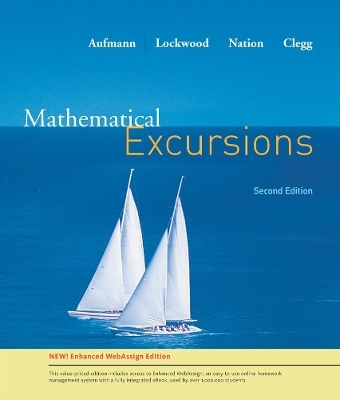
Mathematical Excursion, Enhanced Edition
Brooks/Cole
9780538734998 (ISBN)
- Titel ist leider vergriffen;
keine Neuauflage - Artikel merken
By presenting problem solving in purposeful and meaningful contexts, MATHEMATICAL EXCURSIONS, 2/e, provides students in the Liberal Arts course with a glimpse into the nature of mathematics and how it is used to understand our world. Highlights of the book include the proven Aufmann Interactive Method and multi-part Excursion exercises that emphasize collaborative learning. An extensive technology program provides instructors and students with a comprehensive set of support tools. This Enhanced Edition includes instant access to WebAssign, the most widely-used and reliable homework system. WebAssign presents over 500 problems, as well as links to relevant textbook sections, that help students grasp the concepts needed to succeed in this course. As an added bonus, the Start Smart Guide has been bound into this text. This guide contains instructions to help students learn the basics of WebAssign quickly.
Richard Nation received a B.A. in mathematics from Morningside College and a M.S. degree in mathematics from the University of South Dakota. Mr. Nation also attended a National Science Foundation academic year institute in mathematics at San Diego State University. Mr. Nation taught math at Palomar College in California, where he was on the faculty for 20 years. He has over 38 years’ experience teaching mathematics at the high school and college levels. He is the co-author of several Aufmann titles. Today, Mr. Nation’s professional interests include the impact of technology on curriculum development and on the teaching of mathematics at the precalculus level. Daniel Clegg received his B.A. in Mathematics from California State University, Fullerton and his M.A. in Mathematics from UCLA. He is currently a professor of mathematics at Palomar College near San Diego, California, where he has taught for more than 20 years. Clegg co-authored BRIEF APPLIED CALCULUS with James Stewart and also assisted Stewart with various aspects of his calculus texts and ancillaries for almost 20 years. Joanne Lockwood received a BA in English Literature from St. Lawrence University and both an MBA and a BA in mathematics from Plymouth State University. Ms. Lockwood taught at Plymouth State University and Nashua Community College in New Hampshire, and has over 20 years' experience teaching mathematics at the high school and college level. Ms. Lockwood has co-authored two bestselling developmental math series, as well as numerous derivative math texts and ancillaries. Ms. Lockwood's primary interest today is helping developmental math students overcome their challenges in learning math. Richard Aufmann is the lead author of two best-selling DEVELOPMENTAL MATH series and a best-selling COLLEGE ALGEBRA AND TRIGONOMETRY series, as well as several derivative math texts. Mr. Aufmann taught math, computer science and physics at Palomar College in California, where he was on the faculty for 28 years. His textbooks are highly recognized and respected among college mathematics professors. Today, Mr. Aufmann's professional interests include quantitative literacy, the developmental math curriculum and the impact of technology on curriculum development. He holds a Bachelor of Arts in Mathematics from the University of California, Irvine and a Master of Arts degree in Mathematics from California State University, Long Beach.
Each chapter concludes with a chapter summary, a chapter review, and a chapter test.
1. PROBLEM SOLVING.
Inductive and Deductive Reasoning. Problem Solving with Patterns. Problem-Solving Strategies.
2. SETS.
Basic Properties of Sets. Complements, Subsets, and Venn Diagrams. Set Operations. Applications of Sets. Infinite Sets.
3. LOGIC.
Logic Statements and Quantifiers. Truth Tables, Equivalent Statements, and Tautologies. The Conditional and the Biconditional. The Conditional and Related Statements. Arguments. Euler Diagrams.
4. NUMERATION SYSTEMS AND NUMBER THEORY.
Early Numeration Systems. Place-Value Systems. Different Base Systems. Arithmetic in Different Bases. Prime Numbers. Topics from Number Theory.
5. APPLICATIONS OF EQUATIONS.
First-Degree Equations and Formulas. Rate, Ratio, and Proportion. Percent. Second-Degree Equations.
6. APPLICATIONS OF FUNCTIONS.
Rectangular Coordinates and Functions. Properties of Linear Functions. Finding Linear Models. Quadratic Functions. Exponential Functions. Logarithmic Functions.
7. MATHEMATICAL SYSTEMS.
Modular Arithmetic. Applications of Modular Arithmetic. Introduction to Group Theory.
8. GEOMETRY.
Basic Concepts of Euclidean Geometry. Perimeter and Area of Plane Figures. Properties of Triangles. Volume and Surface Area. Introduction to Trigonometry. Non-Euclidean Geometry. Fractals.
9. THE MATHEMATICS OF GRAPHS.
Traveling Roads and Visiting Cities. Efficient Routes. Planarity and Euler's Formula. Map Coloring and Graphs.
10. THE MATHEMATICS OF FINANCE.
Simple Interest. Compound Interest. Credit Cards and Consumer Loans. Stocks, Bonds, and Mutual Funds. Home Ownership.
11. COMBINATORICS AND PROBABILITY.
The Counting Principle. Permutations and Combinations. Probability and Odds. Addition and Complement Rules. Conditional Probability. Expectation.
12. STATISTICS.
Measures of Central Tendency. Measures of Dispersion. Measures of Relative Position. Normal Distributions. Linear Regression and Correlation.
13. APPORTIONMENT AND VOTING.
Introduction to Apportionment. Introduction to Voting. Weighted Voting Systems.
APPENDIX: THE METRIC SYSTEM OF MEASUREMENT.
Web Appendix: Algebra Review.
| Erscheint lt. Verlag | 9.7.2009 |
|---|---|
| Verlagsort | CA |
| Sprache | englisch |
| Maße | 221 x 254 mm |
| Gewicht | 2202 g |
| Themenwelt | Mathematik / Informatik ► Mathematik ► Algebra |
| ISBN-13 | 9780538734998 / 9780538734998 |
| Zustand | Neuware |
| Informationen gemäß Produktsicherheitsverordnung (GPSR) | |
| Haben Sie eine Frage zum Produkt? |
aus dem Bereich