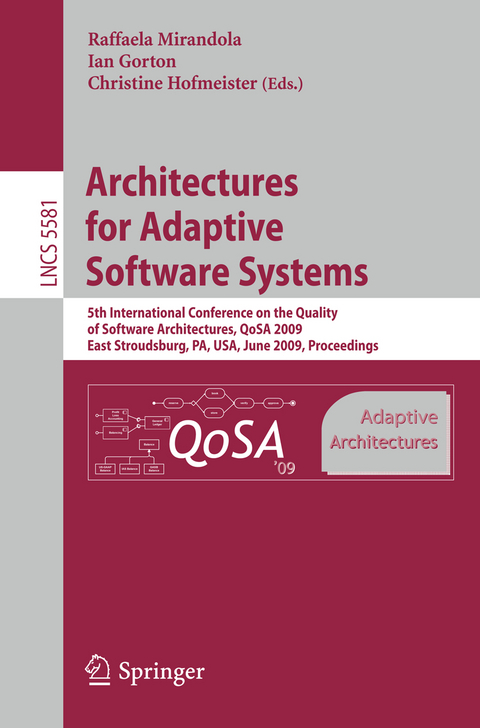
Architectures for Adaptive Software Systems
Springer Berlin (Verlag)
978-3-642-02350-7 (ISBN)
Ian Gorton is a member of the Empirical Software Engineering group at National ICT Australia (NICTA), based in Sydney, Australia. NICTA is Australia's centre of excellence for Information and Communications Technology. He was previously the Chief Architect in Information Sciences and Engineering at PNNL in USA, and has also worked for IBM Transarc, Microsoft Australia and CSIRO. "I'm basically a software (architect, researcher, engineer). I work on a whole range of projects, including new middleware technology, designing architectures for enterprise applications, and carrying out software architecture research. I guess I must enjoy the variety!"
Model-Driven Quality Analysis.- A Model-Based Framework to Design and Debug Safe Component-Based Autonomic Systems.- Applying Model Transformations to Optimizing Real-Time QoS Configurations in DRE Systems.- Automated Architecture Consistency Checking for Model Driven Software Development.- Architectural Performance Prediction.- Improved Feedback for Architectural Performance Prediction Using Software Cartography Visualizations.- Predicting Performance Properties for Open Systems with KAMI.- Compositional Prediction of Timed Behaviour for Process Control Architecture.- Timed Simulation of Extended AADL-Based Architecture Specifications with Timed Abstract State Machines.- Architectural Knowledge.- Achieving Agility through Architecture Visibility.- Successful Architectural Knowledge Sharing: Beware of Emotions.- Toward a Catalogue of Architectural Bad Smells.- Case Studies and Experience Reports.- On the Consolidation of Data-Centers with Performance Constraints.- Evolving Industrial Software Architectures into a Software Product Line: A Case Study.- Adaptive Application Composition in Quantum Chemistry.
| Erscheint lt. Verlag | 8.6.2009 |
|---|---|
| Reihe/Serie | Lecture Notes in Computer Science | Programming and Software Engineering |
| Zusatzinfo | X, 213 p. |
| Verlagsort | Berlin |
| Sprache | englisch |
| Maße | 155 x 235 mm |
| Gewicht | 349 g |
| Themenwelt | Mathematik / Informatik ► Informatik ► Software Entwicklung |
| Schlagworte | AADL • ADA • Algorithm analysis and problem complexity • architectural quality • Autonomic Systems • consistency checking • Embedded Systems • Formal models • Hardcover, Softcover / Informatik, EDV/Informatik • Kami • knowledge sharing • model-based frameworks • model driven software • PCTL • performance constraints • Quantum Chemistry • software architecture • Software engineering • structured analysis • Visualization |
| ISBN-10 | 3-642-02350-9 / 3642023509 |
| ISBN-13 | 978-3-642-02350-7 / 9783642023507 |
| Zustand | Neuware |
| Informationen gemäß Produktsicherheitsverordnung (GPSR) | |
| Haben Sie eine Frage zum Produkt? |
aus dem Bereich