


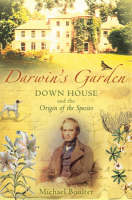
Darwin's Garden
Seiten
2008
Constable (Verlag)
978-1-84529-599-8 (ISBN)
Constable (Verlag)
978-1-84529-599-8 (ISBN)
- Keine Verlagsinformationen verfügbar
- Artikel merken
Paints a portrait of the formation of the England's thinkers and his relationship with the place he loved and shows how his experiments that he conducted over 150 years ago are still revealing new proofs and revelations as we continue to search for the origins of life.
Five years after returning from his trip around the world on HMS Beagle, the young Charles Darwin became the owner of Down House in Kent, where he moved his growing family, far away from the turmoil and distractions of London. He would live here for the rest of his life. It would become the place where he began work on his masterpiece "On the Origin of Species". For almost twenty years he used the garden around him as his laboratory. In the orchard he conducted experiments on pollination. He built a dovecot where he could breed new strains of pigeons that helped him understand the questions of generation. On his daily walk along the sandbank he observed how plants competed for survival. In his heated greenhouse he conducted experiments on orchids and primulas.In solitude he was also able to struggle with the ideas of evolution that had haunted him since his voyage, and give him the courage to publish his revolutionary new ideas.
Bringing Darwin's garden to the present day, Boulter unfolds a shining portrait of the formation of one of England's greatest thinkers and his relationship with the place he loved and shows how his experiments that he conducted over 150 years ago are still revealing new proofs and revelations as we continue to search for the origins of life. 'I much enjoyed "Extinction", and its many conclusions, for which I have every sympathy. I wasn't brought up in science, but I do now begin to see what a vital thing it is in any life' - John Fowles. 'Boulter has an intriguing tale to tell...It is indeed a story worth telling, and a book worth reading' - John Gribbin, "Independent". 'Engagingly argued' - "Times Literary Supplement".
Five years after returning from his trip around the world on HMS Beagle, the young Charles Darwin became the owner of Down House in Kent, where he moved his growing family, far away from the turmoil and distractions of London. He would live here for the rest of his life. It would become the place where he began work on his masterpiece "On the Origin of Species". For almost twenty years he used the garden around him as his laboratory. In the orchard he conducted experiments on pollination. He built a dovecot where he could breed new strains of pigeons that helped him understand the questions of generation. On his daily walk along the sandbank he observed how plants competed for survival. In his heated greenhouse he conducted experiments on orchids and primulas.In solitude he was also able to struggle with the ideas of evolution that had haunted him since his voyage, and give him the courage to publish his revolutionary new ideas.
Bringing Darwin's garden to the present day, Boulter unfolds a shining portrait of the formation of one of England's greatest thinkers and his relationship with the place he loved and shows how his experiments that he conducted over 150 years ago are still revealing new proofs and revelations as we continue to search for the origins of life. 'I much enjoyed "Extinction", and its many conclusions, for which I have every sympathy. I wasn't brought up in science, but I do now begin to see what a vital thing it is in any life' - John Fowles. 'Boulter has an intriguing tale to tell...It is indeed a story worth telling, and a book worth reading' - John Gribbin, "Independent". 'Engagingly argued' - "Times Literary Supplement".
Previously Professor of Palaeobiology at the University of East London and head of a team analysing Fossil Record 2, the largest database of information on extinct animals and plants, Mike Boulter is a distinguished scientist. He is the author of Extinction and currently works at the Natural History Museum. He has been secretary and editor for the International Organisation of Palaeobotany for the past 20 years.
| Erscheint lt. Verlag | 26.6.2008 |
|---|---|
| Zusatzinfo | ill |
| Verlagsort | London |
| Sprache | englisch |
| Maße | 135 x 216 mm |
| Gewicht | 470 g |
| Themenwelt | Literatur ► Biografien / Erfahrungsberichte |
| Sachbuch/Ratgeber ► Natur / Technik | |
| Naturwissenschaften ► Biologie ► Allgemeines / Lexika | |
| ISBN-10 | 1-84529-599-4 / 1845295994 |
| ISBN-13 | 978-1-84529-599-8 / 9781845295998 |
| Zustand | Neuware |
| Informationen gemäß Produktsicherheitsverordnung (GPSR) | |
| Haben Sie eine Frage zum Produkt? |
Mehr entdecken
aus dem Bereich



aus dem Bereich
Buch | Softcover (2024)
Wiley-VCH (Verlag)
CHF 55,85
Band 2: Elektrizität, Optik und Wellen
Buch | Softcover (2022)
Wiley-VCH (Verlag)
CHF 55,85
Vom Ursprung der Sexualitat zum modernen Menschen
Buch | Softcover (2025)
UTB (Verlag)
CHF 54,60


