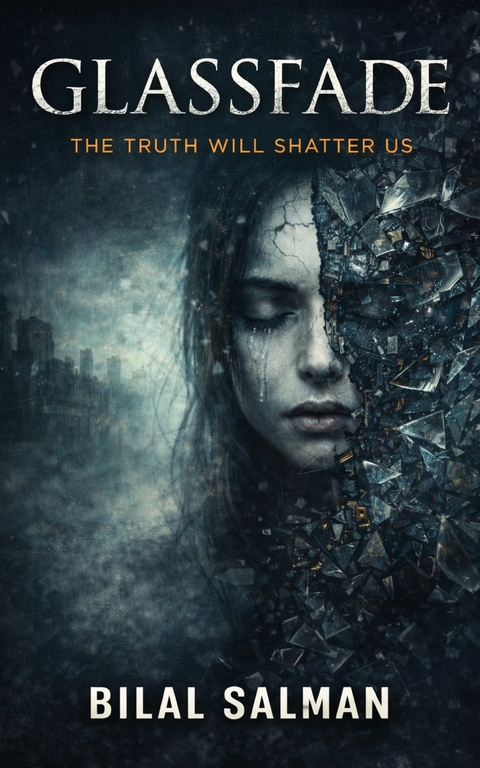
Glassfade (eBook)
96 Seiten
Publishdrive (Verlag)
978-0-00-111863-8 (ISBN)
What happens when the world doesn't end-
but simply stops remembering why it exists?
The collapse came quietly.
Cities still glowed. Systems still ran. Humanity survived.
Yet something essential had begun to fade-not life, not technology, but meaning itself.
Mara Keene is one of the last who stayed.
Alone at a remote research outpost, she watches the world thin around her as people vanish without panic, histories dissolve without trace, and silence grows heavier than noise. When a stranger appears-one who claims to be only a witness-Mara learns the truth: the world is not being destroyed. It is being optimized.
And forgetting is part of the process.
As reality fractures, Mara is forced into a confrontation with something impossible: an echo of herself, a living remainder of what the world is trying to erase. Together, they become a disruption-noticed by forces that exist to preserve stability at any cost.
What follows is not a battle for survival, but a reckoning.
Glassfade is a haunting, philosophical science-fiction novel about memory, responsibility, and the danger of endurance without purpose. It explores a quiet apocalypse where the greatest threat is not extinction-but justification.
This is not a story about saving the world.
It is a story about refusing to let it disappear without being remembered.
Chapter 1
It began with silence. Not the gentle kind that lingers after dawn, when the world stretches awake in soft birdsong, but a heavier kind—dense and waiting, like a pressure in the air before lightning breaks. Cities still hummed with the thin rhythm of traffic, screens still glowed in towers, and engines still breathed their fumes into the streets, but underneath all that noise was something different. Something missing. The world had forgotten its own heartbeat.
People pretended not to notice. They scrolled their devices, folded laundry, tapped through endless news cycles, but every interaction carried a hesitation—an unfinished word at the tip of the tongue, a pause in laughter that came too late, an echo that never returned. Conversations ended with glances toward nothing. Laughter thinned into silence too quickly. Even the air felt altered, as if sound itself no longer trusted the spaces it entered.
The animals noticed first. Birds flew shorter distances, then stopped altogether, wings folding while their eyes turned skyward as if searching for something beyond the sun. Dogs barked without cause, then whimpered when no answer came. Trees shed their leaves weeks early, bare branches trembling against a sky that had lost its shade of blue. People called it stress. Scientists called it climate fluctuation. Politicians called it background noise. Yet the silence grew louder, a crack spreading invisibly through the foundation of things.
Far from the skyscrapers and the endless churn of markets, where dunes rolled like the frozen waves of a forgotten ocean, something entered. Not with fire, not with thunder, but with a shimmer in the air, as though reality itself had forgotten its shape for a moment. From that shimmer, a figure stepped forward, their presence bending light without breaking it. The ground received them without a sound. Dust shifted as if to make room.
The shape was human—almost. Limbs, a face, the suggestion of eyes. But the more one looked, the less certain it became. Their skin reflected like polished glass, showing glimpses of the world around them instead of its own texture. Their eyes held no color, only shifting light. They stood in stillness, inhaled the foreign air, and listened—not with ears, but with something deeper, something that resonated with the very soil beneath their feet.
They had no name, not the way humans understood names. But for the sake of telling, we will call them Aeon. Time stretched into shape. A witness carved into purpose.
Aeon crouched, their fingers brushing brittle roots that crumbled to dust at their touch. The soil trembled faintly, a ripple no human eye would have seen. Aeon closed their eyes, and in that stillness, they heard it: the ache of a world that no longer believed in itself. Not pain like war or hunger, but something quieter—the ache of forgetting. A species drifting so far from meaning that even its suffering had dulled, hollowed out until there was nothing left sharp enough to resist.
Aeon had not come to lead. Not to conquer. They had come to remember, and to remind. Because somewhere, buried beneath the layers of weariness, there were still sparks—faint, fragile, but alive.
They rose and turned their gaze to the horizon. A signal tower blinked faintly in the distance, its lights stuttering like a dying heartbeat. Beyond it, scattered structures squatted in the desert, their edges blurred by shifting sand. Aeon sensed someone there. Not many. Not strong. But someone whose pulse had not yet surrendered. Someone who still dreamed, even if only in fragments.
They began to walk, dust folding behind them like water rippling in their wake.
Elsewhere, the signs of decay deepened. A teacher lost the thread of her own lesson mid-sentence and could not recall what subject she was teaching. A man stood in front of a mirror and failed to recognize the face staring back. Children filled a playground yet spoke no words, sitting motionless among toys they no longer remembered how to play with. Hospitals overflowed not with the sick but with the hollow—patients without diagnosis, symptoms without cause. Doctors scribbled notes, scientists searched for patterns, but every answer dissolved into silence.
Aeon felt it all—the faint tremors of a species forgetting itself. And yet, through the numbness, they sensed one mind that resisted. A solitary thread of memory straining against the unravel. It was enough. Sometimes all it took was one light refusing to extinguish.
The sky dimmed as Aeon drew nearer to the outpost. The wind carried no sound, yet the air felt restless, full of unspoken questions. Somewhere inside the broken husk of metal and sandbags, a woman lingered. She didn’t know it yet, but the silence had already chosen her.
Aeon stepped forward.
The one who stayed had finally arrived.
Aeon moved through the desert as though the world itself had forgotten how to resist them. Sand shifted in slow spirals around their feet, stirred not by wind but by their presence, as if memory itself tried to take form in the dust. The air smelled dry, metallic, sharp against the throat, and every breath tasted faintly of rust and ash. The land was wide, nearly lifeless, yet not dead. Beneath the cracked surface the Earth still pulsed faintly, like a dying heart clinging to its final rhythm. Aeon could feel it. The ache. The longing. The waiting.
On the horizon, a squat building sagged against the dunes, half-buried, forgotten. It had no marker, no satellite signal, no reason to still stand. The desert should have swallowed it whole, but somehow it remained, stubborn and unyielding, as though it too resisted erasure. Aeon paused, studying its outline. This place carried weight—grief etched into its metal walls, loneliness pressed deep into its foundation. The silence here was thicker, heavy enough to touch. Someone lived within it. Someone who had not yet let go.
Inside, Mara Keene brushed dust from a panel of instruments, her movements mechanical, born of habit rather than hope. Most of the devices hadn’t produced real data in weeks. Some had been silent for months. But she checked them anyway, hands moving automatically across knobs and broken screens, as though muscle memory could compensate for meaning. Her notes sprawled across weathered pages, written not for an audience but to convince herself she still existed. The pen’s scratching on paper was her only proof that her mind hadn’t yet gone silent like everything else.
The outpost smelled of old wires and rust, the bitter tang of metal scorched by sun. A cracked water filter hummed faintly in the corner. Heat pressed in, relentless, and sweat collected at the hollow of her neck before dripping into the collar of her shirt. Her lips were dry, cracked from weeks of desert air, but she barely noticed anymore.
She told herself she had stayed for the work. Soil composition. Wind mapping. Carbon tracking. That was the story she whispered to herself in the dark hours when sleep refused to come. But deep down she knew it wasn’t the data that kept her anchored. It was the silence. Out here, her grief didn’t echo off anyone else. It sat with her quietly, an old companion she both despised and clung to.
She stared at her laptop. A blank document blinked on the screen, the cursor pulsing like a heartbeat she couldn’t match. She had meant to write a report, a journal entry, maybe even a goodbye letter, but her thoughts dissolved the moment she tried to capture them. Words slid through her fingers like water. Language itself felt like it was leaving her, piece by piece, each day harder than the last.
Outside, Aeon approached the outpost. Their steps made no sound. The door resisted for a moment, then yielded, as though recognizing something older than rust.
Mara felt it before she heard it. A pressure in the room shifted, the faintest ripple in the air that brushed across her skin like static. She looked up sharply, expecting a draft or a storm. What she saw instead made her freeze.
A figure stood in the doorway. Human in shape, but not entirely. Their body seemed carved from reflection, features uncertain, shifting with the light. Their eyes held no color, only depth, as if they were made of mirrors.
Her first instinct wasn’t fear. It was disorientation, the kind that comes when the rules of reality bend without permission. She reached for a wrench on the table, her fingers curling around the cool metal, her mind racing with explanations—none of which fit.
“Can I help you?” Her voice was steady, though her chest tightened.
The figure did not answer immediately. Aeon studied her not as one studies a stranger’s face, but as though reading something deeper, unseen—the grief carved into her posture, the exhaustion in her gaze, the resilience she wore like armor but hadn’t polished in years.
“You are still listening,” Aeon said at last.
Mara’s breath caught. The voice didn’t fill the air so much as it settled directly into her chest. Soft, layered, neither male nor female, both distant and intimate at once.
“Who are you?” she asked, her grip on the wrench tightening.
“I am here to remember.”
“That’s not an answer.”
“It is the only one I have.”
The air between them thickened. Mara considered bolting for the back door, but something inside her refused to move. This being radiated a presence she could not name—alien yet undeniable, unsettling yet not hostile. For reasons she didn’t understand, she believed it.
“You’re not from here,” she whispered.
“No.” Aeon’s reflection eyes softened. “But I have been watching...
| Erscheint lt. Verlag | 8.12.2025 |
|---|---|
| Sprache | englisch |
| Themenwelt | Literatur ► Romane / Erzählungen |
| ISBN-10 | 0-00-111863-3 / 0001118633 |
| ISBN-13 | 978-0-00-111863-8 / 9780001118638 |
| Informationen gemäß Produktsicherheitsverordnung (GPSR) | |
| Haben Sie eine Frage zum Produkt? |
 EPUB (Adobe DRM)
Größe: 965 KB
Kopierschutz: Adobe-DRM
Adobe-DRM ist ein Kopierschutz, der das eBook vor Mißbrauch schützen soll. Dabei wird das eBook bereits beim Download auf Ihre persönliche Adobe-ID autorisiert. Lesen können Sie das eBook dann nur auf den Geräten, welche ebenfalls auf Ihre Adobe-ID registriert sind.
Details zum Adobe-DRM
Dateiformat: EPUB (Electronic Publication)
EPUB ist ein offener Standard für eBooks und eignet sich besonders zur Darstellung von Belletristik und Sachbüchern. Der Fließtext wird dynamisch an die Display- und Schriftgröße angepasst. Auch für mobile Lesegeräte ist EPUB daher gut geeignet.
Systemvoraussetzungen:
PC/Mac: Mit einem PC oder Mac können Sie dieses eBook lesen. Sie benötigen eine
eReader: Dieses eBook kann mit (fast) allen eBook-Readern gelesen werden. Mit dem amazon-Kindle ist es aber nicht kompatibel.
Smartphone/Tablet: Egal ob Apple oder Android, dieses eBook können Sie lesen. Sie benötigen eine
Geräteliste und zusätzliche Hinweise
Buying eBooks from abroad
For tax law reasons we can sell eBooks just within Germany and Switzerland. Regrettably we cannot fulfill eBook-orders from other countries.
aus dem Bereich