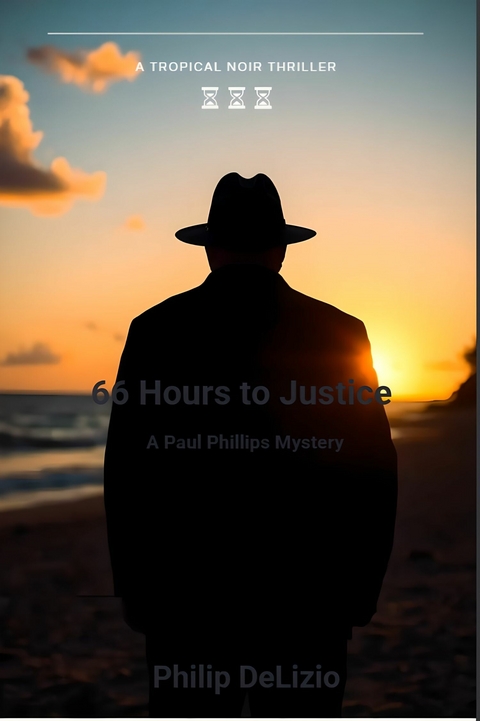
66 Hours to Justice (eBook)
180 Seiten
Publishdrive (Verlag)
978-0-00-113606-9 (ISBN)
When retired detective Paul Phillips is arrested for murdering his old partner on a French Caribbean island, he and his girlfriend have just 66 hours to unmask the real killer-a calculating businessman whose decade-long revenge plan is finally coming to fruition.
Chapter 1 Dawn Arrest
Friday, 06:02. St. Anne breathed like a creature just waking, the sea drawing in and out against the rocks below with a steady hush. The beef, hand-shredded last night, strings of it catching cumin and pepper and the sweetness of softened onions, bobbled lazily in the pot. He'd conceded to time. Proper ropa vieja needed eight hours, however, the clock did not allow eight hours if he planned to hit the morning tide. Six a.m. meant shortcuts, but they could still be meticulous. He tasted, considered, added a squeeze of lime. The kitchen held the smell tight and then bled it out onto the veranda to mix with salt and the faint green of cut palm.
The light came on like a dimmer easing forward. That light, that clean salt air, which was the reason he'd chosen this place. Not to be happy. He had learned to be suspicious of that word. He'd traded sirens for the surf. He'd traded proving himself for searing tuna and watching the tide table. St. Anne had accepted the trade. His bungalow, set on the cliff like a gull settled on a ledge, faced east, and let the mornings arrive unimpeded. He grew mildly obsessed with the clean geometry of routine—when to pull a pan from heat, when to oil the teak, when to leave for the market in town so he could still get parking by the bakery. And then there had been Zoe, entirely unplanned, the only thing in the last five years that hadn't been arranged for calm.
He remembered the first time like a bright fish flashing under the keel. The market near the docks—stalls tight as teeth, umbrellas bleeding color onto the street. She argued in French about passion fruit with an ease that told him fluency was not a performance but a tool. The indignation was stagey; the glint in her eyes wasn't. She'd turned and seen him watching and lifted an eyebrow as if to ask whether he had notes on her delivery.
“You think I'm being unreasonable?” she said. He hadn't laughed much then. He'd done it anyway. “I think,” he replied, “you're enjoying yourself far too much.” She had laughed in a way that made strangers glance over and smile without meaning to. The light on the water that morning had felt like it would last. He tasted it again. A little more lime.
The sound hit the door. Not a knock. A hammering so hard the floorboards shook. Not just noise—an intention. He knew the shape of that sound; it belonged to a different life. He set the spoon down with care as if the steadiness of the gesture could offset the violence of the interruption.
Thump. Thump. Thump.
He wiped his hands. Heart rate up, breath tight. His body ticked over to an old pattern without permission. He moved toward the door. He glanced through the window. The blue and white of a uniform. And a face he knew well enough, Lieutenant Dumas. Not the one who leaned back with a small glass of rum at Le Select and told stories out of school. This version had his jaw locked and his stance widened.
Paul opened the door.
“Good morning,” he said, casual like a man in flip-flops with a wooden spoon in his hand. “'Bit early for a social call, isn't it?”
Dumas's eyes went winter. The volcanic rock under St. Anne's beaches could be warm underfoot by noon; at dawn it could be cold enough to numb. He wouldn't meet Paul's gaze straight on, which was an answer of sorts. His shoulders had gone into parade rest. His fingers betrayed him with a tremor; Paul noted it because he couldn't not note things. The habit was a survival tool he still used like a talisman.
“Paul Phillips, I am placing you under arrest for the murder of Jack Morgan.”
The name hit hard enough to move the air inside his chest. The colors of the morning washed out to chalk. His right hand went pins-and-needles, then cold.
“Jack's… dead?”
“Turn around, please. Hands behind your back.” The clipped tone of someone trying to keep the edges from fraying. Dumas had categories: friend, colleague, officer. He'd selected the least flexible version and put it on like armor.
Murder and Jack weren't words his brain wanted in the same sentence. It tried anyway, stumbled, tried again. He didn't resist. He did look back once, because even now he wanted more data.
“Wait.” He stopped himself, making it a question instead. 'Just… just tell me. When?'
Dumas tightened his jaw until a muscle ticked near his eye.
“ A few days ago. Now turn around.”
A few days ago. He catalogued the past few days without meaning to. He remembered ignoring calls the way you push bills under a magnet on the fridge, meaning to look. The cuffs clicked cold around his wrists and the sound—metal on metal—threaded straight into his nerves. His hands shook.
'This is a mistake,' he said. He heard his voice from a distance, flat. 'You know this is a mistake.'
But Dumas's hand on his arm gentled as soon as it tightened. The lieutenant looked at a nothing-point over Paul's left shoulder because not looking was easier. “I'm sorry, Paul”, he added, almost under his breath. “I have no choice in this.”
People always had choices. He knew better than to say it. It came out anyway.
“Everyone has a choice.” The rebuke landed and he winced at himself. Not fair. Not now. “I didn't mean…”
“It's fine.” The word had too much force in it. The younger officer behind Dumas cleared his throat, soft shoe. Lieutenant, we need to—"
“I know what we need to do,' Dumas snapped, then assembled himself back into neutral. “Let's go.”
* * *
Friday, 06:28. The ride to the St. Anne Police Station was a ride Paul had taken many times. But never in handcuffs. And never through a wire mesh. The island stood up on its elbows and stretched, shutters opening, a boy washing a scooter with a bucket and a hose, a fisherman checking weather with his head tilted to the horizon instead of his phone. Paradise continued its schedule.
The interview room was box-simple: white walls reflecting light too hard to be kind, the smell of coffee had gone stale and lemon-disinfectant not quite masking it. A metal table with a ring bolted to it. His wrists found the ring without drama; the cuffs clipped on quietly. He sat and measured his breaths in units of four. The fluorescent tubes hummed. Somewhere in the HVAC a relay clicked like a metronome forgetting the beat.
Dumas came in with the deliberateness of a man who knew he was going to do something he would replay later in his head. He put a slim folder on the table and sat opposite as if even the way he lowered himself could be evidence in a review.
“The murder took place one week ago.” He slid a photograph across the table. Paul took it because he used to hand photographs across tables like this and because you always look. An alley. Rain makes a particular kind of shine; he could smell the damp paper and rubbish even though the room held only lemons and old coffee. The angle of the shot led his eye to a matte black weight on the ground beside a numbered tent.
His Sig Sauer P22.
“That's my gun,” he said. The professional monotone he hadn't used in a while came back uncoaxed. His throat tightened as if the words were too large. “Reported stolen six weeks ago. You have the report.”
Dumas nodded. The muscles around his mouth didn't move.
“We do. It’s the weapon that killed Jack Morgan.” He produced another plastic evidence bag, the kind you could seal and unseal and initial along the edge. Inside: a single dark hair. “Your hair. With the follicle. Found clutched in Jack's hand.”
Paul looked at it, and the room narrowed. Not a stray. A root meant the bulb was there, fat with cells. Torn out, not shed. The small bald patch that would raise your hand to the spot without thinking. He kept his hair short to the skull. It didn't shed in long strands; it fell like dust. To get a root like that from him would take force or a brush with stiff bristles and a patient collector. Clutched meant under a fingernail or in a fist. That was theatre as much as biology.
Dumas turned his laptop towards Paul. Grainy, rain-smeared footage. A figure in a hood walking away from the body, timestamped in the way cheap DVRs stamped everything: blocky white numbers bottom right. The silhouette, the length of the stride, the shoulder tuck against cold—uncanny. Not exact. But the little familiars of gait are hard to shrug off when you're watching yourself not be yourself.
He let it loop, three times, because the third pass was when pattern recognition could stop arguing with denial. His mouth went dry; his tongue stuck to his teeth. 'My gun, my DNA, my silhouette. Interesting,” he said. Understatement sat on his tongue because it had always fit. He reached toward the photos but placed his palms flat on the table instead. He could name the coping mechanism aloud if he wanted to be cruel to himself: flatten, analyze, don't feel.
“Paul…” Dumas's voice changed —less edge, more apology that wouldn't help either of them. He rubbed his face, stared at a place on the table where there was nothing to look at. 'Listen to me. I know you didn’t do this. But we are under pressure. A former detective is the prime suspect in the murder of his colleague…”
“Ex-colleague,” he said automatically, and the correction tasted like an old habit he should have quit. Reality landed a second behind the words because the brain is a lagging instrument when it doesn't want to hear. Jack. He tried the shape of the question and found it had too many edges. “Jack…” He cleared his throat; it scraped. “How did—"
“Two shots. Close range. The second one…” Dumas let it fall. The pause said more than...
| Erscheint lt. Verlag | 24.12.2025 |
|---|---|
| Sprache | englisch |
| Themenwelt | Literatur ► Krimi / Thriller / Horror |
| ISBN-10 | 0-00-113606-2 / 0001136062 |
| ISBN-13 | 978-0-00-113606-9 / 9780001136069 |
| Informationen gemäß Produktsicherheitsverordnung (GPSR) | |
| Haben Sie eine Frage zum Produkt? |
 EPUB (Adobe DRM)
Größe: 542 KB
Kopierschutz: Adobe-DRM
Adobe-DRM ist ein Kopierschutz, der das eBook vor Mißbrauch schützen soll. Dabei wird das eBook bereits beim Download auf Ihre persönliche Adobe-ID autorisiert. Lesen können Sie das eBook dann nur auf den Geräten, welche ebenfalls auf Ihre Adobe-ID registriert sind.
Details zum Adobe-DRM
Dateiformat: EPUB (Electronic Publication)
EPUB ist ein offener Standard für eBooks und eignet sich besonders zur Darstellung von Belletristik und Sachbüchern. Der Fließtext wird dynamisch an die Display- und Schriftgröße angepasst. Auch für mobile Lesegeräte ist EPUB daher gut geeignet.
Systemvoraussetzungen:
PC/Mac: Mit einem PC oder Mac können Sie dieses eBook lesen. Sie benötigen eine
eReader: Dieses eBook kann mit (fast) allen eBook-Readern gelesen werden. Mit dem amazon-Kindle ist es aber nicht kompatibel.
Smartphone/Tablet: Egal ob Apple oder Android, dieses eBook können Sie lesen. Sie benötigen eine
Geräteliste und zusätzliche Hinweise
Buying eBooks from abroad
For tax law reasons we can sell eBooks just within Germany and Switzerland. Regrettably we cannot fulfill eBook-orders from other countries.
aus dem Bereich