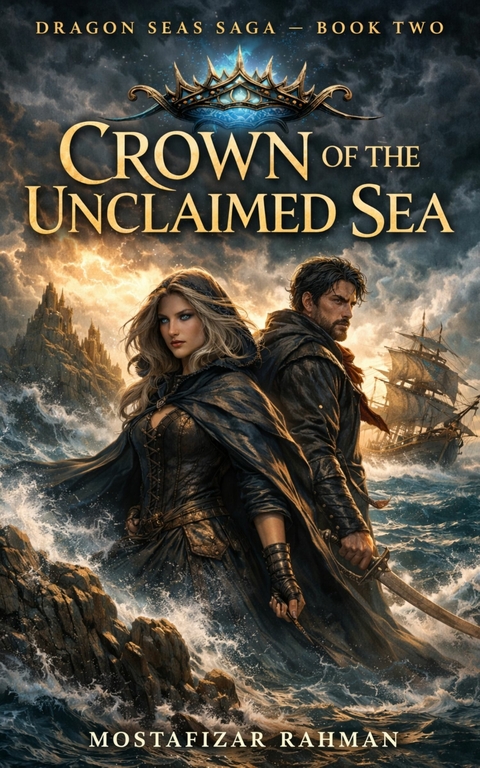
Crown of the Unclaimed Sea (eBook)
950 Seiten
Publishdrive (Verlag)
978-0-00-113499-7 (ISBN)
The sea can't be claimed. But people will try anyway.
After Aurelia's refusal sent shockwaves through the Dragon Seas, Hollowmere wants her to stay-safe, permanent, and useful. The problem is simple: Aurelia will not belong to anyone. Not to a council. Not to a port. Not even to the people who call her hope.
So the world adapts.
The Quiet Ports arrive with polished lanterns and clean hands, offering stability through registries, assessments, and advisories that sound merciful-until trade becomes a weapon. A ledger decides who eats. A stamp decides who sails. And 'neutrality' becomes a disguise for domination.
While Hollowmere wrestles with the temptation to worship what it cannot control, pirates like Kael discover a harsher truth: in the new order, you don't have to be killed to be defeated. You only have to be documented.
Aurelia's power can still storms-but stopping a storm is easy compared to stopping a system. To remain unclaimed, she must learn how to be present without becoming a cage, and how to refuse without turning refusal into ritual.
Crown of the Unclaimed Sea is Book Two in the Dragon Seas Saga, perfect for readers who love:
• Epic nautical fantasy with political intrigue
• A fierce heroine who refuses the savior role
• Pirates, ports, and power games waged in ink
• High stakes without simple heroes or villains
Chapter 1 — The Cost of Being Seen
POV: Aurelia
The sea never went silent.
It only changed its language.
Today it spoke in glassy syllables—short, sharp gusts that worried the surface into nervous ridges, rain that came not as a steady curtain but as thrown handfuls, hard enough to sting when they struck skin. Above, the sky was layered thinly with cloud, pale and wrong, the sun bleached to a cold coin behind it.
Aurelia stood at the rail of a patched trading sloop that had once been painted a cheerful blue and now wore its color like an old bruise. The ship’s name—Mothwing—was half-sanded away, half-overpainted, as if it had tried to become someone else and failed.
Nothing about the vessel was royal. Nothing about it was legendary. It was a box of planks and prayer floating on an indifferent plain.
And yet, on its deck, Aurelia felt like a banner.
She could sense the way eyes found her even when they pretended not to. How voices softened when she stepped near. How a silence spread, not empty but expectant—like a held breath.
She gripped the rail. The wood was wet, gritty with salt. Her fingertips found a shallow groove where a rope had worn the grain for years; the groove was honest. It told the truth of repetition, of strain, of survival.
A boy hovered near her left shoulder, half a step behind as if he didn’t want to be rude by standing beside her, half a step forward as if he feared she might vanish if he didn’t keep close.
Finn. Sixteen, perhaps. The sort of age that made you think you knew everything until the sea taught you otherwise.
He had a coil of line slung over one arm and a face that couldn’t decide whether to be respectful or furious.
“Ma’am,” he said softly—too softly, like the wind might overhear. “Is it coming?”
Aurelia didn’t look away from the horizon. The line where water met sky was a smudged boundary, a place the world pretended to end. “A squall,” she said. “Not a storm.”
Finn swallowed. “But storms are… bigger.”
“Bigger isn’t always worse,” Aurelia murmured. “Sometimes the small things cut deeper.”
He hesitated, then said the words as if he’d been carrying them in his mouth for hours. “If you’re here… will it stop?”
There it was again.
Not fear of weather. Fear of living without a miracle.
Aurelia’s grip tightened until the wet rail squeaked under her hands.
Behind them, sailors moved with quiet urgency. A middle-aged woman in a headscarf knelt beside two children, murmuring steady nonsense to keep them calm. An older man with scarred forearms checked a block and tackle with the tenderness of a priest handling relics. A young deckhand lashed down a barrel with a rope that looked too thin for the job. The ship was overloaded with supplies and people—Hollowmere refugees and Hollowmere loyalists and Hollowmere survivors who did not yet know what they were.
All of them had lived through the same thing: a world that had seemed fixed suddenly becoming fluid.
Solvara’s reach had loosened. The old inevitability had cracked.
That should have felt like relief.
Instead, it felt like the moment after a chain breaks—when your hands are free, and you realize you don’t know what to do with them.
Finn watched her face, hunting for a promise.
Aurelia forced herself to breathe evenly. The air smelled of wet rope, tar, old fish, and the metallic tang of fear. “The sea doesn’t stop,” she said. “It shifts. It spares. It takes. It doesn’t obey.”
Finn’s brow furrowed. “But you—”
“No.” The word came out sharper than she intended. She softened her tone before it could become a blade. “I’m not… what you think.”
He flinched anyway.
She didn’t blame him. She blamed the stories.
Ever since Hollowmere had first seen her refuse—ever since she had said I will not board and made that refusal real in the face of Solvara’s certainty—people had been trying to turn her into something stable. Something they could hold.
They called her an anchor.
As if she were meant to be dropped into the deep to keep their ship from drifting.
As if her purpose was to stop motion.
Aurelia looked out at the approaching darkness of weather and felt the weight of every gaze on the deck like stones piled on her shoulders.
The wind rose in a single decisive breath. The mainsail snapped. The ship leaned to port. Loose items skittered; the deck creaked in protest.
Someone shouted, “Reef the sail! Reef it now!”
A crack of thunder rolled from the distant clouds, dull and low like a giant turning in his sleep.
The children whimpered.
And as if choreographed by instinct, every head turned toward Aurelia.
Not to the captain. Not to the sailmaster. Not to the rigging.
To her.
Aurelia tasted something bitter behind her teeth.
Perform, a voice from memory whispered—familiar, cold.
Contain. Correct.
She had heard those words in Solvara’s halls, spoken gently, as if they were virtues. She had lived inside them like a room with no windows.
Her refusal had broken the door.
But the room had followed her out into the open.
The squall hit with a wet slap. Rain came hard enough to sting her cheeks. Wind shoved at the ship as if trying to force it sideways. Waves rose not tall but steep, jagged in their angles, and struck the hull with hollow knocks.
A barrel broke free despite its lashings and rolled; a sailor lunged and caught it, but the strain wrenched his arm. He cursed, sharp and afraid.
Another sailor slipped, skidding on the suddenly slick boards, and slammed into the rail. A thin line of blood appeared along his elbow, bright against rain-washed skin.
All eyes were still on Aurelia.
Finn’s voice rose above the noise. “Are you going to do nothing?”
Her first instinct—old, trained, automatic—was to reach.
To put her will into the wind, into the sea’s skin, to carve a path of calm through the chaos.
She could do it.
She knew she could.
The knowledge was its own poison.
Aurelia closed her eyes. She listened.
Not to the sea as people listened—waiting to hear what it wanted.
But to the sea as Solvara had taught her to listen—measuring, mapping, predicting. Looking for the seam where the world could be pushed.
She found it, easily. The squall had a rhythm; the waves came in sets. Wind gusted in bursts, not constant. The ship could be aligned to ride it rather than fight it.
The practical truth was there like a lantern in the dark.
But the other truth was heavier.
If she calmed the sea today, they would ask her to calm it tomorrow.
And tomorrow.
And the day after.
They would stop reefing sails. Stop learning the weight of rope. Stop remembering how to brace their feet when the deck leaned.
They would become worshippers instead of sailors.
They would die the first day she wasn’t there.
Aurelia opened her eyes.
She stepped away from the rail and into the center of the deck where everyone could see her. Rain sheeted off her hair. Her tunic clung coldly to her skin. She stood with her feet planted wide, knees loose the way a sailor’s should be, not the way a statue’s would.
“Listen,” she called.
Her voice was not thunder. It didn’t need to be. It had learned how to cut through noise by refusing to compete with it.
“This is a squall,” she shouted over wind. “It will pass. Reef the sail. Point her bow into the gusts. Lash down anything that rolls. Get the children below.”
A few sailors blinked, startled, as if expecting something different.
Finn stared at her, anger and confusion mixing. “That’s it?”
Aurelia met his gaze. Rain ran into her eyes, salty and sharp. “That’s it,” she said.
“You can—” His voice broke. “You can stop it.”
She could have lied.
She could have told him she couldn’t.
But lies became myths, and myths became chains.
So she told the cruel truth instead.
“Yes,” she said. “I can. And I won’t.”
The words landed like a slap.
A murmur rippled through the deck—half outrage, half fear. The mother with the children looked up with wide eyes. The sailor with the bleeding elbow swayed as if the ship had tilted more than it had.
Finn’s face went red. “Why?”
Aurelia’s throat tightened. The answer sat sharp on her tongue: Because I’m not your anchor.
But she needed him to understand more than that.
Because he was not the only one listening. The sea had ears in the form of people.
“Because if I do it,” she said, forcing each word to be steady, “you will forget how to do anything without me. And one day I won’t be here.”
Finn’s lips parted, searching for a retort.
A wave struck. The ship lurched. He grabbed a line to steady himself, his knuckles white.
Aurelia pointed to the rigging. “Move,” she ordered.
The tone—command, not comfort—jerked sailors out of their trance. They sprang into motion because motion was familiar. Rope ran through hands. Knots were tied faster than thought. Someone hauled the reefing line. Someone else shouted a warning as the boom swung.
The squall raged.
Aurelia did not raise a hand to it.
Instead, she moved among them—not touching the weather, but touching the moment.
“Feet...
| Erscheint lt. Verlag | 30.12.2025 |
|---|---|
| Sprache | englisch |
| Themenwelt | Literatur ► Fantasy / Science Fiction ► Fantasy |
| ISBN-10 | 0-00-113499-X / 000113499X |
| ISBN-13 | 978-0-00-113499-7 / 9780001134997 |
| Informationen gemäß Produktsicherheitsverordnung (GPSR) | |
| Haben Sie eine Frage zum Produkt? |
 EPUB (Adobe DRM)
Größe: 4,3 MB
Kopierschutz: Adobe-DRM
Adobe-DRM ist ein Kopierschutz, der das eBook vor Mißbrauch schützen soll. Dabei wird das eBook bereits beim Download auf Ihre persönliche Adobe-ID autorisiert. Lesen können Sie das eBook dann nur auf den Geräten, welche ebenfalls auf Ihre Adobe-ID registriert sind.
Details zum Adobe-DRM
Dateiformat: EPUB (Electronic Publication)
EPUB ist ein offener Standard für eBooks und eignet sich besonders zur Darstellung von Belletristik und Sachbüchern. Der Fließtext wird dynamisch an die Display- und Schriftgröße angepasst. Auch für mobile Lesegeräte ist EPUB daher gut geeignet.
Systemvoraussetzungen:
PC/Mac: Mit einem PC oder Mac können Sie dieses eBook lesen. Sie benötigen eine
eReader: Dieses eBook kann mit (fast) allen eBook-Readern gelesen werden. Mit dem amazon-Kindle ist es aber nicht kompatibel.
Smartphone/Tablet: Egal ob Apple oder Android, dieses eBook können Sie lesen. Sie benötigen eine
Geräteliste und zusätzliche Hinweise
Buying eBooks from abroad
For tax law reasons we can sell eBooks just within Germany and Switzerland. Regrettably we cannot fulfill eBook-orders from other countries.
aus dem Bereich