


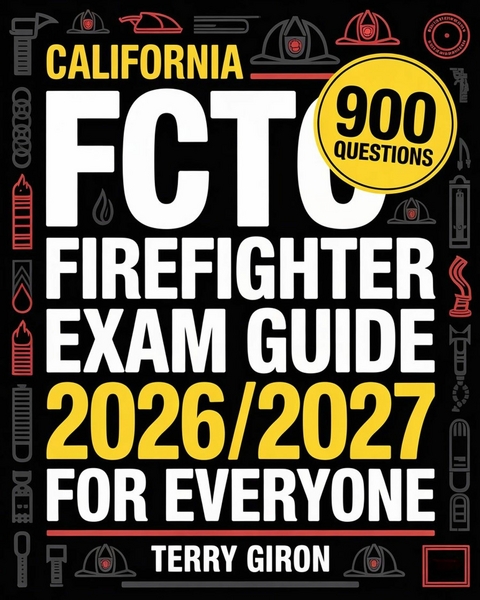
California FCTC Firefighter Exam Guide 2026/2027 for Everyone (eBook)
213 Seiten
Publishdrive (Verlag)
978-0-00-113448-5 (ISBN)
The California FCTC Firefighter Exam Guide 2026/2027 for Everyone is a structured preparation resource designed to support candidates preparing for firefighter entrance and selection examinations administered through the California Firefighter Candidate Testing Center (FCTC). This guide presents exam-relevant concepts and firefighter aptitude topics in a clear, organized format suitable for both first-time applicants and returning candidates.
The content addresses key subject areas commonly evaluated on FCTC firefighter exams, including reading comprehension, situational judgment, mechanical reasoning, mathematics, human relations, observation and memory, teamwork, and problem-solving skills. The guide also emphasizes test-taking strategies, time management, and understanding the structure of firefighter selection exams to support effective preparation.
Designed for Everyone-including aspiring firefighters, fire academy applicants, EMTs, and public safety candidates-this guide serves as a comprehensive review and structured reference to help learners strengthen core skills, improve test performance, and approach the California FCTC firefighter exam with confidence and clarity.
Disclaimer: This exam guide is an independent educational resource created for general exam preparation purposes. It is not affiliated with, endorsed by, or sponsored by the California Firefighter Candidate Testing Center (FCTC), the California State Fire Marshal, or any fire department. All references are used solely for educational purposes.
Chapter 2 — Fire Behavior, Building Construction & Fire Prevention (Exam Topic Area)
Fire dynamics, heat transfer, flashover/backdraft indicators, and hazard recognition
- Explain the concept of thermal runaway in compartment fires and identify the physical processes that lead from localized flaming to compartment flashover.
- Describe how turbulent vs. laminar flow affects flame propagation in a smoke-filled corridor.
- Explain the role of fuel pyrolysis rate in determining growth stage duration for a modern residential fire and which factors most strongly influence that rate.
- Define radiative heat flux and explain how it influences ignition of contents across an open doorway.
- Compare and contrast the energy transfer roles of conduction, convection, and radiation during fire spread in a structure built with lightweight engineered wood trusses.
- Describe the sequence of gas temperatures, gas layer interface movement, and smoke production from ignition to flashover in a well-ventilated single room fire.
- Explain the chemistry and physics behind hydrogen cyanide (HCN) and carbon monoxide (CO) production in smoldering vs. flaming combustion.
- Describe the conditions necessary for backdraft to occur and list the key observable indicators from an exterior approach.
- Explain how ventilation profile (inlet/outlet size and location) alters flame geometry and growth in a modern apartment fire.
- Discuss the importance of neutral plane movement as a hazard recognition cue and the underlying fluid mechanics.
- Explain the effect of compartment geometry (high ceiling vs. low ceiling) on the onset temperature and timing of flashover.
- Describe how burning rate and heat release rate (HRR) differ conceptually and why HRR is the most important parameter in fire behavior.
- Explain how soot loading and smoke optical density influence radiant heat transfer and visibility for egress.
- Describe the role of entrainment in ceiling jet development and how this affects thermal exposure to ceiling-mounted detectors.
- Explain the mechanism by which a localized ventilation opening can trigger a transition from controlled growth to rapid fire development (ventilation-limited to fuel-limited or vice versa).
- Describe the role of flame temperature vs. gas temperature in thermal injury risk to occupants and firefighters.
- Explain why modern furnishings produce faster flaming fires compared to legacy furnishings and outline the material properties responsible.
- Describe how a stratified smoke layer forms, why it can collapse suddenly, and what that indicates about fire progression.
- Explain the physical meaning of the t-square fire growth model and its limitations when applied to compartment fires.
- Describe the impact of wind on fire plume tilt, flame impingement, and the potential for wind-driven interior spread in urban buildings.
- Explain the processes by which collapse of a ceiling can accelerate fire growth and change hazard recognition cues.
- Describe how surface emissivity and absorptivity affect heat transfer from flames to nearby combustible surfaces.
- Explain the role of moisture content in both building materials and contents on fire growth rate and HRR.
- Describe the thermal gradients expected through a masonry wall during a large interior fire and how these gradients influence collapse risk.
- Explain how the presence of polyethylene plastic components in furnishings changes combustion products and fire behavior.
- Describe how compartment ventilation becomes the limiting factor for HRR in a well-sealed, modern apartment fire and how that influences suppression tactics.
- Explain how thermal layering affects smoke movement through stairwells and vertical shafts during high-rise incidents.
- Describe the key thermodynamic differences between flashover and rollover and how each should be recognized tactically.
- Explain how heat release per unit area (kW/m²) relates to ignitability of linings and small items and why this matters for early warning systems.
- Describe the physical causes of backdraft deflagration vs. backdraft detonation and why detonation is rare in building fires.
- Explain how insulation values (R-values) of assemblies influence temperature profiles on exterior surfaces and the potential for exterior fire spread.
- Describe how the chemical structure of polyurethane foam leads to rapid fire growth and toxic product formation.
- Explain the effect of smoke stratification on thermal detector activation heights and times.
- Describe the way in which a developing ceiling jet interacts with overhead structural members to change load distribution and collapse potential.
- Explain how vent sizing calculations (inlet/outlet areas) determine the ventilation flow rate under buoyancy-driven conditions.
- Describe how turbulent flame flicker contributes to intermittent radiation pulses and how those pulses affect nearby superficial ignition.
- Explain the phenomenon of flame attachment to cold surfaces (edge effect) and its significance in fire spread along walls or soffits.
- Describe how fire gases’ specific heat and concentration affect the adiabatic flame temperature in fuel-rich vs. fuel-lean conditions.
- Explain how a fast developing ventilation opening (e.g., broken window) changes combustion stoichiometry and observable smoke characteristics.
- Describe how heat exposure from radiant flux affects PVC window glazing behavior and the consequences for venting and fire spread.
- Explain how the Biot number concept applies to thin vs. thick building elements during fire exposure and what it tells you about internal temperature gradients.
- Describe the reasons modern compartment fires often transition faster to flashover compared with older scenarios, referencing thermal inertia and fuel loads.
- Explain the physics behind smoke jettison (pulsing smoke out of a compartment) prior to flashover and how to distinguish it from backdraft breathing.
- Describe how pre-flashover fuel vapor concentration profiles in a compartment can be mapped conceptually and why those profiles matter tactically.
- Explain the role of soot and condensed organics in forming explosive mixtures in underventilated compartments.
- Describe how radiant heat transfer through a doorway contributes to ignition of contents in an adjacent room and how that may lead to lateral spread.
- Explain how the rate of rise of smoke temperature at the ceiling correlates with HRR and how that can be used in hazard recognition.
- Describe the mechanism by which vertical flame spread on exterior cladding is accelerated by convection currents in a façade cavity.
- Explain how mechanical ventilation (fans) can alter thermal stratification and the risk of inducing flashover during interior attack.
- Describe how the stoichiometric mixture fraction changes when a door is partially opened and the implications for flame behavior at the doorway.
- Explain the observable thermal and chemical signatures that indicate a transition from fuel-controlled to ventilation-controlled burning in a compartment.
- Describe how heat conduction along steel elements (beams, lintels) can cause remote ignition or weakening, and how to recognize these signs externally.
- Explain how unburned pyrolysis gases collect and orient within a complex floor plan and the effect on potential backdraft locations.
- Describe the impact of aerosolized fine particles (soot) on radiative heat transfer and detector performance.
- Explain the role of flame quenching in boundary layers and how that affects flame spread across ceilings and beams.
- Describe the mechanisms that lead to temperature overshoot during compartment re-ventilation and why that can be hazardous.
- Explain how firefighter water application patterns (e.g., short pulses vs. sustained fog) interact with gas temperatures and combustion chemistry during ventilation-limited conditions.
- Describe how the presence of laminated composites in furniture affects smoldering propagation and sudden transition to flaming.
- Explain how exothermic decomposition of certain polymers accelerates HRR and generates additional flammable gases.
- Describe how architectural features (bay windows, atria, void spaces) create chimney effects and change vertical fire development.
- Explain the thermal and chemical indicators that would lead you to suspect smoldering deep-seat fires within upholstered furniture.
- Describe how the pressure field inside a compartment evolves from under-ventilated to open ventilation and how to infer it from window glass behavior.
- Explain why central corridors with closed doors tend to propagate heat and smoke differently than open-plan layouts during early fire growth.
- Describe how elevated oxygen concentration (e.g., oxygen-enriched environments) alters HRR, flame temperature, and hazard recognition cues.
- Explain the concept of pyrolysis vapor flammability limits and how stratified vapor layers within a compartment may become flammable without immediate ignition.
- Describe how thermal radiation attenuation by thick smoke layers changes the effective radiation distance for ignition of external objects.
- Explain why the presence of dust or fine powders in a space can change fire dynamics and the potential for deflagration in concealed spaces.
- Describe how structural sheathing materials (OSB vs. plywood vs. gypsum)...
| Erscheint lt. Verlag | 7.1.2026 |
|---|---|
| Sprache | englisch |
| Themenwelt | Literatur ► Biografien / Erfahrungsberichte |
| ISBN-10 | 0-00-113448-5 / 0001134485 |
| ISBN-13 | 978-0-00-113448-5 / 9780001134485 |
| Informationen gemäß Produktsicherheitsverordnung (GPSR) | |
| Haben Sie eine Frage zum Produkt? |
 EPUB (Adobe DRM)
Größe: 1,1 MB
Kopierschutz: Adobe-DRM
Adobe-DRM ist ein Kopierschutz, der das eBook vor Mißbrauch schützen soll. Dabei wird das eBook bereits beim Download auf Ihre persönliche Adobe-ID autorisiert. Lesen können Sie das eBook dann nur auf den Geräten, welche ebenfalls auf Ihre Adobe-ID registriert sind.
Details zum Adobe-DRM
Dateiformat: EPUB (Electronic Publication)
EPUB ist ein offener Standard für eBooks und eignet sich besonders zur Darstellung von Belletristik und Sachbüchern. Der Fließtext wird dynamisch an die Display- und Schriftgröße angepasst. Auch für mobile Lesegeräte ist EPUB daher gut geeignet.
Systemvoraussetzungen:
PC/Mac: Mit einem PC oder Mac können Sie dieses eBook lesen. Sie benötigen eine
eReader: Dieses eBook kann mit (fast) allen eBook-Readern gelesen werden. Mit dem amazon-Kindle ist es aber nicht kompatibel.
Smartphone/Tablet: Egal ob Apple oder Android, dieses eBook können Sie lesen. Sie benötigen eine
Geräteliste und zusätzliche Hinweise
Buying eBooks from abroad
For tax law reasons we can sell eBooks just within Germany and Switzerland. Regrettably we cannot fulfill eBook-orders from other countries.
aus dem Bereich


