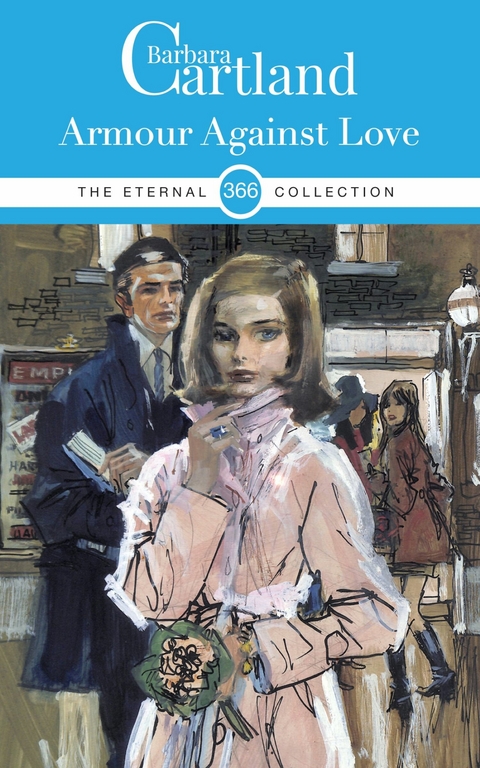
Armour Against Love (eBook)
411 Seiten
Barbara Cartland eBooks Ltd (Verlag)
978-0-00-112383-0 (ISBN)
Once the toast of London's stage, Christine Dillon now finds herself forgotten and adrift. When a solicitor delivers news of her brother's death - and the guardianship of his three children - she is drawn back to the village she left long ago.
Among the rolling fields and whispering gossip, Christine must face the ghosts of her past: a stern father's shadow, a lost love's betrayal, and the choices that shaped her downfall. As she begins to rebuild her life and connect with the children, she discovers strength she thought she'd lost - and an unexpected ally in Michael Farley, a man as wounded by life as she is.
But as tragedy strikes and the mistakes of the past catch up with her, Christine must decide whether to chase the illusion of who she was or embrace the woman she's become.
What choices Christine makes, and how she finds happiness at last, are all told in this powerful story of redemption, resilience, and the courage to begin anew.
1
“Is Mr. Pitman in?”
The girl turned her eyes reluctantly from the detective story and looked up.
“I think he is busy. What name shall I say?”
“Christine Crystal. I thought he might have something for me.”
“What do you do?”
“Oh, juvenile leads – usually.”
The girl got up slowly and shuffled across the room to the door of the inner office. She knocked and entered, leaving the door ajar. Almost without conscious thought Christine crossed the floor. She could hear what was being said.
“What do you want now?”
She recognised Joseph Pitman’s voice. She had seen him on previous occasions. A thick-set vulgar man, who bullied the actors and actresses who must apply to him and toadied to the managers.
“Christine Crystal has called – says she does juvenile leads.”
“Juvenile what! My God, won’t anyone ever tell these women the truth? Inform Christine Crystal, with my compliments, that the British public ain’t blind, deaf and dumb as yet. And tell her to get out. I have got nothing for her and never likely to have – and shut that door as you go, damn you!”
Christine moved away from the door. She was staring through the dirty, rain-spattered panes of the office window when the girl came back.
“Sorry, nothing today,” she said laconically.
Christine made an effort to smile at her. “Thanks awfully! Just thought I’d call in as I was passing.”
“Do you want to leave your address?”
But Christine had made her effort at keeping up appearances. She knew that her hand was trembling as she reached for the outer door.
“No, thank you.”
She ran down the flight of the uncarpeted stairs and into the street. As she walked away, moving without any sense of direction, her cheeks were flaming and she was conscious of her heart thumping.
‘Why should I care?’ she asked herself. ‘It doesn’t matter. There are other agents – and politer ones, too.’
Her heart persisted, so that suddenly she felt breathless and stopped to stare unseeingly into a shop window.
‘I expect it’s because I haven’t been having enough to eat,’ she thought. ‘It’s the second time today I’ve felt like this.’
A sick horror of what had happened that morning swept over her – her landlady’s voice, loud and raucous, echoing round her room and down the stairs. Other lodgers would have been listening. Not that they would be surprised or upset – they were too used to that sort of thing.
“What do you think I am? I’d like to know! A philanthropic society, a charitable institution? I’m not keeping people in my house indefinitely if they can’t pay. Oh, you’ve taken me in nicely, Miss, although I’m the fool to have let you.”
“I promise you I’ll have something next week. You can trust me, Mrs. Hobson. I give you my word of honour.”
“Word of honour! If I’d listened to all the mealy-mouthed actresses who came here promising me this and that on their word of honour, I’d be in the workhouse, that’s where I’d be! And if right was right that’s where you ought to be – or in prison, taking the honest bread out of a working woman’s mouth. How do you think I pay the rent and the rates and the upkeep of my house? On promises? You get out and quick about it.”
Christine had felt the tirade sweep over her, engulfing and suffocating her with its violence. Desperately she had thought to herself,
‘Why can’t I answer her back?’ Yet there was nothing she could say. She was conscious of a handbag that held a few shillings, of a wardrobe that consisted only of her daily necessities. There was nothing she could say, nothing she could do but to stand there silent with her heart thumping, the blood rising slowly up her neck and into her cheeks, then receding again to leave her deathly pale and trembling.
‘I’m getting old,’ she had thought. ‘I can’t stand much more of this.’
She remembered years ago how she had laughed at such upsets. They had not seemed to matter. She had answered back, given as good as she got. Now she felt sick and, what was more, afraid. How often in the last week had she anticipated the scene with Mrs. Hobson. She had known it was bound to happen. Known, despite a springing, unquenchable hope that something would turn up, that the final moment when she must leave 82 Lindcot Road was at hand. It was ridiculous really that she should not be glad to leave such a place and such a neighbourhood. Dirty, damp walls, the wallpaper peeling back from the corners, a hard iron bedstead with its grey, patched sheets, could hardly, even to the wildest imaginings, constitute the idea of home. And yet for the last three months it had meant exactly that to Christine – somewhere where she could be alone, somewhere she could sleep and rest and return to at night.
Sometimes she had thought to herself she must be going crazy when her footsteps quickened as she turned into Lindcot Road. And yet she had often been so tired, so despondent, that the dingy, unimpressive appearance of No. 82 had seemed welcoming in its sheer familiarity. When she had come there first she had just finished an ENSA tour, which had been exceptionally hard work. The travelling conditions had been almost indescribable on the railways, especially those going north. Christine had felt that she would never have enough sleep to make up for that tour, and so 82 Lindcot Road had meant rest, peace, and what was more important than anything, privacy. She had hoped, too, that she would get a part in London. What actress does not dream continually of appearing in the West End? A run of six months – what Heaven it would be! The joy of knowing where one would be tomorrow, of being able to make plans for next week and the week after that.
Then gradually Christine began to understand her own position. She had always been a rotten actress. She had never pretended to herself about that. Years ago her looks had carried her through. It was difficult now when she looked at her press cuttings of 1926 and 1927 to realise that they were of the same woman who looked back at her from the mirror with strained eyes, with lanky, lustreless hair and a frightened expression, which was, she knew, becoming perpetual.
‘Christine Crystal looked entrancing as Lady Marion, a dream of rosebuds and blue ribbon.’ ‘Christine Crystal’s loveliness was breath-taking!’ ‘And then there was Christine Crystal – she came in like a breath of spring. I felt the audience take a deep breath.’
It hadn’t mattered then that she couldn’t act. Her golden hair and blue eyes and perfect pink and white complexion had been lovely enough to hypnotise the audience into believing that she was an actress. She remembered Harry turning on her once about one particular scene they were playing together.
“God! Christine, can’t you understand that you’re supposed to be feeling this? You can’t just stand there...” Suddenly he had stopped. “What the hell does it matter? The audience will look at your face and they won’t worry about the rest.”
He had bent and kissed her and she had remembered nothing else. She had clung to him. Here was her world – a world of her own imagining, far more real, far more vital at that moment than what was taking place on the stage.
The stage had never really meant anything to her. She knew that now. Even though she had once, after she had lost Harry, tried to persuade herself that she had a career. Then she had built castles in the air, just like any schoolgirl.
‘I’ll be a success. I’ll have my name in headlines and bigger ones than his too. I’ll show him what I can do.’
But what had she been able to do without Harry? Nothing! A few weeks every Christmas in pantomime – not as the Prince, of course, her voice wasn’t good enough for that. Dandini, or Lady-in-Waiting to the Princess, a part on tour, a third-rate company playing at third-rate theatres. Monday night, the place half-empty, Saturday packed with drunks who slept or shouted throughout the performance.
No, the career she imagined had certainly not materialised. Instead she had merely sunk lower and lower with each engagement – showgirl in the Zig-Zag Frivolities where the manager expected, because the costumes were so scanty, that the girls would manage without salaries, second lead in a farce that relied on a bedroom scene to attract the type of audience who liked their humour ‘blue’.
Once, she had been engaged as a dance hostess in a stuffy, airless little night club off the Tottenham Court Road. She had tried to tell herself she was tough, but she couldn’t stand it! She had left halfway through the evening – but not before she had told the manager exactly what she thought of him. Now she hadn’t even got the guts or the strength to do that. She must take their insults, take them and tremble because the last vestige of hope of better things had left her, and she had to eat.
Christine pulled herself together. She could not go on standing in front of a shop window for ever. Rows of shoes behind the plate-glass, neatly labelled or presented with enticing tags, recalled to her mind the fact that her own shoes were worn out – her stockings were already damp, she could feel them.
She turned and retraced her steps. The moment had come when she had got to go to the Labour Exchange. She had been dreading it, had shied away from the thought these last two months, and yet had been conscious that it was there ahead of her like some bogy that no amount of reasoning could disperse.
What could she do? She supposed she would be able to turn a screw in a factory as well as anyone else, and...
| Erscheint lt. Verlag | 1.1.2026 |
|---|---|
| Sprache | englisch |
| Themenwelt | Literatur ► Romane / Erzählungen |
| ISBN-10 | 0-00-112383-1 / 0001123831 |
| ISBN-13 | 978-0-00-112383-0 / 9780001123830 |
| Informationen gemäß Produktsicherheitsverordnung (GPSR) | |
| Haben Sie eine Frage zum Produkt? |
 EPUB (Adobe DRM)
Größe: 1,3 MB
Kopierschutz: Adobe-DRM
Adobe-DRM ist ein Kopierschutz, der das eBook vor Mißbrauch schützen soll. Dabei wird das eBook bereits beim Download auf Ihre persönliche Adobe-ID autorisiert. Lesen können Sie das eBook dann nur auf den Geräten, welche ebenfalls auf Ihre Adobe-ID registriert sind.
Details zum Adobe-DRM
Dateiformat: EPUB (Electronic Publication)
EPUB ist ein offener Standard für eBooks und eignet sich besonders zur Darstellung von Belletristik und Sachbüchern. Der Fließtext wird dynamisch an die Display- und Schriftgröße angepasst. Auch für mobile Lesegeräte ist EPUB daher gut geeignet.
Systemvoraussetzungen:
PC/Mac: Mit einem PC oder Mac können Sie dieses eBook lesen. Sie benötigen eine
eReader: Dieses eBook kann mit (fast) allen eBook-Readern gelesen werden. Mit dem amazon-Kindle ist es aber nicht kompatibel.
Smartphone/Tablet: Egal ob Apple oder Android, dieses eBook können Sie lesen. Sie benötigen eine
Geräteliste und zusätzliche Hinweise
Buying eBooks from abroad
For tax law reasons we can sell eBooks just within Germany and Switzerland. Regrettably we cannot fulfill eBook-orders from other countries.
aus dem Bereich