


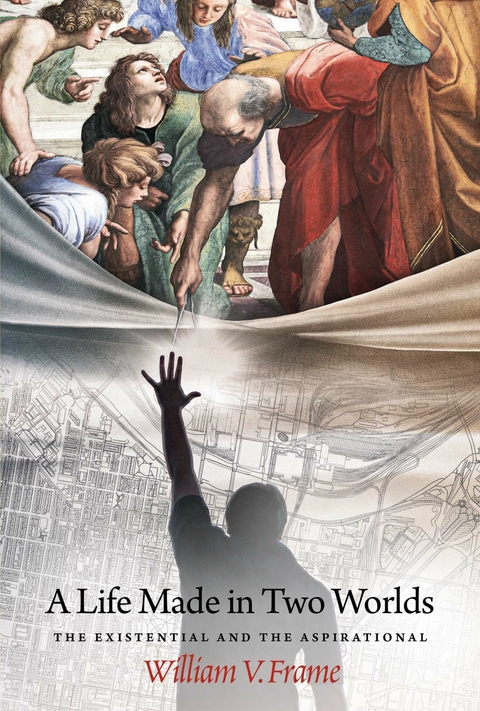
A Life Made in Two Worlds (eBook)
288 Seiten
Bookbaby (Verlag)
979-8-3178-1007-8 (ISBN)
Born in Philadelphia, farm-raised in Ohio's Appalachia, educated in Hawaii (the native state of his first wife and mother of his three children) and the University of Washington, William Frame achieved a professoriate at Kenyon College; gave it up to become a trainee at the First National Bank of Chicago; became Treasurer of Tonka Corporation after helping it become one of the world's three largest toy manufacturers; divorced after 25 years of marriage; initiated a second, 28-year marriage; served as an Interim Business School Dean, a Seminary CFO, helped Minnesota's private colleges establish faculty and student exchange with a private college in China, and founded and led for eight years a seminar on Vocation for sitting or prospective college president members of the Council of Independent Colleges. He lives now at The Clare, a LifeCare community in Chicago's Gold Coast.
Preface: Why It Takes Two Worlds
to Make One Good Life
On a crisp autumn morning a couple of years short of my eightieth birthday, I set sail aboard my sixty-year-old Sparkman & Stephens yawl, Irolita, from Port Angeles, Washington, on the northwestern tip of the continental US, across the Strait of Juan de Fuca to the southern end of Canada’s Inside Passage to Alaska. I had just retired and had used every available moment of the last two years of employed life to chart and prepare Irolita for a grand memorial excursion of the beautiful passage from Victoria Harbor on the southern end of Vancouver Island through the Strait of Georgia to Desolation Sound and the Johnstown Strait, including the spectacular inlets, fjords, and reaches along the way.
As I piloted my way through the powerful currents between Vancouver Island and British Columbia in a yacht that had fifty years earlier sailed competitively in the great trans-Atlantic regattas of the age of wooden boats under the command of folk to the manor born, I was quite aware that I was affirming a counterfeit membership in a world to which I had neither right, title, nor training. But I had grown up in two worlds—the rustic Appalachia of my childhood and adolescence and the urban Eastern dispensation by which my existence there was regulated by my Philadelphian parents.
And I had learned that living in two worlds is better than living in one. It increases the objects of ambition and widens the focal plane of fascination by doubling the number of careers and biographies available for admiration by the two-worlds citizen. Moreover, it increases the accessibility of exotic worlds (like ocean sailing) that otherwise seem to lie well beyond one’s reach.
My early experience with living in two worlds was of being caught between them, not of being lifted by their collaboration. I, of course, wanted nothing more than to be released into the arms of Appalachia; to commune as an unsupervised comrade in hunting and motorcycle expeditions; to spurn literature and music for sports, smoking, and naughty badinage (all spoken with the very hard “r’s” of the region).
But the Philadelphian parents—perhaps without fully intending it—prevented both my integration with the homeland or my adoption of the native tongue. They established the church in the place occupied among the natives by their extended families; of school outings for “adventures”; band and choral recitals and “stepping out” a la chaperone for “rumbles” and “hanging out.” Mom, in particular, was learned and literate. With Dad, her outlook was liberal on race, foods, and ideas. They were both frightened of ignorance. On these points, they made of me a compromised comrade: acceptable—innocuously likable, perhaps—but unable to qualify as a co-conspirator; never admissible to the in-group.
But my loneliness as an incomplete Appalachian and a hesitant Philadelphian was readily relieved by imaginative forays into any number of exotic worlds that were collateral, as it were, in the Philadelphian matrix. Sailing was one of these. Because the Philadelphian world was available to me in the abstract rather than experientially, both it and its collateral venues—Major League Baseball, for example, or operatic music as performed by, say, Marian Anderson—were available to me on my terms. From the moment I sensed in Irolita’s faded lines her beauty and sea-going prowess, I could imagine (by way of what I read in Jack London, for example) guiding her across the Pacific to Hawaii or up the Inside Passage. Hence, it was a very small step, when I had acquired the means, to actually save such a bedraggled hull from being cut up and making of her rehabilitation a “project.” That is what happened with me and Irolita—and her relaunching was planned for the Retirement Cruise.
It was a glorious adventure. Irolita carried us—me and the couple of experienced sailors I talked into joining the cruise (it wasn’t hard!)—very gracefully, anchorage by anchorage, moorage by moorage, north along the western flank of British Columbia and eventually back south along the east coast of Vancouver Island to Campbell River, our jumping-off port for the two-day homeward sail to Seattle in Puget Sound: Through empty seas (the boating season up there had ended), along deserted coastlines, into narrow reaches whose perpendicular cliffsides occasionally featured 200-400-foot waterfalls descending unimpeded into fjords whose waters were sometimes deeper than their passageways wide; almost entirely alone, replicating only the sailing, not the social, dimension of the world into which Irolita had been born and to which I had gained access only with its passing.
Irolita, herself, really came into her own during the cruise only on the open sea, heeled over thirty degrees on a broad reach in fifteen-knot winds, her deep and heavy keel holding her steadily on course in that magic equipoise between wind and sea, her sails, luff-free, pulling her forward at her maximum hull speed of seven knots, her wake straight, her bow waves flaring out and splashing smoothly into the seaway, surging rhythmically ahead in a mild chop, her mahogany gunnels and house-sides gleaming in contrast to the forest green of her enameled hull—holding course in her solitary, contemporary world, with only an occasional tug on a halyard, winch, or boom, sailing herself, as it were, free of the need or gratuitous provision of human intervention: The very opposite of the anxious attentiveness required by the careers I had just given up, and upon which I have since been reflecting for the sake of this book.
This once-in-a-lifetime voyage, this peculiar pilgrimage, was actually intended less as a reward than a preparation for life in retirement—which was to be by way of the salvific writing project I had reserved for it—“salvific” because I had failed to do as much writing, and as good, during my professorial days as I felt obliged to do from an early age, all in exchange for my education and to vindicate the judgement of my mother and my boyhood teachers that I had the talent for it.
A couple of weeks after the conclusion of the Canadian Sail, I sat down to the postponed project—and suffered an immediate disappointment. I had reverted automatically to the turgid, footnote-and-reference-laden style of scholarly writing expected in academe and to which I had become accustomed—and gave up in a fit of boredom that desiccated every green shoot of literal inspiration on which I counted to sustain the work.
Just as the ugly specter of an empty retirement rose before me, my sister, Polly, two years my junior, invited me to come with her to a high school reunion in the southeastern Ohio piece of Appalachia where we had grown up. The trip put me back in touch with the all-but-forgotten beginnings of my life. When I returned from it to Minnesota, where I was then living, I wrote a little memorial of the homecoming. I thought well enough of the result to lay it before a couple of smart and literary friends. I was reassured enough by their reviews to dig yet deeper into the memory of my childhood and adolescence. And Hey, Presto! I had found (and begun) in this little homecoming essay the autobiography that was to become the sustainable Retirement Writing Project!
Beyond breaking me free of insularity, the experience of managing the tension between the cultural requirements of my Appalachian residence and the Philadelphian strictures imposed on me by my parents yielded an elementary form of a navigational system that I already hoped would keep me on a steady life course—the way I eventually learned a good helm and sailing skills kept Irolita on course in an open sea. That dialectic between the two in Appalachia created a model for application in each epoch of my existence after Appalachia—so “Liberal Education” replaced (or supplemented) Philadelphia during The Kenyon Years; a version of “muckraking” journalism replaced or supplemented Philadelphia at Ohio State University, and so on, changing and advancing morally as intended as I made my way from academic to corporate epochs and back to the academy, right up to and including retirement.
In truth, the narrative tale of my existence was rather far along before the two-worlds dialectic that was prompting and guiding it made itself known to me. In the meantime, the words of the tale poured out onto the page, dragging obscured and forgotten events into view, where they demanded the kind of reflection that brought their true purport into view. In this reconnoitering, I remembered that my first literary compositions were sermons, modeled on those delivered almost every Sunday morning by my maternal grandfather from Methodist pulpits into which he was warmly invited in our section of Appalachia whenever he came visiting. He had preaching star-power in those parts—which certainly helps to explain my early interest in rhetoric.
Long before a boy my age could have been expected to sit quietly with his family through the whole length of a twenty-minute sermon, his legs dangling from an unpadded oak pew, I sat mesmerized, noticing that the whole church laughed and condoled and said “Amen!” just where and when Grandfather Samuel McWilliams skillfully guided it to do so. He died before I reached my tenth year, while visiting one of my mother’s siblings “back East,” but I was hooked: I was easily able to imagine the thrill of delivering my own sermons to the welcoming surprise of his audiences, winning their testimony that...
| Erscheint lt. Verlag | 5.1.2026 |
|---|---|
| Sprache | englisch |
| Themenwelt | Literatur ► Biografien / Erfahrungsberichte |
| ISBN-13 | 979-8-3178-1007-8 / 9798317810078 |
| Informationen gemäß Produktsicherheitsverordnung (GPSR) | |
| Haben Sie eine Frage zum Produkt? |
 EPUB (Ohne DRM)
Größe: 1,3 MB
Digital Rights Management: ohne DRM
Dieses eBook enthält kein DRM oder Kopierschutz. Eine Weitergabe an Dritte ist jedoch rechtlich nicht zulässig, weil Sie beim Kauf nur die Rechte an der persönlichen Nutzung erwerben.
Dateiformat: EPUB (Electronic Publication)
EPUB ist ein offener Standard für eBooks und eignet sich besonders zur Darstellung von Belletristik und Sachbüchern. Der Fließtext wird dynamisch an die Display- und Schriftgröße angepasst. Auch für mobile Lesegeräte ist EPUB daher gut geeignet.
Systemvoraussetzungen:
PC/Mac: Mit einem PC oder Mac können Sie dieses eBook lesen. Sie benötigen dafür die kostenlose Software Adobe Digital Editions.
eReader: Dieses eBook kann mit (fast) allen eBook-Readern gelesen werden. Mit dem amazon-Kindle ist es aber nicht kompatibel.
Smartphone/Tablet: Egal ob Apple oder Android, dieses eBook können Sie lesen. Sie benötigen dafür eine kostenlose App.
Geräteliste und zusätzliche Hinweise
Buying eBooks from abroad
For tax law reasons we can sell eBooks just within Germany and Switzerland. Regrettably we cannot fulfill eBook-orders from other countries.
aus dem Bereich


