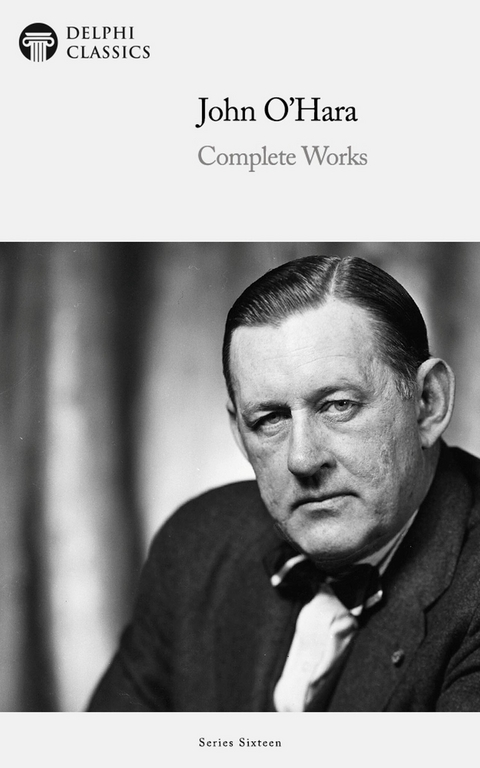
Delphi Complete Works of John O'Hara Illustrated (eBook)
6965 Seiten
Delphi Publishing Ltd (Verlag)
978-1-80170-280-5 (ISBN)

One of America's most prolific writers of short stories, John O'Hara helped develop 'The New Yorker' magazine story style. His large body of works represent a sprawling social history of upwardly mobile Americans from the 1920s through to the 1960s. A best-selling novelist by the age of thirty, he penned such modern masterpieces as 'Appointment in Samarra' and 'BUtterfield 8'. His work won the admiration of Ernest Hemingway, F. Scott Fitzgerald and John Updike. Today, he is recognised by many as one of the most under-appreciated American writers of the twentieth century. For the first time in publishing history, this eBook presents O'Hara's complete fictional works, with numerous illustrations, rare texts, concise introductions and the usual Delphi bonus material. (Version 1)
* Beautifully illustrated with images relating to O'Hara's life and works
* Concise introductions to the major texts
* All 17 novels, with individual contents tables
* Many rare novels appearing for the first time in digital publishing
* Even includes 'The Second Ewings', the unfinished sequel, never digitised before!
* Images of how the books were first published, giving your eReader a taste of the original texts
* Excellent formatting of the texts
* All the short story collections, including the posthumous collections, available in no other collection
* Special chronological and alphabetical contents tables for the short stories
* Easily locate the stories you want to read
* Includes O'Hara's two non-fiction books - available in no other collection
* Ordering of texts into chronological order and genres
CONTENTS:
The Novels
Appointment in Samarra (1934)
BUtterfield 8 (1935)
Hope of Heaven (1938)
Pal Joey (1940)
A Rage to Live (1949)
The Farmers Hotel (1951)
Ten North Frederick (1955)
A Family Party (1956)
From the Terrace (1958)
Ourselves to Know (1960)
The Big Laugh (1962)
Elizabeth Appleton (1963)
The Lockwood Concern (1965)
The Instrument (1967)
Lovey Childs (1969)
The Ewings (1972)
The Second Ewings (1972)
The Short Story Collections
The Doctor's Son and Other Stories (1935)
Files on Parade (1939)
Pipe Night (1945)
Hellbox (1947)
Sermons and Soda Water (1960)
Assembly (1961)
The Cape Cod Lighter (1962)
The Hat on the Bed (1963)
The Horse Knows the Way (1964)
Waiting for Winter (1966)
And Other Stories (1968)
The Time Element and Other Stories (1972)
Good Samaritan and Other Stories (1974)
The Short Stories
List of Short Stories in Chronological Order
List of Short Stories in Alphabetical Order
The Non-Fiction
Sweet and Sour (1954)
My Turn (1966)
2
JULIAN ENGLISH SNAPPED awake, and knew that he had beaten the arrival of Mary, the maid, by one step. He was correct: Mary appeared in the doorway and said: “Mrs. English says it’s eleven o’clock, Mr. English.” In a lower key she add: “Merry Christmas, Mr. English.”
“Merry Christmas, Mary. Did you get your envelope?”
“Yes, sir. Mrs. English give it to me. Thank you very kindly, and my mother says to tell you she made a novena for you and Mrs. English. Shill I close the windows?”
“Yes, will you please?” He lay back until Mary left the room. Such a pretty day. Bright; and there were icicles, actually icicles, hanging in the middle of the windows. With the holly wreath and the curtains they made you think of a Christmas card. It was quiet outside. Gibbsville, the whole world, was resting after the snow. He heard a sound that could mean only one thing; one of the Harley kids next door had a new Flexible Flyer for Christmas, and was trying it out belly-bumpers down the Harley driveway, which was separated from the English driveway only by a two-foot hedge. It would not take long for the room to get warm, so he decided to lie in bed for a few minutes.
There ought to be more days like this, he thought. Slowly, without turning his head, he pulled himself up to a half sitting position and reached out for the package of Lucky Strikes on the table between his bed and Caroline’s bed. Then he remembered to know better than to look in the direction of Caroline’s bed — and looked. He was right again: Caroline had not slept in her bed. Everything returned to him then, as though in a terrible, vibrating sound; like standing too near a big bell and having it suddenly struck without warning. His fingers and his mouth lit a cigarette; they knew how. He was not thinking of a cigarette, for with the ringing of that bell came the hangover feeling and the remorse. It took him a little while, but eventually he remembered the worst thing he had done, and it was plenty bad. He remembered throwing a drink at Harry Reilly, throwing it in his fat, cheap, gross Irish face. So now it was Christmas and peace on earth.
He got out of bed, not caring to wait for warmth and luxury. His feet hit the cold hardwood floor and he stuck his toes in bedroom slippers and made for the bathroom. He had felt physically worse many times, but this was a pretty good hangover. It is a pretty good hangover when you look at yourself in the mirror and can see nothing above the bridge of your nose. You do not see your eyes, nor the condition of your hair. You see your beard, almost hair by hair; and the hair on your chest and the bones that stick up at the base of your neck. You see your pajamas and the lines in your neck, and the stuff on your lower lip that looks as though it might be blood but never is. You first brush your teeth, which is an improvement but leaves something to be desired. Then you try Lavoris and then an Eno’s. By the time you get out of the bathroom you are ready for another cigarette and in urgent need of coffee or a drink, and you wish to God you could afford to have a valet to tie your shoes. You have a hard time getting your feet into your trousers, but you finally make it, having taken just any pair of trousers, the first your hands touched in the closet. But you consider a long, long time before selecting a tie. You stare at the ties; stare and stare at them, and you look down at your thighs to see what color suit you are going to be wearing. Dark gray. Practically any tie will go with a dark gray suit.
Julian finally chose a Spitalsfield, tiny black and white figure, because he was going to wear a starched collar. He was going to wear a starched collar because it was Christmas and he was going to have Christmas dinner with his father and mother at their house. He finally finished dressing and when he saw himself in a full-length glass he still could not quite look himself in the eye, but he knew he looked well otherwise. His black waxed-calf shoes gleamed like patent leather. He put the right things in the right pockets: wallet, watch and chain and gold miniature basketball and Kappa Beta Phi key, two dollars in silver coins, fountain pen, handkerchiefs, cigarette case, leather key purse. He looked at himself again, and wished to God he could go back to bed, but if he should go back to bed he would only think, and he refused to think until after he had had some coffee. He went downstairs, holding on to the banister on the way down.
As he passed the living-room he saw a piled row of packages, obviously gifts, on the table in the middle of the room. But Caroline was not in the room, so he did not stop. He went back to the dining-room and pushed open the swinging-door to the butler’s pantry. “Just some orange juice and coffee, Mary, please,” he said.
“The orange juice is on the table, Mr. English,” she said.
He drank it. It had ice, glorious ice, in it. Mary brought in the coffee and when she had gone he inhaled the steam of it. It was as good as drinking it. He drank some of it black, without sugar, first. He put one lump of sugar in it and drank some more. He put some cream in it and lit a cigarette. “I’d be all right if I could stay here,” he thought. “If I could just stay here for the rest of my life and never see another soul. Except Caroline. I’d have to have Caroline.”
He finished his coffee, took a sip of ice water, and left the dining-room. He was standing in front of the table, with its pile of gifts, when he heard someone stamping on the porch, and almost immediately the door opened and it was Caroline.
“Hello,” she said.
“Hello,” he said. “Merry Christmas.”
“Yeah,” she said.
“I’m sorry,” he said. “Where’ve you been?”
“Took some things to the Harley kids,” she said. She hung up her camel’s hair coat in the closet under the stairs. “Bubbie said to wish you a Merry Christmas and he told me to ask you if you wanted to ride on his new Flexie. I told him I didn’t think you would, this morning.” She sat down and began to unbuckle her arctics. She had beautiful legs that not even the heavy woolen plaid stockings could distort. “Look,” she said.
“I’m looking,” he said.
“Don’t be funny,” she said, and pulled her skirt down. “I want you to listen. This is what I want to say: I think you’d better take that bracelet back to Caldwell’s.”
“Why? Don’t you like it?”
“I like it all right. It’s one of the most beautiful things I’ve ever seen, but you can’t afford it. I know how much it cost.”
“So what?” he said.
“Well, just this. I think we’ll probably need every cent we can save from now on.”
“Why?”
She lit a cigarette. “Well, you fixed it last night. No point in going into why you threw that drink at Harry, but I just want to tell you this much, you’ve made an enemy for life.”
“Oh, no. Naturally he’s sore, but I’ll be able to fix it. I can handle that.”
“That’s what you think. I’ll tell you something. Have you any idea how news travels in this town? Maybe you think you have, but listen to me. I just came from the Harleys’, the only people I’ve seen except Mary since last night, and almost the first thing Herbert Harley said when I got in the house was, ‘Well, I’m glad somebody put Harry Reilly in his place at last.’ Of course I tried to laugh it off as if it were just a joke between you and Harry, but do you realize what that means, Herbert Harley’s knowing about it so soon? It means the story’s got all over town already. Somebody must have told the Harleys over the phone, because I know Herbert hasn’t had his car out. There aren’t any tracks in their driveway.”
“Well, what of it?”
“What of it? You stand there and ask me what of it? Don’t you realize what that means, or are you still drunk? It just means that the whole town knows what you did, and when Harry realizes that, he’ll do anything short of murder to get even with you. And I don’t have to tell you that he won’t have to commit murder to get even with you.” She stood up and smoothed her skirt. “So — I think you’d better take the bracelet back to Caldwell’s.”
“But I want you to have it. I paid for it.”
“They’ll take it back. They know you.”
“I can afford it,” he said.
“No, you can’t,” she said. “Besides, I don’t want it.”
“You mean you don’t want to take it from me?”
She hesitated a moment, and bit her lip and nodded. “Yes. I guess that’s what I mean.”
He went to her and put his hands on her arms. She did not move except to turn her head away from him. “What’s the matter?” he said. “Reilly doesn’t mean anything to you, for God’s sake, does he?”
“No. Not a thing. But you’d never believe that.”
“Oh, ridiculous,” he said. “I never thought you were having an affair with him.”
“Didn’t you? Are you sure you didn’t?” She freed herself. “Maybe you didn’t actually think I was having an affair with him, but part of the time you wondered whether I was. That’s just as bad. And that’s the real reason why you threw the drink in his face.”
“I might have thought you kissed him, but I never thought you were having an affair with him. And the only real reason why I threw a drink in his face was I just happen to dislike him. I can’t stand his stupid Irish face, that’s all. And those stories.”
“His face looked pretty good last summer when you needed money, and by the way, here’s something...
| Erscheint lt. Verlag | 12.12.2025 |
|---|---|
| Reihe/Serie | Delphi Series Sixteen |
| Sprache | englisch |
| Themenwelt | Literatur ► Anthologien |
| Literatur ► Romane / Erzählungen | |
| Schlagworte | Appointment • Butterfield • Frederick • PAL • rage • Stories • Terrace |
| ISBN-10 | 1-80170-280-2 / 1801702802 |
| ISBN-13 | 978-1-80170-280-5 / 9781801702805 |
| Informationen gemäß Produktsicherheitsverordnung (GPSR) | |
| Haben Sie eine Frage zum Produkt? |
 EPUB (Ohne DRM)
Digital Rights Management: ohne DRM
Dieses eBook enthält kein DRM oder Kopierschutz. Eine Weitergabe an Dritte ist jedoch rechtlich nicht zulässig, weil Sie beim Kauf nur die Rechte an der persönlichen Nutzung erwerben.
Dateiformat: EPUB (Electronic Publication)
EPUB ist ein offener Standard für eBooks und eignet sich besonders zur Darstellung von Belletristik und Sachbüchern. Der Fließtext wird dynamisch an die Display- und Schriftgröße angepasst. Auch für mobile Lesegeräte ist EPUB daher gut geeignet.
Systemvoraussetzungen:
PC/Mac: Mit einem PC oder Mac können Sie dieses eBook lesen. Sie benötigen dafür die kostenlose Software Adobe Digital Editions.
eReader: Dieses eBook kann mit (fast) allen eBook-Readern gelesen werden. Mit dem amazon-Kindle ist es aber nicht kompatibel.
Smartphone/Tablet: Egal ob Apple oder Android, dieses eBook können Sie lesen. Sie benötigen dafür eine kostenlose App.
Geräteliste und zusätzliche Hinweise
Buying eBooks from abroad
For tax law reasons we can sell eBooks just within Germany and Switzerland. Regrettably we cannot fulfill eBook-orders from other countries.
aus dem Bereich