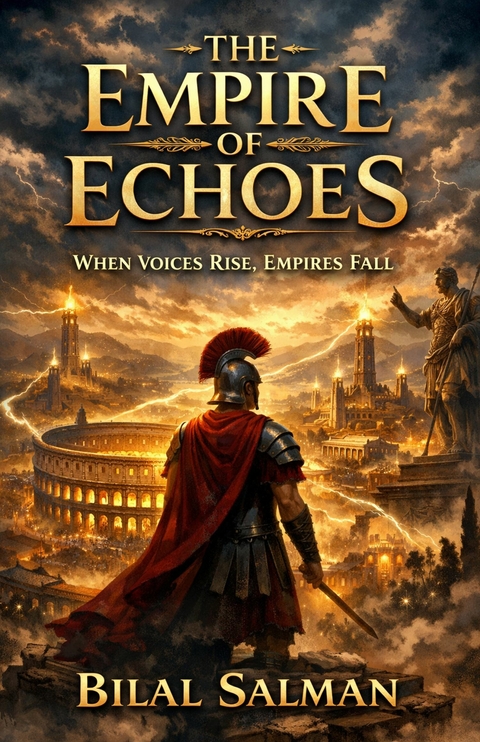
The Empire of Echoes (eBook)
235 Seiten
Publishdrive (Verlag)
978-0-00-112520-9 (ISBN)
Rome was built on silence. Orders flowed downward, whispers died in shadows, and no voice rose higher than the Emperor's. Until one invention changed everything.
Timaeus, a gifted but reluctant inventor, creates the lattice - a web of bronze and crystal that can carry voices across the empire. At first, it is hailed as Rome's greatest triumph, a tool of order and control. But when its echoes fall into the hands of the people, whispers ignite into chants, and chants swell into thunder.
As rebellion spreads through the streets, the fate of an empire hangs in the balance. Caught between guilt and destiny, Timaeus must decide whether his creation will bind Rome in silence forever...or break its chains in fire and blood.
From the smoke of the Subura to the flames of the Colosseum, The Empire of Echoes is a breathtaking alternate history where power is built not on swords, but on sound - and one voice can burn an empire.
Chapter 2
The morning sun rose sharp and gold above the Palatine, flooding the marble courtyards with light so bright it seemed to burn away the shadows of the night before. The palace gardens smelled of laurel and roses, the air fresh with dew, yet beneath the surface calm, the Emperor’s court seethed with purpose. Couriers rushed in and out of the atrium, their sandals slapping against the polished floors, their scrolls sealed with the imperial mark. Artisans bent over tables, carving new casings of bronze, setting crystals into sockets as if assembling weapons for war.
Timaeus watched them with hollow eyes. The invention he had built in secret now multiplied before him, no longer fragile, no longer unique. Dozens of copies stood lined along the walls, their surfaces gleaming, their hum faint but steady, like a hive alive with unseen bees. The Emperor had commanded that every governor, every general, every major city receive one. Messengers would depart that very hour to carry the devices across the empire, guarded by soldiers as though they bore treasure more valuable than gold.
The thought made Timaeus’s skin crawl. His net had been stretched wider in days than he had ever imagined in years. Soon Hispania would hear the Emperor’s voice as swiftly as the Forum did, and the sands of Egypt would tremble with commands spoken in Rome. He could almost feel the world shrinking, its distances folding like parchment. The empire was becoming not a sprawl of provinces held by roads and legions, but a single body, every limb bound to the heart on the Palatine.
The Emperor entered, his purple cloak trailing, the scent of cedar oil clinging to the fabric. His expression was serene, almost godlike, but his eyes burned with restless fire. He stopped before the row of machines and lifted a hand as though blessing them.
“Today,” he declared, his voice carrying easily across the chamber, “Rome ceases to be a city and becomes a soul. No corner of the world shall be silent to me. No governor shall act unseen, no soldier shall march without my knowledge. Through this net, I will bind them all—not with chains, but with voice.”
The courtiers murmured in awe. The Praetorian prefect bowed his head, though his eyes gleamed with calculation. Lucilla, standing among the senators, tilted her face just enough to catch Timaeus’s gaze. Her expression was unreadable, but he felt the weight of her earlier words pressing against his thoughts. Whose voice will Rome obey?
That afternoon, as the couriers departed, the city seemed to hold its breath. Horses stamped impatiently at the gates, their breath steaming in the cool air. The carts rattled with their cargo, bronze and crystal packed in straw, the faint hum vibrating through the wood. Citizens gathered to watch, curiosity lighting their faces. Some cheered, convinced they witnessed the dawn of a miracle. Others whispered uneasily, crossing themselves or muttering prayers to ward off whatever unseen spirit now carried the Emperor’s commands.
By evening, the first reports returned. In Ostia, the port thronged with sailors had stilled when a crystal at the docks spoke in the Emperor’s voice, demanding loyalty and vigilance. In Capua, farmers dropped their tools and stared at a glowing stone set in the marketplace, listening as if Jupiter himself thundered from the heavens. In Sicily, fishermen left their nets half-drawn, salt still stinging their hands, when the Emperor’s command echoed across the square. The empire had spoken, and the provinces had heard.
But not all received it with awe. In a tavern in Gaul, voices rose in anger. “Why should Rome’s words follow us here, across the mountains? Are we not slaves enough without his tongue in our ears?” In the alleys of Jerusalem, murmurs spread that this was no miracle but a curse, a sign that Rome sought to choke even the breath of its conquered peoples. In Germania, a chieftain laughed as the crystal hummed faintly in the governor’s tent. “Your Emperor may speak with thunder,” he sneered, “but thunder fades. The forest does not bow to echoes.”
Timaeus lay awake that night, staring at the ceiling of his chamber in the palace, the air thick with the smell of oil lamps. The faint hum of the devices carried even here, vibrating through the walls, constant, inescapable. He closed his eyes, but his thoughts raced. The Emperor believed he had built chains. But chains could be broken. Voices could slip through cracks, multiply, twist into shapes he had never intended.
He thought of Lucilla, her words precise, her eyes sharp as a blade. He thought of the people gathered at the fountains and markets, their hunger undeniable. He thought of himself, once a dreamer, now caught in a storm he had unleashed.
And as the hum of the machines filled the silence, he felt the first stirrings of dread certainty: the empire had not been united by his invention—it had been unbalanced. And imbalance, in Rome, always ended in blood.
In Antioch, the air was thick with dust and spice, the scent of cinnamon and pepper clinging to the markets that spilled into the wide streets. Camels groaned beneath loads of silk, their hooves clattering against stone. Traders shouted in a dozen tongues, their cries blending with the sharp ring of hammered bronze. It was a city alive with noise, a city that had always felt far from Rome’s grasp, until now.
The governor stood in his hall, draped in robes too heavy for the heat, sweat beading on his brow as he leaned over the new device. The crystal glowed faintly, its hum restless in the stifling air. He had listened dutifully to the Emperor’s voice earlier that day, words echoing across the hall while his guards stared in awe. Loyalty, obedience, Rome united as one. Fine words. But as the crystal pulsed, he realized what it meant: Rome could speak, yes, but so could he.
He lowered his voice into the mouthpiece, testing it like a man running his fingers over the edge of a new blade. His words traveled outward, not as proclamation but as a whisper, seeded carefully in the markets. By evening, men repeated what they had heard. “The Emperor demands higher taxes,” one merchant swore. “He needs more grain, more gold, more labor.” Another nodded, insisting he had heard it himself, that Rome was tightening its grip. Resentment stirred, subtle but sharp. The governor smiled in the shadows, pleased with the precision of his deceit.
Timaeus received word of these rumors days later, though the net itself carried them faster than couriers ever could. He sat in his workshop within the palace, scrolls strewn across the table, the air sharp with the smell of heated bronze. Reports came in fragments, yet the pattern was clear. The Emperor had spoken once, but the people had begun to hear voices that were not his. Already the net twisted with contradictions—commands that bent, words that warped, truth entangled with lies.
He pressed his palms against his eyes, exhaustion clawing at him. This was exactly what he had feared: that the invention would not unite but multiply chaos. He had dreamed of knowledge, of connection, yet what spread now was distortion. The empire was not listening to Rome—it was listening to itself, a thousand voices tumbling over one another, impossible to silence.
The Emperor entered without warning, his presence filling the chamber like a storm. His cloak swept across the floor, the scent of cedar oil and iron following him. His eyes burned with fury, though his voice remained calm, the calm of a man who had learned that true power did not need to shout.
“There are lies,” he said, his hand resting on the crystal as if to steady himself. “In Antioch, they say I demand more grain. In Gaul, they whisper that I prepare for war against Germania. Even here in Rome, rumors crawl like rats through the Subura. Your invention carries my words faster than any courier—but it carries theirs just as swiftly.”
Timaeus’s chest tightened. “Caesar, I warned—”
“You warned nothing,” the Emperor cut in, his gaze sharp enough to slice through stone. “You built this net, and now you will master it. I want filters. I want control. I want a way to silence lies before they are spoken. If this invention cannot be bent to my will, then it is no invention—it is treachery.”
The words stung. Timaeus bowed his head, though his thoughts churned. How could he cage voices once loosed into the world? They would slip through cracks, spread through alleys, hide in whispers. To silence them all would mean silencing the people themselves.
Later that night, Lucilla’s servant found him again, slipping into the workshop like smoke. The man carried no torch, only a whispered message: The Senator knows what troubles you. The Emperor cannot control the net. But perhaps together, we can.
Timaeus sat in the dim glow of the crystals, the air humming, the smell of hot bronze sharp in his nose. His heart pounded with the weight of choice. The Emperor demanded silence. Lucilla offered balance. And he—caught between lightning and storm—knew that whichever path he chose would shape not only his fate, but the fate of Rome itself.
The Subura, Rome’s sprawling slum, was alive with the stench of humanity. The narrow streets reeked of sweat, spilled wine, and the sour bite of rotting fish. Smoke from cheap braziers curled into the night, blending with the sharp tang of urine in the gutters. Yet beneath the filth and chaos, there was energy, restless and pulsing, a hunger that never slept.
At the heart of one crooked square, a crystal glowed atop a stolen pedestal, faint but steady, its hum vibrating through the stones. It had been...
| Erscheint lt. Verlag | 18.12.2025 |
|---|---|
| Sprache | englisch |
| Themenwelt | Literatur ► Historische Romane |
| ISBN-10 | 0-00-112520-6 / 0001125206 |
| ISBN-13 | 978-0-00-112520-9 / 9780001125209 |
| Informationen gemäß Produktsicherheitsverordnung (GPSR) | |
| Haben Sie eine Frage zum Produkt? |
 EPUB (Adobe DRM)
Größe: 2,3 MB
Kopierschutz: Adobe-DRM
Adobe-DRM ist ein Kopierschutz, der das eBook vor Mißbrauch schützen soll. Dabei wird das eBook bereits beim Download auf Ihre persönliche Adobe-ID autorisiert. Lesen können Sie das eBook dann nur auf den Geräten, welche ebenfalls auf Ihre Adobe-ID registriert sind.
Details zum Adobe-DRM
Dateiformat: EPUB (Electronic Publication)
EPUB ist ein offener Standard für eBooks und eignet sich besonders zur Darstellung von Belletristik und Sachbüchern. Der Fließtext wird dynamisch an die Display- und Schriftgröße angepasst. Auch für mobile Lesegeräte ist EPUB daher gut geeignet.
Systemvoraussetzungen:
PC/Mac: Mit einem PC oder Mac können Sie dieses eBook lesen. Sie benötigen eine
eReader: Dieses eBook kann mit (fast) allen eBook-Readern gelesen werden. Mit dem amazon-Kindle ist es aber nicht kompatibel.
Smartphone/Tablet: Egal ob Apple oder Android, dieses eBook können Sie lesen. Sie benötigen eine
Geräteliste und zusätzliche Hinweise
Buying eBooks from abroad
For tax law reasons we can sell eBooks just within Germany and Switzerland. Regrettably we cannot fulfill eBook-orders from other countries.
aus dem Bereich