


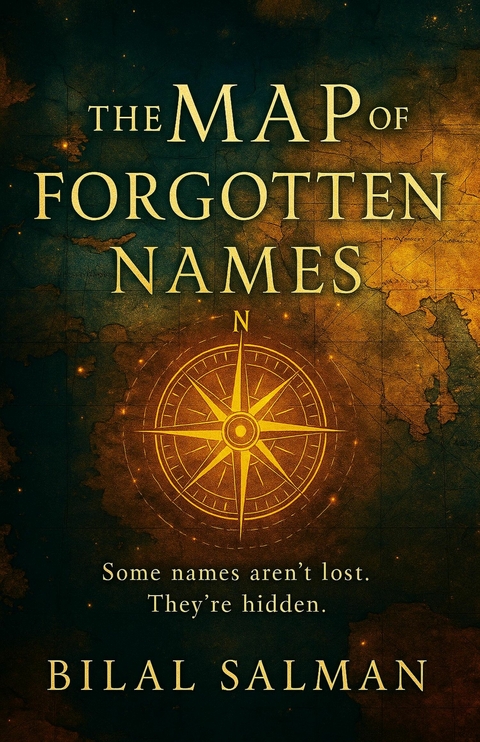
The Map of Forgotten Names (eBook)
220 Seiten
Publishdrive (Verlag)
978-0-00-112339-7 (ISBN)
There are places that disappear without a sound-not because they're destroyed, but because they're erased.
Samuel Hassan finds a notebook on his doorstep that redraws the world. Names vanish from memory. Streets fade. And now, his own identity is slipping away.
To survive, he must remember a town no one else believes existed. A girl no one can name. And a map sewn into skin that leads to a place erased from every record-except his.
The Map of Forgotten Names is a haunting literary thriller about memory, identity, and the high cost of being remembered. Perfect for fans of The Midnight Library, Dark Matter, and The Shadow of the Wind.
Chapter 1
She woke to the sound of ticking.
It wasn’t the clean tick of a clock hung on the wall, but something deeper, slower, as if it came from inside her chest—or beneath the iron bed—echoing through stone and silence. The rhythm carried weight, each beat stretching long enough to unsettle, too measured to belong to any ordinary timepiece.
The room was dim, though not entirely dark. A candle flickered somewhere in the corner, its flame a fragile bloom fighting the cold air. The light danced across high stone walls, revealing the shapes of maps pinned and layered over one another until the room itself looked stitched together by cartography. The edges curled from dampness, the ink of rivers bled outward like veins under diseased skin, and whole forests had been chewed through by rats or erased by time. The scent of mold mixed with faint wax and something metallic, like rusted iron.
Her breath came shallow, as though the air had been stored too long, used by too many lungs before hers. Her chest ached with every inhale, and her tongue was so dry it felt like it might splinter. She blinked slowly, her lashes sticking together, her limbs weighed down as if she had walked for days without sleep. Her fingers wouldn’t quite close. Her legs resisted bending. Not paralysis—something heavier, exhaustion pressed into her muscles like stone.
The bed beneath her was iron-framed, stiff, and it smelled faintly of rust. Her thin nightgown scratched against her skin like an irritant. She shifted, and something tugged at her arms.
Bandages.
White cloth wound tight from wrist to elbow. Not the thick, hurried wrapping of an accident, but deliberate, precise, as if every line of fabric had been placed with intent. Beneath the gauze her skin throbbed, bruised and raw, the memory of pain without its cause. A flicker of panic rose, swelling sharp in her throat.
She didn’t know where she was.
She didn’t know who she was.
Her mouth moved before her voice obeyed. The sound that emerged was no more than a rasp, brittle and broken. She tried again, but her throat caught, scratching like paper.
The candle’s light trembled.
A door stood across the room, iron-handled, framed in shadows. Before she could call out—before she could even try—footsteps whispered down the hallway. Not rushed. Not hesitant. Calm. The handle turned.
The door opened.
A man entered. His movements were quiet, controlled, the kind of silence that belonged to someone practiced in listening. He was tall, middle-aged, his coat falling to his knees. A short-trimmed beard, gray against a pale face, framed a jaw as sharp as stone. His gloves caught the candlelight, smooth leather that creaked faintly when his hands moved. His eyes swept over the maps first, cataloguing them like a librarian checking for missing volumes, before resting on her.
“You’re awake,” he said. The words carried neither relief nor surprise.
Her lips cracked as she tried again. This time her voice reached him. “Where am I?”
He didn’t answer immediately. Instead, he stepped aside, allowing a younger woman to enter behind him. She carried a metal basin steaming with the scent of mint leaves and something sharper, sterile, like alcohol. Her nurse’s apron was clean but worn thin from use. Her eyes darted to the bed, then quickly away, as though looking too long at the girl might draw her into something forbidden.
“You’re safe,” the man said at last. His tone was steady, too steady. “This is the Waldhaus Institute. A private facility.”
The words carried no meaning to her. Waldhaus. Institute. A foreign language pressed against her empty mind.
“For what?” she asked.
“Rest,” he replied. “Recovery.”
Her throat tightened. “From what?”
The man didn’t answer. He gestured instead to the nurse, who approached with the basin. She filled a cup, lifting it to the girl’s lips. The water was warm, laced with bitterness that coated her tongue, leaving an aftertaste that did not belong to herbs alone. She swallowed reluctantly, her body craving it even as her mind recoiled.
When the cup lowered, she whispered, “Why am I bandaged?”
The man stepped closer, his shadow merging with the candlelight. “Let me show you.”
With practiced care, he unwrapped the cloth from her arm. The fabric tugged against skin not fully healed, and she winced. Beneath the gauze, the truth was revealed: faint lines carved into flesh, darkened like ink sunken into veins. They weren’t random scratches. They weren’t wounds.
They were a pattern.
A map.
Her breath stopped. The markings curved over the bend of her elbow, winding toward her wrist—roads, rivers, elevations etched like tattoos she had never chosen. The sight filled her with both recognition and dread, as though her body remembered something her mind could not.
She whispered, “What is this?”
The man’s gaze lingered on the markings before rising to her face. “We were hoping you’d tell us.”
Her pulse quickened. “I don’t understand.”
“You arrived six nights ago,” he explained. “Barefoot. Through the woods. No papers. No coat. You collapsed outside the east gate.”
She shook her head. “I don’t remember.”
“We didn’t expect you to,” he said evenly. “You were delirious when we found you. Bleeding from the arms. No identification. You’ve been unconscious since.”
“Then how do you know I’m not… dangerous?”
He held her gaze, calm as stone. “We don’t.”
The words hollowed her chest. She stared, waiting for reassurance, for kindness, for anything human to crack his composure. None came.
From his coat he drew a folded page. The parchment cracked softly as he opened it, revealing a hand-drawn map. Every curve, every bend, every village marked in black ink matched the one etched into her skin. Identical. Even the name scrawled in the corner: Waldstein.
Her stomach clenched. The name struck something deep, not memory but instinct, like a bell tolling inside her. She didn’t know why it mattered—only that it did.
“I don’t know this place,” she said, though her voice trembled with doubt.
“No one does,” the man replied. “Not anymore.”
He folded the page with slow precision, slipping it back into his coat. The nurse froze by the basin, her trembling hands betraying her silence.
“You spoke that word in your sleep,” the man said. “The first night. You whispered it again and again.”
“That doesn’t mean anything,” she whispered.
“To us, it does.”
He turned toward the door.
“Wait,” she called, heart thudding against her ribs. “What’s my name?”
He paused in the doorway, his back to her.
“You had no identification. No one has claimed you. But you repeated one name, very softly, before you fell unconscious again.”
Her throat burned. “What name?”
He looked back, his eyes sharp but unreadable.
“Isadora.”
She frowned. “That could be anyone.”
He nodded. “Yes. It could.”
He stepped into the hall.
“I never told you my name,” she said, louder this time.
“No,” he replied, glancing back. “You didn’t.”
Then the door closed, the sound final.
The ticking began again. Louder. Or closer.
The air in the corridor was colder than the room she had left behind. It pressed against her skin with a damp weight, carrying the faint metallic tang of rust and something sourer, like boiled medicine left too long in its cup. The nurse who had stayed behind with the basin hadn’t followed. Isadora was alone again, the silence stretching down the hallway like a rope waiting to tighten.
Every step she took seemed louder than it should have, the soles of her boots striking stone with sharp, echoing finality. Her hand brushed the wall for balance, fingertips trailing across cracks and chipped plaster. She still clutched the folder they had left her—no, not left. Placed. Prepared. Everything about this place felt staged, as if every word spoken and every door opened had been rehearsed long before she arrived.
The photo inside the file haunted her more than the bandages, more than the map burned into her flesh. A girl’s face. Pale skin. Light eyes. A smile that didn’t quite belong. The caption below had called her Isadora Voss.
It wasn’t her.
The resemblance was close enough to unsettle, but the differences carved deep. The curve of the jaw, the slope of the nose, the delicate turn of the mouth—each almost hers, but not. As though someone had taken her reflection and redrawn it with a steadier hand, smoothing the flaws, creating a version of her she couldn’t recognize but couldn’t entirely deny.
That was the part that chilled her most. It wasn’t that the picture looked like someone else. It was that it almost looked like her.
The letter had been worse. The signature—Isadora Voss—written in graceful loops that weren’t hers. She could still see the elegant curl of the “s” in her mind, the neat way the “I” hooked downward. She had never written like that. She had never given consent to be here. And yet the letter, calm and careful, had claimed she had agreed to her own confinement.
Her hand tightened around the folder until the cardboard creaked.
They wanted her to believe this identity belonged to her.
But she couldn’t let it.
At the end of the corridor, a faint sound scraped the silence—metal against stone....
| Erscheint lt. Verlag | 15.12.2025 |
|---|---|
| Sprache | englisch |
| Themenwelt | Literatur ► Krimi / Thriller / Horror |
| ISBN-10 | 0-00-112339-4 / 0001123394 |
| ISBN-13 | 978-0-00-112339-7 / 9780001123397 |
| Informationen gemäß Produktsicherheitsverordnung (GPSR) | |
| Haben Sie eine Frage zum Produkt? |
 EPUB (Adobe DRM)
Größe: 1,4 MB
Kopierschutz: Adobe-DRM
Adobe-DRM ist ein Kopierschutz, der das eBook vor Mißbrauch schützen soll. Dabei wird das eBook bereits beim Download auf Ihre persönliche Adobe-ID autorisiert. Lesen können Sie das eBook dann nur auf den Geräten, welche ebenfalls auf Ihre Adobe-ID registriert sind.
Details zum Adobe-DRM
Dateiformat: EPUB (Electronic Publication)
EPUB ist ein offener Standard für eBooks und eignet sich besonders zur Darstellung von Belletristik und Sachbüchern. Der Fließtext wird dynamisch an die Display- und Schriftgröße angepasst. Auch für mobile Lesegeräte ist EPUB daher gut geeignet.
Systemvoraussetzungen:
PC/Mac: Mit einem PC oder Mac können Sie dieses eBook lesen. Sie benötigen eine
eReader: Dieses eBook kann mit (fast) allen eBook-Readern gelesen werden. Mit dem amazon-Kindle ist es aber nicht kompatibel.
Smartphone/Tablet: Egal ob Apple oder Android, dieses eBook können Sie lesen. Sie benötigen eine
Geräteliste und zusätzliche Hinweise
Buying eBooks from abroad
For tax law reasons we can sell eBooks just within Germany and Switzerland. Regrettably we cannot fulfill eBook-orders from other countries.
aus dem Bereich


