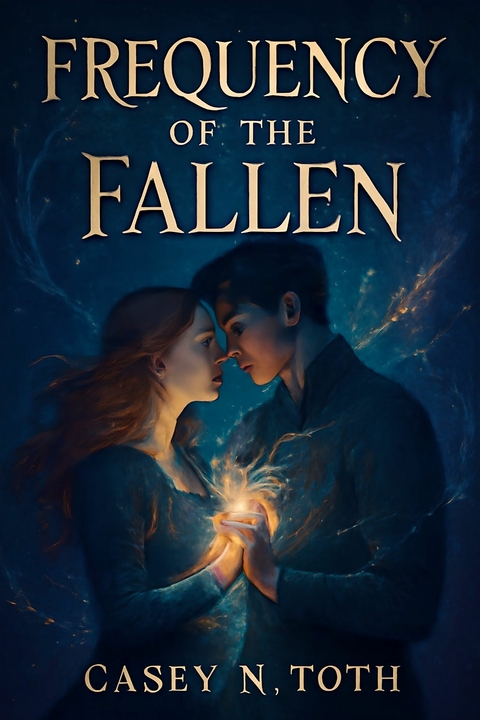
Frequency of the Fallen (eBook)
868 Seiten
Publishdrive (Verlag)
978-0-00-112117-1 (ISBN)
Riven has always been attuned to the pulse of the universe, but when she forms an intimate connection with Kade, the resonance between them unlocks a force capable of saving or destroying the world. As the Entropic Harmonic threatens to collapse reality itself, Riven and Kade's bond becomes the only thing standing between salvation and utter destruction. With a combination of love, sacrifice, and the mysterious science of resonance, they must navigate a path where every choice risks their lives and their future together. Resonance is a breathtaking Romantasy where the stakes are nothing less than the very fabric of existence-and the bond between two souls who refuse to let go.
Chapter 1 Ghost Static
The studio lights glowed with a low, steady fluorescence, the kind of wash that made the concrete walls feel like the inside of a machine. Outside, the city exhaled its last sigh of daylight; amber streetlamps bled through the slatted blinds, turning the room into a thin slice of twilight. Riven Hale sat alone at the central console, shoulders hunched over a bank of monitors that flickered with spectrograms and waveforms like nervous heartbeats. The day’s recordings—hours of traffic, distant sirens, the perpetual murmur of a metropolis that never truly slept—lined the digital queue, waiting for her to strip away the layers of noise that hid whatever useful signal lay beneath.
She had been at this for twelve hours, the minutes blurring into a continuous loop of clicks, scrolls, and the occasional sip of bitter coffee that tasted more like a promise than a comfort. Fatigue pressed against her temples, a dull ache that threatened to drown out the finer details she prided herself on hearing. Yet even in that state her ears remained hyper-attentive, tuned to the subtlest shifts in frequency. She had learned early on that the world spoke in a spectrum of vibrations, and if she could listen closely enough the hidden stories would reveal themselves. The memory of her first field-recording—a deserted subway tunnel where a single drip of water turned into a symphony of echo—still lingered in the back of her mind, a reminder that even the most mundane sound could carry a secret.
The routine cleanup began with a soft click, the software launching its automated filter cascade. Riven watched the waveform scroll across the screen, the familiar rise and fall of urban sound—engine revs, the hiss of pneumatic brakes, the occasional laugh of a passerby—being peeled away layer by layer. She half-listened to the ambient cityscape that still leaked through the filters: the distant drone of a train on a far-off track, the faint echo of a street musician’s chord. Her mind drifted, cataloguing each removed artifact with the detached precision of a scientist who trusted data above intuition. She noted the frequency bands she was eliminating—60 Hz hum from the building’s old transformers, the 1 kHz chatter of a nearby construction site, the 3–5 kHz hiss of distant traffic. In the back of her head a mental checklist ticked off each category, a ritual that kept her grounded when the hours stretched thin.
Then, in the middle of a monotonous stretch of flat baseline, a thin spike flashed on the spectrogram. It was a line so narrow it seemed to cut through the sea of gray, its amplitude modest—just enough to rise above the background hiss but not enough to scream of a malfunction. It repeated at regular intervals, each pulse identical to the last, a perfect cadence that no random urban noise could sustain. Riven’s eyes narrowed. The spike was too regular to be a stray car horn, too soft to be a faulty microphone. It was, in that moment, a question posed in pure tone.
She rewound the timeline, dragging the cursor back to the moment before the spike emerged. The waveform stretched under her fingers like a taut string, and she isolated the fragment, cutting it out and looping it on a separate track. The software obeyed, and the spike sang its solitary note on repeat. The sound that emerged was not a harsh click but a soft thud—thud-thud—each pulse spaced by a breath, each beat slightly off the metronomic precision of a clock. It felt like a heartbeat trying to match a rhythm it did not belong to, a pulse that stumbled just enough to be unsettling. The thud resonated in her chest, a low vibration that seemed to echo the rhythm of her own pulse, as if the recording were trying to sync with her body.
Riven leaned forward, elbows resting on the cool metal of the console, and increased the gain. The thuds grew louder, each one resonating through the room’s acoustic panels, vibrating the very air. As the volume rose, a subtle shift occurred. The familiar hum of the air-conditioning unit seemed to recede, the walls that had always felt like a static backdrop now pressed inward, as if the sound itself were a tide pulling the space toward a center point. The air grew heavier in her lungs, each inhalation a little more labored, the temperature dropping a fraction as the studio’s atmosphere contracted around her. She felt a pressure on the back of her neck, a faint tightening that made the hair on her arms stand up.
A sudden, needle-sharp spike of static ripped through the loop, a high-frequency screech that cut the thuds like a blade. Instinctively, Riven flinched, her hand jerking up to yank off the left earcup of her headphones. The plastic snapped, and the sudden loss of insulation sent a hiss of static cascading from the speakers, a white noise that filled the room for a heartbeat before collapsing into a low, trembling hum. The hum was not just electronic; it carried a texture, a vibration that seemed to pulse in sync with the thuds, as if the two were locked in a secret conversation. She could feel the low frequency reverberate through the desk, through the metal legs of her chair, through the soles of her shoes.
Beneath that hum, something else breathed. A soft exhalation, unmistakably human, slipped through the static. It lingered longer than a sigh, edged with a tremor that vibrated with an emotion Riven could not yet name. The breath was fragile, as if the speaker itself were holding its own lungs, yet it bore a weight that pressed against her chest, a gravity that seemed to come from somewhere far beyond the studio walls. The timbre hinted at a throat strained by cold or by holding back words; it pulsed in time with the thuds, a counter-rhythm that made the whole loop feel like a living organism.
Riven froze, the headset dangling from one ear, the other exposed to the room’s ambient silence. Her mind raced through the catalog of possible explanations. A faulty DAC could produce a glitch, a corrupted file could embed an unintended sample, perhaps a stray transmission from a nearby radio tower had leaked into the recording. She imagined a prank—a hidden voice track left by a colleague for amusement. Each hypothesis slid into place and then fell away, unable to account for the intimate quality of the breath, the way the thuds seemed to align with her own pulse, the way the sound made the room feel as though it were wrapping around her like a hand. She thought of the old urban legend among field-recordists about “the whispering tunnel,” a myth that claimed abandoned spaces retained a memory of the people who once passed through them, replaying their sighs when the right frequency was coaxed out.
She pressed play again, the loop restarting with the soft thud that now felt like a heartbeat echoing her own. She leaned closer, the edge of the monitor brushing her cheek, the glow of the spectrogram painting shadows across her eyes. The thuds resonated through the floorboards, through the chair, through the marrow in her fingers. Her own heart hammered in her throat, a rhythm that matched the irregular pulse on the screen. The breath rose and fell in the background, a silent whisper that seemed to be speaking directly to her, though no words formed. She could almost taste the metallic tang of the exhalation, as if it were being breathed into the very air of the studio.
With each repetition, the rational part of her mind receded, replaced by a quiet, irrational certainty that grew louder than the static. The sound was not random; it was a call, a signal sent across a distance she could not yet comprehend. It was as if someone—somewhere—had tuned their own frequency to hers, threading a fragile line through the entropic fabric of the world. The thought lodged itself in the pit of her stomach, a seed of both dread and hope, and she felt the studio’s walls pulse in response, as if acknowledging the presence she could now sense but not see. She imagined the signal as a thin filament of light, stretching from the concrete of the city to some hidden place beneath the streets, perhaps a forgotten bunker or an abandoned subway platform where a voice had been left behind, waiting for a listener.
Riven’s breath caught, and she let the loop run, the thuds and the exhalation weaving together into a fragile melody. She felt the weight of the moment settle, a pressure that was not fear but an awareness that the world she had always measured in decibels and Hertz was suddenly larger, more intimate. The studio, once a sanctuary of controlled sound, now hummed with a presence that seemed to be reaching out, a hand made of frequency and feeling, stretching across the void. She imagined the hand as translucent, its fingers composed of sine waves, gently brushing the back of her neck, sending a shiver that traveled down her spine.
She did not know who—or what—was on the other side of the signal, but the certainty that she was no longer alone in the silence was enough to make the fatigue in her bones shift into a restless anticipation. The thud-thud continued, steady and imperfect, a heartbeat that was no longer solely her own. As the loop faded into a low, trembling hiss, Riven felt a tremor of something she could only describe as yearning, a quiet invitation to listen deeper, to follow the sound beyond the confines of her lab, beyond the limits of her own perception. She imagined stepping out of the studio, following the thud through the city’s veins, down alleys where the concrete seemed to pulse in time with the rhythm she now carried inside her.
The night outside deepened, the city lights flickering like distant stars, and the studio’s walls seemed to pulse in time with the lingering echo. Riven pressed a hand to the console, feeling the faint...
| Erscheint lt. Verlag | 4.12.2025 |
|---|---|
| Sprache | englisch |
| Themenwelt | Literatur ► Romane / Erzählungen |
| ISBN-10 | 0-00-112117-0 / 0001121170 |
| ISBN-13 | 978-0-00-112117-1 / 9780001121171 |
| Informationen gemäß Produktsicherheitsverordnung (GPSR) | |
| Haben Sie eine Frage zum Produkt? |
 EPUB (Adobe DRM)
Größe: 1,3 MB
Kopierschutz: Adobe-DRM
Adobe-DRM ist ein Kopierschutz, der das eBook vor Mißbrauch schützen soll. Dabei wird das eBook bereits beim Download auf Ihre persönliche Adobe-ID autorisiert. Lesen können Sie das eBook dann nur auf den Geräten, welche ebenfalls auf Ihre Adobe-ID registriert sind.
Details zum Adobe-DRM
Dateiformat: EPUB (Electronic Publication)
EPUB ist ein offener Standard für eBooks und eignet sich besonders zur Darstellung von Belletristik und Sachbüchern. Der Fließtext wird dynamisch an die Display- und Schriftgröße angepasst. Auch für mobile Lesegeräte ist EPUB daher gut geeignet.
Systemvoraussetzungen:
PC/Mac: Mit einem PC oder Mac können Sie dieses eBook lesen. Sie benötigen eine
eReader: Dieses eBook kann mit (fast) allen eBook-Readern gelesen werden. Mit dem amazon-Kindle ist es aber nicht kompatibel.
Smartphone/Tablet: Egal ob Apple oder Android, dieses eBook können Sie lesen. Sie benötigen eine
Geräteliste und zusätzliche Hinweise
Buying eBooks from abroad
For tax law reasons we can sell eBooks just within Germany and Switzerland. Regrettably we cannot fulfill eBook-orders from other countries.
aus dem Bereich