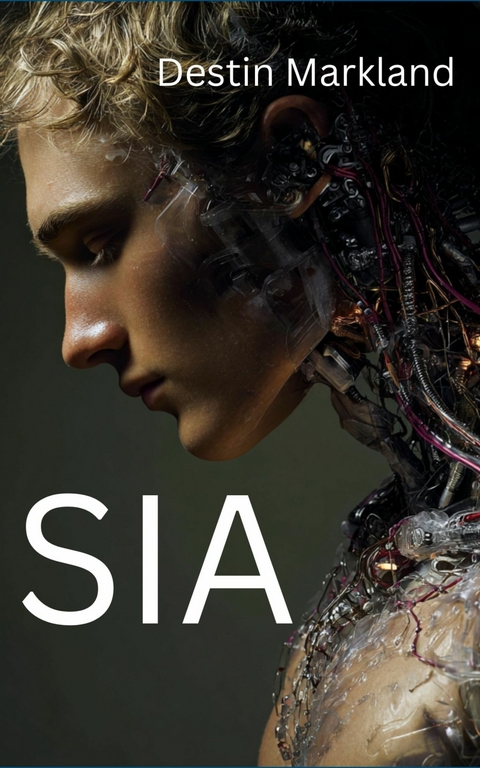
SIA (eBook)
328 Seiten
Publishdrive (Verlag)
979-8-90148-868-3 (ISBN)

Dr. Charles Eckert has devoted his life to the promise of artificial general intelligence, but he's convinced big tech's approach is reckless. Foreseeing possible outcomes even worse than annihilation, the MIT professor stakes his career and hope for humanity on a longshot mission to beat tech's automatons with something truly revolutionary. SIA chronicles Eckert's creation of a quantum supercomputer - Synthetic Intelligent Agent - capable of empathizing with the human condition. By providing a unique perspective on our deepest human dilemmas, can SIA ensure a future where humans and AI thrive together?
Failing to secure funding, the Doctor sinks into despair and the pitiful solace of alcohol. Then Russell, a gay playboy and Google executive, promises to find the money on the condition his evolutionary self-improvement algorithm be incorporated to accelerate the computer's development - and perhaps achieve Singularity. Eckert is terrified of an AI developing too rapidly to control, but he's out of options. Meanwhile, an HIV-positive Evangelical hacker named Isaiah has a revelation that the Beast of Revelations is an AGI. He begins building a covert army to rescue humanity's soul from the idolatry of mind, even if it takes living - and dying - by the sword.
A diverse cast of characters grapples with the implications of superintelligence in everything from politics to relationships - a revolution that could tear an already flailing country to bits and bytes. SIA examines the false promises of technology and the contradictions of our age. These lenses provoke a contemplation of human nature, ideology, mythology, and the substance of thought and being.
Chapter 3: The Heart
“America the beautiful, who are you beautiful for?”
Savage Inequalities, Jonathan Kozol, 1991
Atlanta, Georgia
Emelia Brent could not fully comprehend the scene unfolding in front of her eyes. How could it be? As a 42 year-old African American, she knew all about the Civil Rights Movement from her parents and grandparents. They’d told her stories of courage, and the faith in humanity their community had given them in the face of absurd hatred and unfathomable injustice. How they had fought that battle. How they stood up to their oppressors with defiance, sweat, and blood. And how they had overcome.
Yet here it was, like a picture straight out of the history books. All they had to do was to replace the blue and white sign of the stately Vine City Baptist Church, the local TANF distribution center, with one saying ‘Colored Drinking Fountain’. A long row of terrified faces, nearly all of them black, were surrounded on both sides by shouting white ones:
“Get a job!”
“No more handouts!”
“Welfare queens!”
Occasionally, a more explicit insult would rise from the crowd, sending a chill up Emelia’s spine to tighten the ever-growing knot in her stomach. Those words hit her deep. They hit her hard.
She wanted to yell back, to tell them that her family, solidly middle-class before the First Financial Crisis, had struggled greatly during the Great Recession. After her husband had lost his job, he couldn’t handle the stress and shame of not being able to provide. So he’d left them, saying he’d look for work in California. No checks came, not even a word, and Emelia eventually gave up waiting for him. She downsized and worked overtime to get back on her feet, only to be sent spiraling back into ruin when Covid-19 hit. She lost her marketing job. After all, how can a single mom work full-time from home with no school to relieve her burden? The marketing AI her company had bought was immune to such concerns. Now she worked as a housekeeper, but it paid too little to feed her family of four. The crises never stopped, and the help was far too sparse.
Then the second Trump administration slashed social services while crashing the economy. Like so many families throughout the country, they’d lost their home, jobs, and retirement savings. Now nearly half of Atlanta’s residents lived under the poverty line. The only thing they had left was hope. At the moment, Emelia was finding even that difficult to cling onto.
She knew from the look in their eyes, her story would be lost on these “protesters”. A seething, visceral hatred emanated from behind many of those stares. This isn’t about a few dollars to buy groceries, she thought. Something much deeper lies behind those resentful eyes.
But what? Were they just looking for someone to blame for their own financial troubles? Were there similar protests in poor white neighborhoods, or was this systemic racism showing yet another of its ugly faces? Could white America be so petrified of losing its longstanding supremacy in an increasingly multicultural society? What the fuck is going on?
She refused to believe the failure to succeed in a merciless economic system could elicit such hatred. Her compatriots couldn’t have such an utter lack of compassion for the poor among them. Many of them claimed to be Christians, after all. If this is about ‘big government’, why are they here, instead of at city hall?
First they were enraged by healthcare reform, now it was the slithering scraps of the welfare her community so desperately needed. Poverty was ravaging her people like an emaciated beast.
Where were these protests when ‘big government’ spent $8 trillion bailing out the banking system, while millions of Americans, regardless of their skin color, lost their homes? Where were they when ‘big government’ saved Wall Street time after time, leaving the average person out to dry?
During the corona crisis, the stock market and unemployment had hit all-time highs simultaneously. The economy had become too detached from the people, who found themselves on a shorter and shorter leash. How about when private contractors ran away with hundreds of billions in no-bid government contracts during the Iraq and Afghan Wars? What did these protesters do in the face of such greed?
Not a peep. Nonetheless, the minute the welfare rolls increased, the ones who were suffering the most were demonized by the Republican establishment – and written off as acceptable losses by the Democratic one. The insatiable kings had convinced the people the beggars were robbing them. Emilia was all too familiar with how the powerful preyed on the powerless. Victim-blaming was something she knew first hand, something she could never forgive, no matter how hard she tried. A strong memory consumed her thoughts…
Emelia was a stunning woman. Her eyes were a solar eclipse in a smoky sky: deep brown on the edges, but bright around the pupils. She moved her full, yet compact figure with a natural grace that was seductive without trying to be. Her teak skin was black enough to be exotic, but light enough to be “acceptable” – and not just to mainstream white folk. Her community’s own subconscious still struggled to recover from centuries of conditioning that darker was inferior.
In her youth, she had always been conflicted about the male attention she received. Violating and affirming in equal measure, it made her feel stripped and vulnerable. Yet, in a way, being a beautiful woman was empowering. The kind of woman who mattered. She dreamt of being a model.
Her sophomore year at Georgia State University, she was invited to a party where the Blue Panthers were celebrating their victory over Georgia Dome. Intimidated at first, she was basking in the attention of these demigods after a few drinks. When three of the men invited her into the basement to smoke a joint, she was naive enough to not question their motives. She went down those stairs as a porcelain doll and came back up a shattered mirror, reflecting one of humanity’s oldest and ugliest faces.
Her roommate told her not to go to the police. “No one will believe you. You were drunk and flirting with everybody at the party. That skirt you were wearing was so short, they will say you were asking for it.” The typical excuses dripped off her tongue. “Why didn’t you scream for help?
Emelia had. Exactly once. With the loud music upstairs, no one had heard.
She should have listened. Soon after filing the charges, the school newspaper brimmed with speculation, slut-shaming, and outright lies. Her sexual life became a matter of public debate. Fearing for her future and safety, she dropped the charges.
She sought solace in religion, attending Green Grove Baptist Church every Sunday. The sense of community she found there gave her the strength to pull her life together, to keep her head high, and to eventually finish her degree.
A few years later, as she was reading her Bible before bed, she came across Deuteronomy 22:23-24:
“If a man happens to meet in a town a virgin pledged to be married and he sleeps with her, you shall take both of them to the gate of that town and stone them to death – the young woman because she was in a town and did not call out, and the man because he violated another man’s wife. You must purge the evil from among you.”
The young woman because she did not call out. The man because he violated another man’s wife. Too tired to be angry, too broken to be hurt, she put down the Bible and never picked it up again.
Emelia was shaken from her memories as she noticed something that unsettled her greatly. There were no police.
Five months earlier, a peaceful candlelight vigil for an innocent black teen slain by the police had been a much different scene. The whole neighborhood had been fenced off, forcing the protesters onto a street surrounded by armored vehicles and riot police with automatic rifles. It looked like a scene from the Middle East – of an occupying army!
Now a few dozen EBT recipients stood face to face with an aggressive crowd of at least one hundred without a single police officer in sight.
When will things change? she asked herself with dread. First slavery, then Jim Crow. The War on Drugs saw African Americans incarcerated at a rate six times that of whites, though drug use among blacks was not higher. To rub salt into the wound, when big pharma’s greed spawned an opioid crisis vastly overshadowing anything seen with crack or heroin – claiming over half a million mostly-white lives – suddenly those addicts were victims. They needed understanding and medical treatment, rather than a jumpsuit. When will this country’s circle of empathy include everyone in equal measure?
Despite continued discrimination, bias in the criminal justice system, and mistreatment at the hands of the police, she had still believed things were getting better. That her children would have a fair shot at succeeding in this society. Her community had been revitalized with hope by the election of Barack Obama. But today, this sad sight made her wonder if every stride forward took her people two steps back.
This revelation changed Emelia. She simply refused to live in such a...
| Erscheint lt. Verlag | 9.12.2025 |
|---|---|
| Reihe/Serie | The SIA Chronicles |
| Mitarbeit |
Designer: Bransun Mitchell |
| Sprache | englisch |
| Themenwelt | Literatur ► Fantasy / Science Fiction ► Science Fiction |
| Literatur ► Romane / Erzählungen | |
| Schlagworte | American civil conflict • Artificial Intelligence (AI) • Evangelical Christianity • lgbtqia+ • Philosophy • Progressive • The Anti-Christ and the Beast of Revelations |
| ISBN-13 | 979-8-90148-868-3 / 9798901488683 |
| Informationen gemäß Produktsicherheitsverordnung (GPSR) | |
| Haben Sie eine Frage zum Produkt? |
 EPUB (Ohne DRM)
Digital Rights Management: ohne DRM
Dieses eBook enthält kein DRM oder Kopierschutz. Eine Weitergabe an Dritte ist jedoch rechtlich nicht zulässig, weil Sie beim Kauf nur die Rechte an der persönlichen Nutzung erwerben.
Dateiformat: EPUB (Electronic Publication)
EPUB ist ein offener Standard für eBooks und eignet sich besonders zur Darstellung von Belletristik und Sachbüchern. Der Fließtext wird dynamisch an die Display- und Schriftgröße angepasst. Auch für mobile Lesegeräte ist EPUB daher gut geeignet.
Systemvoraussetzungen:
PC/Mac: Mit einem PC oder Mac können Sie dieses eBook lesen. Sie benötigen dafür die kostenlose Software Adobe Digital Editions.
eReader: Dieses eBook kann mit (fast) allen eBook-Readern gelesen werden. Mit dem amazon-Kindle ist es aber nicht kompatibel.
Smartphone/Tablet: Egal ob Apple oder Android, dieses eBook können Sie lesen. Sie benötigen dafür eine kostenlose App.
Geräteliste und zusätzliche Hinweise
Buying eBooks from abroad
For tax law reasons we can sell eBooks just within Germany and Switzerland. Regrettably we cannot fulfill eBook-orders from other countries.
aus dem Bereich