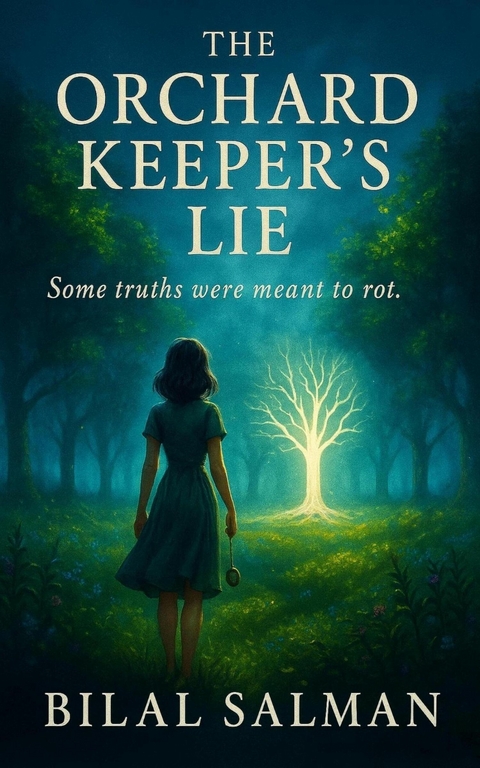
The Orchard Keeper's Lie (eBook)
250 Seiten
Publishdrive (Verlag)
978-0-00-111912-3 (ISBN)
She escaped the orchard once. But the story it planted is still growing...
When Eva Thorne returns to her hometown of Gravenmoor, the orchard behind her childhood home is quiet. Too quiet. Memories twist. Faces vanish. And a white tree blooms in the center of town-where nothing should grow.
As her past unravels, Eva discovers she wasn't the only one who made a vow in the orchard. One said yes. The orchard answered.
Now, the roots are rewriting reality-and she's the only one who remembers how it used to be.
The Orchard Keeper's Lie is a haunting psychological thriller about memory, betrayal, and the stories we bury to survive. Perfect for fans of The Haunting of Hill House, Sharp Objects, and Home Before Dark.
Chapter 1
The letter arrived on a Tuesday, though it felt less like mail and more like something that had been waiting for her, patient as rot.
It was tucked in the middle of a stack of bills and flyers, wedged between an electricity notice and a glossy coupon book. Ordinary camouflage for something that was anything but. The envelope itself was plain—no return address, no stamp from a town she recognized. Just white paper, slightly smudged at the edges, like too many fingers had handled it before it found hers.
What stopped her cold wasn’t the envelope. It was the name.
Eva Thorne.
Not “E. Miller,” the name she signed at work and forced into email signatures with false cheer. Not “Eva Marie,” which lived on her lease, her driver’s license, her bank account. This was different. Handwritten. Careful, almost deliberate in the rounded strokes. It was the kind of handwriting that belonged to someone who had known her once—really known her—and wanted her to remember who she used to be.
The city noises bled through the thin walls of her Oakland apartment: the thin, high whine of a siren blocks away, an ice cream truck’s warped melody dragged through the heat, dogs barking from a balcony down the street. But as she stood in the hallway with the envelope between her fingers, the sounds thinned, like someone had lowered the world’s volume just for her.
Her thumb brushed the flap. The paper was warm, or maybe her hand was trembling harder than she realized. She tore it open in the hall, too impatient to carry it inside, too uneasy to wait.
The page inside was bare except for a single line, perfectly centered.
“You left something behind in the orchard, and it remembers.”
She read it once. Then again. A third time, as if the words might change with repetition. But they didn’t.
Her first instinct was to crumple it, ball it tight until the sentence disappeared into her palm, and shove it in the trash with the pizza coupons. But her fingers froze halfway, stiff with something more dangerous than fear. A knowing.
The orchard.
She hadn’t spoken that word aloud in over a decade. It belonged to a version of her life she had buried under noise: new cities, half-kept jobs, apartments that never held her long enough to grow roots. She’d smothered Gravenmoor with movement, with distraction, with forgetting.
But forgetting was never the same as erasing.
She pressed the letter to her chest, pulse rattling against it, then forced herself to set it down on the kitchen counter. She tried to make coffee. Tried to fold laundry. Tried to keep herself inside the tiny domestic rituals that built her life here, but the words sat heavy in her skull, repeating without sound until they were all she could think.
That night she didn’t sleep.
She lay in bed with the fan spinning too fast overhead, its whirring blades catching shadows and flinging them across the ceiling like restless ghosts. The smell came back first. Apples. Not the crisp, waxed kind wrapped in grocery store plastic, but the orchard kind—sour, half-rotten, too early, sinking into the dirt with a sweetness that turned to rot too quickly. The scent wrapped itself around her memory, the way the orchard keeper used to mutter about “unripe truths” whenever a fruit dropped before its time.
By morning, she had stopped pretending. She packed a bag without thinking. One pair of jeans. A sweater. Her father’s old lighter, the one he used to flip open and closed even though he hadn’t smoked in years. And the letter. Always the letter.
She scribbled a note for her neighbor—“Water the plants”—even though she hadn’t owned any in months. Then she locked the apartment behind her, slid into her car, and started north.
The city peeled away quickly, eager to be rid of her. High-rises flattened into cracked suburbs. Traffic thinned, the sound of engines fading until there was only the hum of her own car and the long exhale of wind. By mile marker seventy-three, the landscape shifted. Dry hills rose like ribs around her. Fences sagged against them, held together with rust and stubbornness. And then something changed in the air—so subtle she might’ve missed it if she hadn’t been waiting for it.
The kind of familiarity that burned at the back of her throat.
A sign passed in her headlights: WELCOME TO GRAVENMOOR – HOME OF THE OLDEST ORCHARD WEST OF THE SIERRA.
The paint was chipped, the wood faded to gray, the whole thing crooked as though the ground itself had tried to spit it out.
Her chest tightened.
She kept driving.
Five miles past town, the orchard appeared. Hidden behind its slatted fence, still leaning but never falling. The trees loomed like bones in the pale morning light, blackened, twisted, wrong. Their branches stretched upward as though pulled from the soil instead of planted in it, roots sunk not in earth but in ash.
And then she saw him.
A man.
Standing in the middle of the rows. Still. Watching.
She couldn’t see his face, not with the fog curling through the branches, but his shape was there—tall, thin, arms hanging loose at his sides like he’d been waiting all this time just for her.
Her foot slammed harder against the gas, instinct moving faster than thought. She didn’t breathe until the bend took the orchard from sight. She flicked her eyes to the rearview mirror—empty. The man was gone, or he had never been there at all.
Her chest hurt by the time she reached the edge of town.
Gravenmoor looked like it had been preserved in vinegar. Too sour to rot, too stubborn to change. The diner leaned left. The drugstore’s windows were barred, its CLOSED sign worn blank from being flipped too many times. Kids coasted down cracked sidewalks on rusting bikes. Everything was smaller, meaner, exactly as it had been and yet not at all.
The motel was the same. Beige stucco walls, green metal frames around the doors, curtains too thin to keep secrets. The sign still read THE GRAVENMOOR INN, though it had never deserved the word “inn.”
Room 6.
Her mother used to call it the escape hatch, the place she ran to when home was too loud, too broken. Eva hadn’t stepped inside it since she was seventeen.
The wallpaper had changed, but the air hadn’t. It smelled like mildew and motel soap, a sour trace of cleaning bleach, and something older that clung in the corners like regret. She sat on the edge of the bed, pulled the letter from her bag, and read it again. A single line, but it carried more weight than pages of confession.
She left it on the nightstand.
Unpacked slowly. Touched the lighter. Tried to feel like herself in a place that had stolen too much of her already.
Then came the knock.
Three sharp taps. Even. Deliberate.
Her heart stopped.
She froze, listening.
Another knock. The exact same rhythm.
She moved to the door, pressing her eye to the peephole.
No one.
Her breath fogged against the door. She should’ve ignored it. Locked the deadbolt. Turned on the television and drowned the silence with static. But instead, she twisted the handle and pulled it open.
The hallway was empty.
But something waited on the floor.
An old photograph, folded twice, left neatly on the mat like a gift or a curse.
Her fingers trembled as she picked it up. The paper was soft, almost damp at the edges. She unfolded it slowly.
Four children stood beneath a tree. Laughing. Smiling. Sunlight caught in their hair.
Her. Liam. Grace. And Isaac.
Her stomach turned to ice.
One of them had died fifteen years ago. Burned in the orchard.
The one in the middle.
The one smiling the widest.
The one who shouldn’t have been there at all.
Eva didn’t sleep that night. Not really. She lay on the thin motel mattress, staring at the water stains on the ceiling that looked too much like spreading roots, the photograph clutched in her hand until her fingers cramped. Every time she closed her eyes, she saw it again—four children frozen in time beneath a tree that no longer stood, laughter bright in their faces. Hers, Liam’s, Grace’s…and Isaac’s.
Isaac Hayes had died in that orchard. She had seen the flames swallow the branches, felt the heat blister her cheeks, tasted the acrid smoke as it clawed into her lungs. She remembered screaming his name, the frantic push of feet in mud, Liam’s arm yanking her out of the choking dark. She remembered the sirens, the shovels, the empty funeral where the coffin held nothing but ash. And now here he was, smiling in her hand like nothing had ever happened.
The air outside the motel window was thick with fog by morning, rolling low across cracked sidewalks and sagging rooftops. It clung to the glass like breath. The square below looked almost staged, frozen in a quiet tableau—the diner door propped open with a brick, the crooked flag at the post office, the shape of a man hosing down his storefront though the water never seemed to hit the ground. Eva slipped on a sweater, tied her hair back, and shoved her father’s lighter into her pocket. The cold metal steadied her, even though she didn’t light cigarettes. She needed the weight, the familiarity, something to keep her grounded.
She walked without breakfast, her boots striking hollow against sidewalks that seemed too narrow, too empty. The air smelled faintly of mildew and rain even though it hadn’t rained in weeks. Every face she passed turned too quickly, eyes catching hers with recognition but lingering too long, as though trying to...
| Erscheint lt. Verlag | 9.12.2025 |
|---|---|
| Sprache | englisch |
| Themenwelt | Literatur ► Romane / Erzählungen |
| ISBN-10 | 0-00-111912-5 / 0001119125 |
| ISBN-13 | 978-0-00-111912-3 / 9780001119123 |
| Informationen gemäß Produktsicherheitsverordnung (GPSR) | |
| Haben Sie eine Frage zum Produkt? |
 EPUB (Adobe DRM)
Größe: 956 KB
Kopierschutz: Adobe-DRM
Adobe-DRM ist ein Kopierschutz, der das eBook vor Mißbrauch schützen soll. Dabei wird das eBook bereits beim Download auf Ihre persönliche Adobe-ID autorisiert. Lesen können Sie das eBook dann nur auf den Geräten, welche ebenfalls auf Ihre Adobe-ID registriert sind.
Details zum Adobe-DRM
Dateiformat: EPUB (Electronic Publication)
EPUB ist ein offener Standard für eBooks und eignet sich besonders zur Darstellung von Belletristik und Sachbüchern. Der Fließtext wird dynamisch an die Display- und Schriftgröße angepasst. Auch für mobile Lesegeräte ist EPUB daher gut geeignet.
Systemvoraussetzungen:
PC/Mac: Mit einem PC oder Mac können Sie dieses eBook lesen. Sie benötigen eine
eReader: Dieses eBook kann mit (fast) allen eBook-Readern gelesen werden. Mit dem amazon-Kindle ist es aber nicht kompatibel.
Smartphone/Tablet: Egal ob Apple oder Android, dieses eBook können Sie lesen. Sie benötigen eine
Geräteliste und zusätzliche Hinweise
Buying eBooks from abroad
For tax law reasons we can sell eBooks just within Germany and Switzerland. Regrettably we cannot fulfill eBook-orders from other countries.
aus dem Bereich