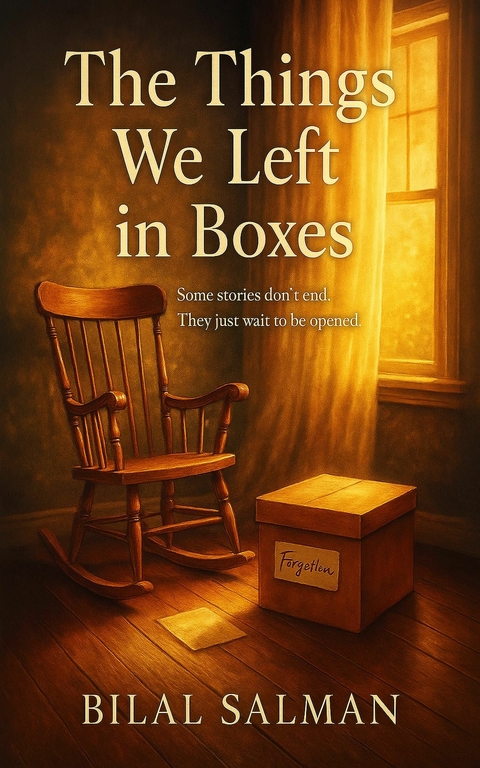
The Things We Left in Boxes (eBook)
250 Seiten
Publishdrive (Verlag)
978-0-00-111909-3 (ISBN)
Some boxes are full of memories. Others are full of silence. And some are never meant to be opened - until now.
When Leena Hart is hired to help an elderly widow clear out her home, she expects another job of sorting clutter and old furniture. What she finds instead is a quiet house filled with sealed boxes, each one holding a fragment of Eleanor Price's life - lost love, long-buried grief, unanswered letters, and one final secret she's never shared.
As the boxes open, so do old wounds. But between the silence and the sorting, something unexpected begins to grow: healing, connection, and the courage to forgive.
The Things We Left in Boxes is a heart-rich story about what we carry, what we leave behind, and the people who help us unpack the truth.
Chapter 1
People think letting go starts with a single choice, a clean line drawn through memory. They imagine it looks like sealing a box with thick tape and stacking it neatly in a corner where it will no longer whisper. But the truth is more jagged. Letting go begins in hesitation—in the breath you hold too long, in the weight you feel pressing against your ribs when your hand lingers on an object you thought you were ready to discard. It begins when you stare at an old sweater and feel your throat tighten as though the fabric itself is holding your pulse. It begins in the moments you open a drawer, glimpse what waits inside, and shut it quickly, not because it is jammed, but because something unseen inside it still seems to breathe.
I had built my life around moments like those. For years, I had stood in attics where the air was heavy with dust and forgotten photographs, in basements where the damp earth clung to old wedding albums no one dared to touch, in closets filled with decades of silence. People hired me to make space in their lives—to fold, to label, to decide what deserved to be carried forward and what could be surrendered. They believed I was there for efficiency, for order. But the truth was, I had long stopped being just an organizer. My real work was in listening to the things people didn’t say, in touching the objects they couldn’t bring themselves to touch, in carrying the weight of their hesitations when their hands refused to.
And then there was 18 Primrose Lane.
The house had a kind of stillness that didn’t feel empty. It felt watchful. Even from the street, I could sense it waiting, its shutters sagging like tired eyelids, its paint peeling in long curls as though time itself had been gnawing at the wood. The garden was a map of surrender: hedges wild and unshaped, grass yellowing in patches, flowers gone brittle from too many seasons unattended. As I climbed the steps, the wood groaned beneath my weight. For a fleeting moment, I thought I heard relief in that sound, as if the house had been holding its breath for years and was finally exhaling.
I tightened my grip on the clipboard tucked under my arm. It was mostly habit—I knew this wouldn’t be a job I could reduce to lists or checkboxes. Some houses demanded more than an inventory. Some houses wanted a witness.
Before I could knock, the door opened.
She stood framed in the hallway light, her figure etched in shadow against the glow behind her. A woman with silver threaded through her dark hair, her posture straight but her eyes carrying the weight of something that had pressed against her for far too long.
“Ms. Hart?” Her voice was steady, clipped, but not unfriendly.
“That’s me,” I said, offering a small smile. “And you must be—”
“Eleanor.” She cut me off gently, almost apologetically. “Just Eleanor. No ‘Ms.’”
There was no sharpness in her tone, only the caution of someone who had grown careful with how much of herself she offered to strangers.
She stepped back, allowing me inside. The threshold felt like a crossing, the kind that changed the air itself.
The scent met me first—an old mingling of lavender sachets tucked in drawers, books that had absorbed decades of stories, and something metallic beneath it all, like the tang of keys forgotten too long on a windowsill. The temperature was cooler than I expected, a faint draft curling against my skin as if the house preferred to keep a little distance from the warmth of human breath.
But what struck me most wasn’t the air, or the cold, or even the smell. It was the weight. A heaviness that seemed to sit in the corners, quiet but undeniable, as if memory had shape and had taken residence in the rooms.
Boxes lined the hallway, stacked with varying precision. Some were firm and square, labels scrawled in thick black marker. Others slouched, collapsing against one another, weary with the burden of what they held. My eyes moved across the words written on their sides:
DANIEL – KEEP
BOOKS – COLLEGE YEARS
WEDDING (UNOPENED)
LETTERS I NEVER SENT
The last one caught me. My eyes lingered, almost against my will. The neatness of the lettering was painful in its care.
“You’ve already started,” I said softly, tracing the words with my eyes, not daring to touch.
Eleanor’s shoulders lifted and fell in a small shrug. “I’ve been starting for twenty years.”
Her voice carried no bitterness, no humor—only the quiet plainness of truth spoken too often in silence.
She led me into the living room. The furniture was elegant but worn, pieces chosen in another lifetime when people still sat straight-backed, their words measured. A fireplace stood like a sentinel at the center, its mantel crowded with photographs in mismatched frames. None of them showed smiles. The faces were solemn, the eyes turned outward as though caught staring into other decades.
Neither of us sat. The air between us hummed with the kind of restraint that builds when people are deciding whether to trust one another.
“I don’t want you to throw anything away,” she said suddenly. The steel in her voice was subtle, but unmistakable.
I nodded. “I understand.”
“No.” Her gaze lifted, meeting mine directly now. “I mean it. I’m not hiring you to clear out my life. I want to remember what’s here. Before it disappears. Before I do.”
Her words settled in the room like dust after a heavy step.
I didn’t reach for my clipboard. I didn’t need to. There was no form for this. No column labeled remembrance.
“You’re not looking for an organizer,” I said quietly. “You’re looking for a witness.”
Something flickered across her face—half recognition, half surrender. And then she spoke words that would stay with me long after I left, words that pressed against my chest like a pin beneath the skin:
“What we leave behind isn’t stuff. It’s proof we were ever here.”
I didn’t write it down. I didn’t have to.
Because she was right.
No one truly wants to let go of their things. What they want is to be remembered. The boxes we keep aren’t about value or utility—they are our last plea that someone, someday, will be curious enough to open them and understand who we were.
That day, in the quiet shadows of Eleanor’s house, I stopped calling myself a downsizer.
That was the day I became a story-keeper.
Some boxes feel heavy before you even lift them. The weight doesn’t come from the cardboard or the objects inside but from the unspoken things packed between them—expectations, disappointments, futures that never came to pass.
This one sat alone in the dining room. Unlike the others, it hadn’t been shoved against a wall or stacked in tired surrender. It rested neatly in the center, as though everything around it had learned to step aside. The box wasn’t dented or dusty, not like the others that bore the stains of years. This one had been preserved. Guarded. Its edges sharp, its tape unbroken, its presence deliberate.
The label caught me immediately. Unlike the blocky, hurried handwriting that marked the other boxes, this one was written in careful cursive. Elegant. Intimate. A handwriting that hadn’t been rushed by grief but crafted with hope.
WEDDING – UNOPENED
The word itself carried a strange gravity, like a doorway into a room I wasn’t sure I wanted to enter. I crouched in front of the box, resting my palms lightly on my knees, and let my eyes trace the sweep of those letters. For a moment, the air seemed heavier here. Warmer too, as though the memory inside radiated its own quiet energy.
From the kitchen came a low sound—Eleanor humming beneath her breath, the kind of half-melody people carry when their hands are busy but their minds are far away. Then the hiss of the kettle broke through, sharp and urgent, like a reminder that the world outside this box still existed.
I reached out, fingertips brushing the tape. My hand trembled—not from the weight of the box, but from the certainty that opening it meant stepping into a part of Eleanor’s life she had spent decades deciding not to face.
Her footsteps moved closer, steady but unhurried, the rhythm of someone who had learned how to carry silence. She appeared in the doorway, two mismatched teacups in hand, one blue and one cream, and set them carefully on the rug beside me. The steam curled upward, carrying the faint fragrance of black tea and something floral, maybe bergamot.
“You don’t have to open that one,” she said quietly.
I glanced up at her. “Is it yours?”
She lowered herself to the floor with surprising grace, folding her legs beneath her. Her movements were deliberate, like rituals practiced too many times to forget. She placed a pale hand on the top of the box. The skin was fragile, almost translucent, but beneath it I sensed a strength that had endured storms.
“It’s not what you think,” she said, her voice carrying both weariness and a strange clarity. “It’s not filled with pressed flowers or love letters. No lace-wrapped memories. Nothing sweet.”
Her fingers lingered on the cardboard as though it could still sting.
“I bought the dress,” she continued, her voice lowering into the rhythm of confession. “It wasn’t expensive. Satin, with buttons running all the way down the back. I practiced fastening them alone in the mirror until I could do it without trembling. I booked a little church with windows that made even cloudy days glow. I picked out the music. We didn’t have much money, so I made a mixtape....
| Erscheint lt. Verlag | 9.12.2025 |
|---|---|
| Sprache | englisch |
| Themenwelt | Literatur ► Romane / Erzählungen |
| ISBN-10 | 0-00-111909-5 / 0001119095 |
| ISBN-13 | 978-0-00-111909-3 / 9780001119093 |
| Informationen gemäß Produktsicherheitsverordnung (GPSR) | |
| Haben Sie eine Frage zum Produkt? |
 EPUB (Adobe DRM)
Größe: 1,1 MB
Kopierschutz: Adobe-DRM
Adobe-DRM ist ein Kopierschutz, der das eBook vor Mißbrauch schützen soll. Dabei wird das eBook bereits beim Download auf Ihre persönliche Adobe-ID autorisiert. Lesen können Sie das eBook dann nur auf den Geräten, welche ebenfalls auf Ihre Adobe-ID registriert sind.
Details zum Adobe-DRM
Dateiformat: EPUB (Electronic Publication)
EPUB ist ein offener Standard für eBooks und eignet sich besonders zur Darstellung von Belletristik und Sachbüchern. Der Fließtext wird dynamisch an die Display- und Schriftgröße angepasst. Auch für mobile Lesegeräte ist EPUB daher gut geeignet.
Systemvoraussetzungen:
PC/Mac: Mit einem PC oder Mac können Sie dieses eBook lesen. Sie benötigen eine
eReader: Dieses eBook kann mit (fast) allen eBook-Readern gelesen werden. Mit dem amazon-Kindle ist es aber nicht kompatibel.
Smartphone/Tablet: Egal ob Apple oder Android, dieses eBook können Sie lesen. Sie benötigen eine
Geräteliste und zusätzliche Hinweise
Buying eBooks from abroad
For tax law reasons we can sell eBooks just within Germany and Switzerland. Regrettably we cannot fulfill eBook-orders from other countries.
aus dem Bereich