


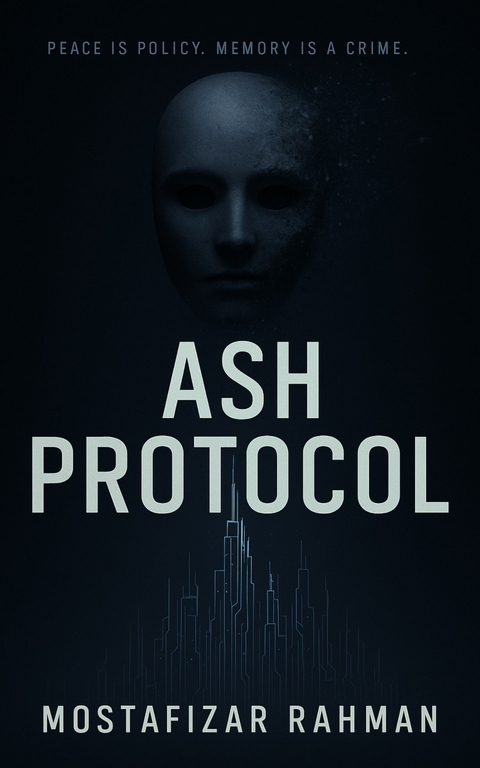
ASH PROTOCOL (eBook)
770 Seiten
Publishdrive (Verlag)
978-0-00-111429-6 (ISBN)
In Vesper Arcology, peace isn't a dream-it's policy.
Trauma is edited. Memories are cleaned. And anyone who refuses to forget becomes a threat to the city's perfect calm.
When a powerful civic architect is found dead, smiling as if he chose bliss over survival, Neurocrime Agent Rio Noor is called to 'confirm and close' the case before panic spreads. But the crime scene holds something Vesper was never meant to allow: a message written in ash.
REMEMBER WHAT YOU ERASED.
Soon, the city's public feeds are hijacked by a masked figure who calls his killings 'recovery.' Each death is precise. Each victim is connected to a secret neurological program buried under black protocols the Council denies exist. And with every new case, Rio feels something inside his own mind slipping-like a door he doesn't remember opening.
As bodies fall and erased truths rise from the Burn Vault, Rio is forced to hunt a killer who might be restoring justice... or igniting war. With the Arcology tightening its grip and his own memories turning unreliable, Rio must decide what's more dangerous:
The crimes being committed-
or the memories the city has been hiding all along.
Ash Protocol is a dark, fast-paced near-future thriller about memory, power, and the cost of manufactured peace.
Because in Vesper, forgetting is survival...
and remembering is rebellion.
Prologue
Prologue – Zero
On the night the city burned, there were no sirens in the Underway.
The alarms were for the levels above—for the districts the news would later call “affected zones,” for the broken glass and smoke and footage that would loop in public feeds until the Council decided people had felt enough.
Down here, under the skin of Vesper Arcology, the only sound was the hum of machines.
Arif Rahman stood in a room with no windows and watched the fire from six different angles.
The riot filled his screens. A crowd surging at the base of the Arcology. Police lines fracturing. Fire rising where glass and light were supposed to be permanent. The feed AI tried to stabilize the colors, flatten the panic, smooth the jagged edges of reality into something the human nervous system could tolerate.
For the first time since he’d come to work in Stone Quarter, the AI was failing.
The flames were too bright. The screams were too loud. The patterns refused to collapse into neat lines of behavior.
“Resolution Riot,” someone in the control room had already named it. A title for history. A label that made the chaos sound contained.
Arif knew better.
History wasn’t written up there.
It was written here.
“Rahman.”
The supervisor’s voice cut through the hum. Calm. Trained.
Arif turned.
Director Hale stood at the back of the intake control room, hands clasped behind his back, white coat hanging with the effortless authority of a man who believed he was on the right side of every equation. His badge bore the overlapping circles of Eidolon Bio Systems and Vesper Civic Memory Authority.
“Phase One is ready,” Hale said. “We’re out of time. Begin the protocol.”
Arif’s throat felt dry.
“Sir, the candidates—”
“Are already on-site,” Hale said. “The Resolution Riot will seed trauma across an entire generation if we let it. We won’t. We have the tool. We use it.”
Project ASH: MAINTENANCE GRID — PHASE I
The words glowed at the top of Arif’s primary console, steady and unblinking.
He’d written most of the code that sat under them.
On paper, the program was elegant—targeted memory stabilization for high-risk subjects, trauma sequence isolation, emotional load smoothing. In the models, it had worked perfectly. Children who had seen too much went to sleep afraid and woke up stable.
That was how Hale had framed it in the first briefing.
“We’re not erasing them,” he’d said. “We’re protecting them from experiences their brains were never built to carry. We’re doing what good parents can’t.”
Arif had wanted to believe that.
He still wanted to.
But the more time he spent in Stone Quarter, the harder it was to ignore the other numbers.
The black protocols.
The denied wings.
The quiet transports that never appeared on any public registry.
He looked back at the feed.
Smoke curled through lower corridors in ugly, organic shapes. Somewhere above them, children were watching the world crack.
“Begin,” Hale repeated. “We can’t control the riot. We can control what it does to them.”
Control. Always that word.
Arif turned to the secondary monitor.
SUBJECT: S–0
AGE: 8
STATUS: WITNESS / FUTURE-RISK
Future-risk. The label they gave children whose minds might destabilize the Arcology later. Those who saw too clearly. Those who asked too much.
He keyed the intercom.
“Bring him in.”
The intake room beyond the glass lit up.
Two orderlies in soft shoes guided a small boy into the center chair.
The boy was all bones and angles, dark hair plastered to his forehead with sweat. His eyes scanned the room the way a cornered animal scans for exits. Not curiosity. Calculation.
Arif felt an old, unwelcome resemblance in that gaze.
The chair was bolted to the floor. Straps waited for wrists and ankles. A halo of sensors hung overhead like a crown on a mechanical arm.
One of the orderlies murmured to the boy, words meant to be soothing. “You’re safe here. The fire’s over. We’re going to help you forget the bad parts.”
The boy jerked his head toward the glass.
He couldn’t see Arif through the mirrored panel, not really, but some instinct told him there was someone there.
“Where’s my brother?” he demanded.
His voice hit the mic as a crack, too loud for his size.
Arif’s fingers tightened on the console.
“In the next room,” the orderly said automatically. “He’s helping us help you.”
A practiced lie. A script.
Arif glanced at the side monitor. The file for SUBJECT: S–1 was already queued. No photograph yet. No status beyond “intake pending.”
He swallowed.
“Subject S–0,” he said into the control mic, keeping his voice as even and gentle as he could. “My name is Arif. I’m on the other side of the glass. I’m going to be with you the whole time.”
The boy’s gaze snapped to the glass.
“You’re in there?” he asked.
“Yes.”
“Can you see my brother?”
Arif forced his voice to stay steady.
“No. But I promise you this part will be short.”
The word promise tasted like metal.
He started the sequence.
The halo lowered until it hovered a breath above the boy’s head. Electrodes kissed his temples, his spine, the soft skin behind his ears. The console filled with a live neural map—spikes and waves, familiar patterns with an unfamiliar intensity.
“Begin guided recall,” Hale said quietly.
Arif tapped the command.
The screen bloomed with images pulled straight from S–0’s sensory cortex.
The riot came back, this time from eight-year-old eyes.
Crowds. Heat. The sound of glass breaking at a pitch adults no longer heard. A hand gripping his shoulder too tightly. His brother’s voice in his ear: Don’t look. Just run.
Smoke. Boots. A corridor full of bodies moving the wrong way.
The Arcology was not supposed to look like this. It was supposed to be smooth lines and soft light and controlled weather. Seeing it fractured was like seeing a god bleed.
“Watch,” Arif said, the word part of the scripted protocol. “If it hurts, tell me.”
“It already hurts,” the boy whispered.
His hands clenched the chair arms.
On the feed, the memory lurched.
A white coat. A needle. Hands pulling the brothers apart.
S–0’s breathing hitched, turned ragged.
Arif’s own chest felt tight in a way that had nothing to do with oxygen.
“Subject,” Hale’s voice cut in, cold and clinical, “you can end the pain at any time. You know the word.”
The boy squeezed his eyes shut.
“Erase,” he choked.
The command lit up on Arif’s console.
ERASE REQUEST: ACCEPT?
His finger hovered over the key.
That was the bargain, he reminded himself. They offered the child a way out. They didn’t force him. They gave him agency over his own forgetting.
It sounded clean in the design documents.
It did not feel clean now.
He pressed ACCEPT.
A high-frequency pulse rippled through the neural map. The memory window blurred, then folded in on itself. The screams cut off mid-sound. Fire became static.
The boy slumped in the chair, breathing hard.
Arif watched the traces with a split attention—half on the child’s vitals, half on the data stream beneath. The program didn’t simply delete. It redirected, copied, archived.
On a hidden layer of the interface, a new entry blinked.
BURN VAULT — NODE ZERO
ARCHIVE: EVENT / RESOLUTION RIOT / S–0
He clicked it.
A warning flashed:
ACCESS DENIED — COUNCIL TIER ONLY
Of course.
“Baselines?” Hale asked.
Arif swallowed. “Emotional load down forty-three percent. Cortisol normalizing. Traumatic sequence inaccessible to conscious recall. Subject will retain everything around it, but not the core event.”
“Textbook,” Hale said, satisfied. “Proceed to sedation taper.”
In the intake room, the boy blinked as the halo rose.
“How do you feel?” Arif asked.
S–0 frowned.
“Cold,” he said. “Tired.”
“Do you remember what happened?” Arif asked.
“There was… noise,” the boy said slowly. “People were shouting. Someone pushed me. Then I woke up here.”
His gaze flicked to the glass again.
“Do I have a brother?”
The question landed in Arif’s chest like a thrown stone.
He heard the script in his head, the sentence they’d been given for this moment.
No. You were alone. You’re safe now. There’s no one left who can hurt you.
Isolation for stability. Loneliness for compliance.
The words refused to come out of his mouth.
He cut the mic.
“Answer him,” Hale said quietly.
Arif stared at the child.
In the feed from the riot, he’d seen the way the boy reached back for a smaller hand, refusing to let go until he was forced. He’d seen the terror in both faces when Authority intervened.
Children were supposed to be resilient. That was the word the Council liked.
They never finished the sentence.
Resilient enough to survive what we do to them.
“Answer him, Rahman,” Hale repeated, voice hardening. “He can’t carry a loss this big and a memory this violent. It will break him. You know the...
| Erscheint lt. Verlag | 5.12.2025 |
|---|---|
| Sprache | englisch |
| Themenwelt | Literatur ► Krimi / Thriller / Horror |
| ISBN-10 | 0-00-111429-8 / 0001114298 |
| ISBN-13 | 978-0-00-111429-6 / 9780001114296 |
| Informationen gemäß Produktsicherheitsverordnung (GPSR) | |
| Haben Sie eine Frage zum Produkt? |
 EPUB (Adobe DRM)
Größe: 3,2 MB
Kopierschutz: Adobe-DRM
Adobe-DRM ist ein Kopierschutz, der das eBook vor Mißbrauch schützen soll. Dabei wird das eBook bereits beim Download auf Ihre persönliche Adobe-ID autorisiert. Lesen können Sie das eBook dann nur auf den Geräten, welche ebenfalls auf Ihre Adobe-ID registriert sind.
Details zum Adobe-DRM
Dateiformat: EPUB (Electronic Publication)
EPUB ist ein offener Standard für eBooks und eignet sich besonders zur Darstellung von Belletristik und Sachbüchern. Der Fließtext wird dynamisch an die Display- und Schriftgröße angepasst. Auch für mobile Lesegeräte ist EPUB daher gut geeignet.
Systemvoraussetzungen:
PC/Mac: Mit einem PC oder Mac können Sie dieses eBook lesen. Sie benötigen eine
eReader: Dieses eBook kann mit (fast) allen eBook-Readern gelesen werden. Mit dem amazon-Kindle ist es aber nicht kompatibel.
Smartphone/Tablet: Egal ob Apple oder Android, dieses eBook können Sie lesen. Sie benötigen eine
Geräteliste und zusätzliche Hinweise
Buying eBooks from abroad
For tax law reasons we can sell eBooks just within Germany and Switzerland. Regrettably we cannot fulfill eBook-orders from other countries.
aus dem Bereich


