


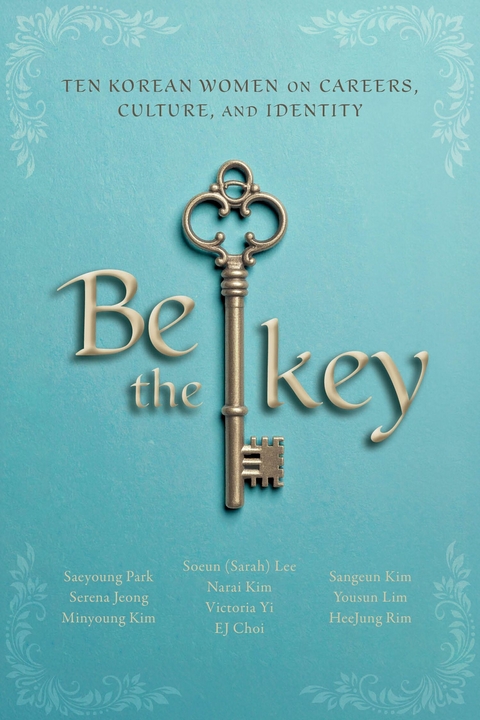
Be the Key (eBook)
260 Seiten
Bookbaby (Verlag)
979-8-3178-1391-8 (ISBN)
Josie is a British technologist who bridges technology, society, and culture. In 2023, she was honored as a Top 100 Technologist to Watch. She continues to drive impact by organizing hackathons and workshops, mentoring emerging developers, and reducing barriers to the tech industry for under-represented groups. Having lived and worked in Korea for more than a decade and holding dual degrees in history, she brings both cross-cultural insight and a reflective, interdisciplinary perspective to her projects. As an occasional editor as well as a technologist, she amplifies voices and ideas that might otherwise go unheard.
"e;Be the Key: Ten Korean Women on Careers, Culture, and Identity"e; is a deeply human and refreshingly honest exploration of what it means to shape a career, a sense of self, and a purpose-across cultures, expectations, and moments of doubt. Written by ten Korean women whose professional journeys span journalism, technology, recruitment, sustainability, automobile, pharmaceuticals, and finance, this book brings together a collection of personal essays that are both intimate and resonant. Each chapter stands on its own, yet together they form a layered, collective portrait of modern womanhood, leadership, and quiet strength. From confronting patriarchal norms in male-dominated industries to navigating motherhood while managing high-pressure roles, these stories offer no illusions about ease or perfection. One author shares what it felt like to present the same proposal four times until it finally succeeded. Another recalls pumping breast milk in the newsroom bathroom while covering politics. Others reflect on corporate survival training in the Scandinavian wilderness or negotiating promotions in environments where job titles mattered more than talent. These are not tales of polished triumph, but of persistence, reinvention, and deeply personal growth. The authors first met through the British Embassy in Seoul and the British Chamber of Commerce's EMPOWER program a year-long initiative that connected women professionals through mentorship, storytelling, and mutual support. That shared experience led to the group's first book, published in Korean in 2024. Encouraged by readers who said the stories gave them courage and comfort, the group decided to write again this time in English, reaching out to a global audience. With support from the Australia-Korea Foundation, their reflections continued to evolve through a creative project in Melbourne, where new cross-cultural encounters shaped the pages of this book. "e;Be the Key"e; is not a linear success manual nor a prescriptive guide to leadership. Instead, it offers something quieter and more enduring: the voices of women who have grown by questioning, adapting, stumbling, and continuing. The book honors those who are often overlooked those who lead not by command but by clarity, who turn inward not to hide but to listen, and who find power in connection over competition. This is a book for readers who seek meaningful stories about becoming whether in the early stages of a career, during a period of transition, or in search of direction in an unfamiliar world. It speaks to those navigating cultural dualities, managing expectations, or simply wondering if they are allowed to want something different. Above all, it reminds us that change doesn't come from waiting. It comes from turning the key and realizing we've had it all along. Be the Key: Ten Korean Women on Careers, Culture, and Identityby Saeyoung Park (Author), Serena Jeong (Author), Minyoung Kim (Author), Soeun (Sarah) Lee (Author), Narai Kim (Author), Victoria Yi (Author), EJ Choi (Author), Sangeun Kim (Author), Yousun Lim (Author), HeeJung Rim (Author), Josie Daw (Editor)
Serena Jeong
Serena is an executive recruiter who helps others find clarity and confidence in their professional paths. She believes in designing careers rooted in self-trust and purpose.
Finding My Way, Without a Map – Serena Jeong
The Turning Point: Leaving My First Job
I originally chose my first job in overseas sales because it seemed like an exciting opportunity. The company was well-known in the medical device industry, and I had learned about it while researching businesses for my university thesis. When I saw their job posting, I applied on impulse, intrigued by the idea of a global role. Though I had no prior experience in sales, I was eager to try something new.
Unlike major corporations with rigorous standardized hiring processes, this company had a unique approach. One of the most memorable parts of my interview was reviewing my aptitude test results with the CEO himself. Despite being unprepared for it, I somehow passed every stage and received an offer. At that point, I was so eager to begin my professional journey that I accepted without hesitation. The salary and benefits were decent, and I was thrilled to finally step into the working world.
For a while, the job was great—I was learning, meeting interesting people, and even had opportunities to travel abroad. One day, the vice president asked me why I worked so hard, to which I confidently responded:
‘Because I’m happy here.’ At the time, I meant it. But over time, I began to feel differently.
After two years, I started noticing things that made me uncomfortable. It was a good company; I would have lots of opportunities, including managing distributors in overseas countries even when I was a junior worker, but as time went by, I realized that the company culture didn’t quite fit with what I value at work. Personally, I enjoy being in a team where people cheer each other on and celebrate wins together. But like many traditional Korean companies, their working culture was more competitive. People paid more attention to mistakes than successes, and it sometimes created distance between colleagues.
At some point, I knew I had to decide—stay and adapt or move on. Many people advised me to stay at least three years, since that’s often seen as the minimum time before changing jobs, and there was the severance pay.3 But I kept asking myself, ‘Will I be happy if I stay longer?’
In the end, I decided to leave before I lost the excitement and passion I had for my work. It wasn’t easy, but I chose to take a bold step—to start over. Instead of worrying about leveraging my experience for my next job, I focused on leaving as soon as possible. I didn’t have another job lined up, but I felt a strong need to start fresh. Some might have thought I was making a rash decision, but I believed that even if I had to start over, I’d be in a better place than if I had stayed in an environment that wasn’t right for me.
When I submitted my resignation, the vice president passed me in the hallway and sarcastically asked:
‘Why are you leaving? I thought you were happy here.’ That was when I knew, without a doubt, that I had made the right choice.
I replied, ‘I was, but I’m not anymore.’
A Leap into the Unknown: My Unplanned Journey
After leaving my first job, I had no immediate plans, no structured career roadmap—just a strong urge to escape, to take a deep breath, and to reset. I thought to myself, ‘If not now, then when?’ With that, I booked a one-way ticket to Europe for a month-long trip, without an itinerary or detailed plans.
London was my first stop. People say the default weather in London is rain, but oddly enough, the city welcomed me with sunshine. It felt like a sign. Every morning, I jogged along the Thames and sat on a bench in Hyde Park, simply letting my mind wander. For the first time in years, I had no deadlines, no obligations, no pressure to be productive. One day, as I was casually browsing Google Maps to decide where to run next, I saw Dublin pop up. Why not? Guinness, Irish music, a new adventure. Without a second thought, I booked a last-minute flight to Dublin.
It was the first time I had experienced true freedom. Growing up in an academically demanding environment, I had spent most of my student life buried in books. Once I started working, the sense of responsibility kept me constantly tied to my phone, even during vacations. But here I was, wandering the streets of Europe, making decisions on impulse, living completely in the moment.
More importantly, being alone gave me space to reflect. As I explored new places, I naturally started having conversations with myself. Who am I when no one is watching? What excites me? What kind of work truly makes me happy? These weren’t questions I had ever taken the time or mental space to ask before. The answers weren’t immediate, but for the first time, I felt like I was searching in the right direction.
By the end of my trip, I had identified three key priorities, three non-negotiables that I needed in my next job. These weren’t based on salary, benefits, or company reputation, which are often the default criteria people consider. Instead, I focused on what truly mattered to me. Interestingly, I forgot about this list for a while, only rediscovering it years later in an old journal. Looking back, it felt almost prophetic that the job I ended up choosing aligned perfectly with my priorities.
- A People-Centered Role: I realized I drew energy from interacting with people. My first job in overseas sales had been exciting not because of the products but because of the people I met. So, I narrowed down my search to three potential career paths: sales, consulting, and human resources.
- A Culture That Fits Me: I wanted to work in an environment where I could speak up, take ownership, and be surrounded by people who value honesty and feedback. I needed a place where good work was recognized, where autonomy and accountability went hand in hand. I had a gut feeling that an international company would offer more of what I was looking for.
- A Location That Supports My Lifestyle: This one might sound trivial, but at the time, it was non-negotiable. I was passionate about playing squash and had been commuting for an hour each way after work just to play. The next company I joined needed to be close enough that I could continue playing regularly.
When I returned from my trip, I used these three priorities as my guiding framework for job searching. The result? I landed a role in a completely new field—headhunting—something I had never considered before. But because it aligned with what I valued, I quickly realized it was the right fit. Fast forward eight years, and I’m still here, thriving in this industry.
Through my work as a recruiter, I now ask candidates the same questions I once asked myself: ‘Why are you really looking for a new job? What are your top priorities?’ I’m often surprised by how many people haven’t given these questions much thought. Without clarity, it’s easy to jump into a new job only to feel unfulfilled and start the cycle all over again.
So, if you’re considering a career move, I encourage you to set aside external noise and focus on what truly matters to you. Your priorities don’t have to be the same as mine—maybe for you, salary and benefits do matter most, and that’s okay. The key is making sure you’re moving forward with intention, not just because it feels like the right time to switch jobs.
This experience taught me that sometimes, the best way to find your next step isn’t through logical planning; it’s through stepping away, embracing the unknown, and giving yourself the space to figure out what truly matters.
Facing the Unknown in My First Year
Less than a month into my new job, the only senior team member who had joined before me resigned. During our brief handover meeting, we spent just five minutes discussing work. The rest of the conversation was casual small talk. I naively assumed he was giving me time to get up to speed with the projects before fully taking over.
So, when I reached out to him after he left, expecting some guidance, his response shocked me:
‘I don’t really remember much about that project. Also, I’d prefer it if you didn’t contact me again.’
I was left completely on my own. With no proper handover and almost no background information, I was thrown into live projects where clients immediately questioned my competence. Who are you? Are you even qualified to handle this? I heard those words more times than I could count. It was an overwhelming and discouraging start. But, instead of panicking, I told myself:
‘Let’s just give it a shot. If I deliver results, they’ll take me seriously.’
I had majored in Italian languages and business administration precisely because I disliked subjects like math and science. Yet here I was, tasked with finding battery researchers for the next phase of the electric vehicle boom. The technical language was completely foreign to me, but I started learning everything I could—reading chemistry reports, studying industry trends, and...
| Erscheint lt. Verlag | 2.9.2025 |
|---|---|
| Sprache | englisch |
| Themenwelt | Literatur ► Biografien / Erfahrungsberichte |
| ISBN-13 | 979-8-3178-1391-8 / 9798317813918 |
| Informationen gemäß Produktsicherheitsverordnung (GPSR) | |
| Haben Sie eine Frage zum Produkt? |
 EPUB (Ohne DRM)
Größe: 625 KB
Digital Rights Management: ohne DRM
Dieses eBook enthält kein DRM oder Kopierschutz. Eine Weitergabe an Dritte ist jedoch rechtlich nicht zulässig, weil Sie beim Kauf nur die Rechte an der persönlichen Nutzung erwerben.
Dateiformat: EPUB (Electronic Publication)
EPUB ist ein offener Standard für eBooks und eignet sich besonders zur Darstellung von Belletristik und Sachbüchern. Der Fließtext wird dynamisch an die Display- und Schriftgröße angepasst. Auch für mobile Lesegeräte ist EPUB daher gut geeignet.
Systemvoraussetzungen:
PC/Mac: Mit einem PC oder Mac können Sie dieses eBook lesen. Sie benötigen dafür die kostenlose Software Adobe Digital Editions.
eReader: Dieses eBook kann mit (fast) allen eBook-Readern gelesen werden. Mit dem amazon-Kindle ist es aber nicht kompatibel.
Smartphone/Tablet: Egal ob Apple oder Android, dieses eBook können Sie lesen. Sie benötigen dafür eine kostenlose App.
Geräteliste und zusätzliche Hinweise
Buying eBooks from abroad
For tax law reasons we can sell eBooks just within Germany and Switzerland. Regrettably we cannot fulfill eBook-orders from other countries.
aus dem Bereich


