


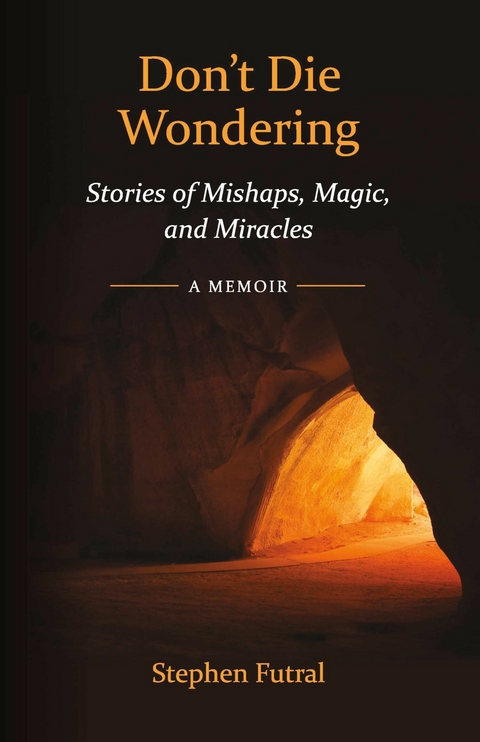
Don't Die Wondering (eBook)
180 Seiten
Bookbaby (Verlag)
979-8-3178-2058-9 (ISBN)
Stephen Futral is an avid artist, writer, and poet. Stephen's father was an enthusiastic businessman who carried the family on trips around various sites and attractions, starting in their hometown of Manhattan and then later throughout the world. His life abroad at an early age shaped much of his thinking, and opened him to new ideas which he happily explored through his art. At 17, Stephen spent a year in Israel, studying at The Betzalel School of Art and Design in Jerusalem and spending time with Yona Mach, a famous Israeli artist who was his mentor. At the end of the year, he spent a month in Ein Hod, an art colony outside of Haifa overlooking the Mediterranean, before developing a portfolio and gaining acceptance at Parsons, Pratt and the School for Visual Arts in NYC. Five years later, Stephen flew from NYC to Rome and then went by land to India. Stephen was able to be involved in many artistic projects and endeavors while pursuing the spiritual path, starting a family, and continuing to move around. He currently resides in Colorado with his family.
Accomplished artist and spiritual practitioner Stephen Futral takes us on a mind-expanding trip to exotic locales across the globe, meeting remarkable people and having extraordinary experiences!A child of post-World War II America, these earthly and spiritual adventures are a fascinating read of life in its times largely because of the writer's own attitude toward them. Futral rides the waves of coincidence where they take him, with zest and stamina and few regrets. The adventures read like those of a charmed hero in a fairy tale, mistake-prone and lucky, unapologetic and resilient.
CHAPTER 2 Mount Vernon 1956 – 1961 (10 – 16 years old)
When I was nine years old and in fifth grade, we moved out of the Bronx. Everyone thought the neighborhood was becoming more “ghettoized” with “bad elements” and it was time to get out of the Bronx before those bad elements spawned juvenile delinquency, as it was called then. Ha! Little did we know what was in store for us in Mt. Vernon. I believe the suburbs were worse, always trying to live up to something that city life exemplified even though so many moved to the suburbs for a “better life.” All the wannabes tried hard, even if they were only punks.
Dad and Mom went from owning a luncheonette to owning a beauty parlor in a prestigious area of Mt. Vernon, New York, called Fleetwood. It wasn’t too far from the high school, A.B. Davis HS (today called Mt. Vernon High) I attended. The beauty parlor was called The Fabulous, a cheesy sounding name now, but suitable back then. I worked there on Saturdays sweeping up the hair, putting the women under the hair dryers and taking them out when they were done, taking the nets off, and taking all the clips and rollers out—all prep for Dad or any of the other stylists to do the comb out. I used to get manicures there with clear nail polish. Josie, the manicurist was really nice and fun to talk to. As I got used to this role, I started to get all the females from school to come, which helped build the clientele as well as giving me a personal social forum in which to interact with the girls. Mom kept the books, booked the appointments, and was the general schmoozer. She never minced words when she didn’t like someone; if they were an asshole, her face was always tell-tale.
We went from living in a cockroach-infested hovel of an apartment in the Bronx to a luxurious apartment with a den and separate huge living room with a big fireplace and alcove seating by a huge window. It also had two bathrooms and two doors to the kitchen, one of which was a swinging door from the kitchen to the den. We chose to make the large opening in the foyer our dining area. The building had a large lobby, beautiful stone or marble stairs, and an elevator. It made me feel wealthy even if we weren’t, since the contrast to where we came from was so great.
Once again my neighborhood had many cool older Italians coexisting with the Jews and the Irish. On several occasions, I was picked on either in school or on the streets. Once they knew that I was friends with Louie Crescenzo, however, I had some protection from the bullies. It was comforting, since there were enough fights and vying for dominance going on to last a lifetime. I was also friends with Robert Ramaglia, who lived nearby and was in the same grade. Sometimes we’d steal hubcaps or break car antennae. Other times we’d hang on the street corners singing a cappella— bass, alto, falsetto, background, or lead. We’d pick which parts to sing and practice the most popular songs, singing doo-wop as best as we could. These songs, all about love, had so much meaning for us; they helped us go through the stages of puppy love, which we never believed or admitted was merely puppy love. From our perspective, it was the real thing . . . each time and with each person.
We moved when I was going into fifth grade. At Holmes Elementary School, which I attended through sixth grade, the students seemed to be sexually precocious. I had a famous fifth grade party for my tenth birthday. My parents were working, so my Aunt Clarice was our chaperon. She went into the back bedroom and left us alone. After so many spin-the-bottle turns, we came up with another idea. One girl went into the kitchen and each boy had about five minutes to do what he wanted. All the girls agreed and so we went at it, although there wasn’t much to go for, but the excitement and idea were so risqué that we were all giggles, like we were in a secret society together. When Monday came around, word got out and, before I knew it, I was called into the office and my mother had to come to school. We all had a good chuckle and couldn’t really believe that everyone was so outraged; it was good clean fun, just a little early for our age.
At this time we also had clubs, almost like the Greeks in college. These were the days of Harry Belafonte and Calypso music and our two clubs were The Maryanns and The Day-Os. I don’t remember doing anything with them, but we were cool. As coolness developed, I walked home on my lunch hour during junior high to eat lunch and change my shirt, something all the girls noticed in the afternoon. Then I’d change again after school for the late afternoon and evening activities. After school we watched American Bandstand, sometimes at Beth Roberts’ house. Beth was one of our popular beauties, and she had a pool table in her basement den. That’s where we’d watch the show, learn new steps, and all dance together.
Who am I?
To this day I can remember so clearly that feeling of initial self-discovery, that first realization of “who am I?” I was friends with everyone, every faction and clique ranging from cool to schmuck. I’d hang with the hoods, with the rich, with the intellectuals, and inadvertently with the nerds, putzes (fools, idiots), and schmegegges (losers). In itself, this was not a problem, but I acted differently with each of these groups. One day in junior high, I was getting a drink of water and to the left were the nerds or intellectuals coming down the hall and to the right was all the cool hoodies converging at the water fountain; I was embarrassed. How was I to act? I respected and enjoyed the smart folks but didn’t want to not be cool with my other friends. I finessed the situation satisfactorily, but it was a huge quandary for me. It took lots more self-discovery before I realized I wasn’t being disingenuous but rather I had an ability to be like a chameleon and blend in with any group.
It was apparent at an early age that I had a bent and possibly some talent or at least innate ability in the realm of art. In fifth grade, I entered the United Nations Poster Contest and won first prize, which gave me an exciting trip to the United Nations. When I was in sixth grade, I did my first portraits of my sister Jackie and my father; they were both profiles but had some sophistication for my age and ability. By junior high I did a drawing of Moses praying for the children of Israel’s quest for freedom. For a class in American Government and Economics, I did a report on Americanism vs. Communism with a drawing of a hammer and sickle and Karl Marx on the cover. I pursued art throughout the rest of high school and went on to attend four different art schools.
Like many artists in those days, I was a smoker. I started smoking when I was eleven. A cigarette ad proclaimed, “Lucky Strike means fine tobacco,” but we would say, “Loose Sweaters Mean Floppy Tits.” Ever the jokesters. We all had a knack for changing the words to songs and ads into junior high level humor. My cousin Scott, who was a year older, and I went to the movies at a theater that had a circular ramp going up to the balcony. I was walking backwards because I was watching what was on the screen at the same time I was inhaling a Lucky Strike. Between getting dizzy and light-headed from the cigarette and walking up the incline backwards, I fell down and enjoyed the fuzzy quality while we laughed and laughed. When we’d sneak cigs in the boy’s room at school, I learned I could light a single sheet of toilet paper; it would rise and float and be lighter than air, which always fascinated me. I used to do it outside my third-floor window at home as well until a nosy neighbor called the police, who came to the door and shut it down, as if I were trying to burn down the building.
I worked on the weekends at the corner luncheonette for Sam, the owner; he was a nice man and treated me like an adult. We’d hang and talk while I’d assemble all the Sunday papers and the comics. It always reminded me of my parent’s luncheonette as I’d have a toasted and buttered Kaiser roll or onion roll and dip it into the cup of coffee, leaving an oily slick from the butter. It tasted damn good.
And I was an awakening sexual being. These were the days of discovering Lady Chatterley’s Lover, Candy, and Peyton Place; we wore out the pages of the “good” parts, which seemed to be specially written for all of us new masturbators to discover the power of our own imagination and visualization. I believed that once I “got laid” everything would be perfect, the search would be over, zits would be gone, or at least some answers to the angst of being a teenager would be provided.
One of the pleasures I had was joining some wealthy friends at their country clubs, where they were busy enjoying the amenities like valet parking, playing golf, swimming, attending banquets, and a general sense of being somewhat special. None of these wealthy friends looked down on me, nor did I ever feel like they were doing me a favor. We enjoyed each other’s company in a certain atmosphere. But some of these guys were as devious and as lecherous as the next. I remember them showing me how to see into the women’s dressing rooms using small mirrors. I could stand on a bench and look over the opening between the rafters and the roof. In their defense, it had nothing to do with money; it was simply the “raging hormones” factor and that weird but exciting feeling of having gotten away with...
| Erscheint lt. Verlag | 1.12.2025 |
|---|---|
| Sprache | englisch |
| Themenwelt | Literatur ► Biografien / Erfahrungsberichte |
| ISBN-13 | 979-8-3178-2058-9 / 9798317820589 |
| Informationen gemäß Produktsicherheitsverordnung (GPSR) | |
| Haben Sie eine Frage zum Produkt? |
 EPUB (Ohne DRM)
Größe: 2,1 MB
Digital Rights Management: ohne DRM
Dieses eBook enthält kein DRM oder Kopierschutz. Eine Weitergabe an Dritte ist jedoch rechtlich nicht zulässig, weil Sie beim Kauf nur die Rechte an der persönlichen Nutzung erwerben.
Dateiformat: EPUB (Electronic Publication)
EPUB ist ein offener Standard für eBooks und eignet sich besonders zur Darstellung von Belletristik und Sachbüchern. Der Fließtext wird dynamisch an die Display- und Schriftgröße angepasst. Auch für mobile Lesegeräte ist EPUB daher gut geeignet.
Systemvoraussetzungen:
PC/Mac: Mit einem PC oder Mac können Sie dieses eBook lesen. Sie benötigen dafür die kostenlose Software Adobe Digital Editions.
eReader: Dieses eBook kann mit (fast) allen eBook-Readern gelesen werden. Mit dem amazon-Kindle ist es aber nicht kompatibel.
Smartphone/Tablet: Egal ob Apple oder Android, dieses eBook können Sie lesen. Sie benötigen dafür eine kostenlose App.
Geräteliste und zusätzliche Hinweise
Buying eBooks from abroad
For tax law reasons we can sell eBooks just within Germany and Switzerland. Regrettably we cannot fulfill eBook-orders from other countries.
aus dem Bereich


