


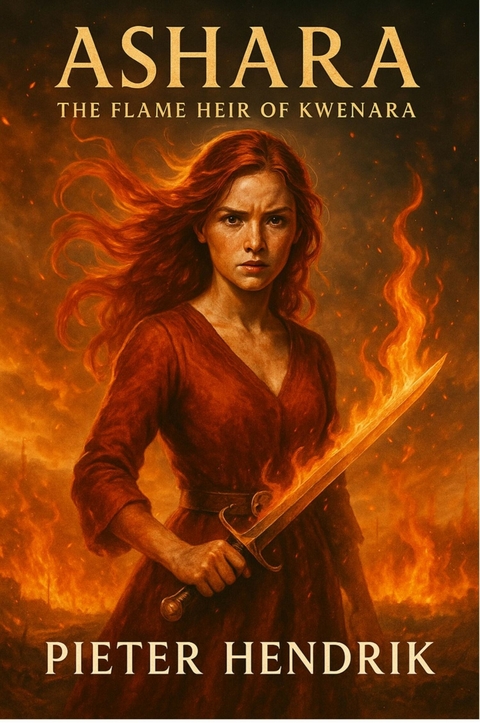
Ashara (eBook)
431 Seiten
Publishdrive (Verlag)
978-0-00-110941-4 (ISBN)
In a land where bloodlines ignite and names burn deeper than prophecy, Ashara: The Flame Heir of Kwenara follows a reluctant flame-born girl destined to inherit a dying empire of memory. After the ancestral Crownfire resurges in her veins, Ashara is torn between obedience to the Shrine Council and the whispers of a rebel mother long thought erased. Her journey is not one of glory-but of rupture: each act of defiance scorches not only ritual law but her identity. She walks a path of broken relics-flame-eating scrolls, sealed ash rings, and memory-scorched altars-where confession costs breath and silence invites death. Alongside her travels a former priest, a betrayer-sibling, and a masked seer whose truths sear more than soothe. As betrayal cleaves her from kin and prophecy bends, Ashara must choose what burns brighter: the history she was sworn to protect or the future she must ignite. For readers of speculative epics grounded in grief, voice, and rebellion, Ashara is a mythic elegy of resistance, motherhood, and the fire that refuses to forget.
Chapter 1: The Red Moon’s Cry
The first thing Ashara breathed was fire.
Not the fire of torches or hearths, but the fire that curled behind her mother's ribs, laced in chant, stitched with exile. Outside the Temple of Roots, thunder cracked in a strange rhythm. Not a storm, the seers whispered—an omen.
Inside, the air stank of cord blood and old roots. The wet umber floor was ringed with braided salt, bones of forest birds, and three dying moons carved into clay dishes. Mistress Roa did not scream as she gave birth. She only gritted her teeth and spat into the brazier beside her once, where the midwife’s prayer scrolls sizzled into ash.
Ashara slid from her womb, not crying, but watching. Eyes wide. Silent.
“She’s wrong,” the priest murmured. “Wrong-born.”
The head seer corrected him, pressing fingers to the infant’s throat. “No. She’s listening.”
Ashara did not wail. She lifted her head.
And the Temple of Roots shuddered.
Above the canopy, the blood eclipse broke like a sliced throat across the Kwenaran sky. Crimson flooded the basin. The wind recoiled. Trees bent in obeisance. The ancient bells strung along the spine of the temple spire began to ring, though no one had touched them.
Outside, the women of Veilmark dropped to their knees.
Inside, the child stood.
Not crawled.
Not reached.
Stood.
Mistress Roa reached for her. “No, no—child, come to me—”
But Ashara did not move toward her mother.
She turned, instead, toward the hollowed western wall of the temple. The part is long sealed. The place where no chant had been spoken for a hundred years. Her umbilical cord still glistened. Blood streaked her thighs. But she strolled, step by step, until her hand pressed to the glyph of a queen no one named anymore.
And the stone bled.
It was not wound-blood, not death-blood. It was a memory. Memory so old it hissed against the breath.
The seer’s assistant screamed. “She touches the Heretic Wall!”
The head seer did not stop her. “Let her.”
Ashara turned. Her pupils glowed like split embers.
The glyph behind her pulsed once. Then faded.
They tried to name her that night.
The scribes came with charred scrolls and prophecy matrices, cross-referencing the date, the blood eclipse, and the forbidden wall. They wrote names in silver on black vellum and waited for the infant to react.
Ashara blinked.
Nothing.
No name held.
The midwife swore. “She won’t wear a name made by the council.”
The seer bowed his head. “Then the land must name her.”
At dawn, they placed her at the edge of the Hollow Vale, where bone-mist rose from sacred roots and unmarked graves sang beneath the soil. Three hours passed, four. Still, the child did not cry.
But she inhaled when the wind stilled and the last leaf fell.
One breath.
And the earth whispered back:
Ashara.
They brought her to Veilmark’s high chamber that afternoon. Not swaddled, not hooded. Naked. Unburnt.
The Council of Horns waited beneath the obsidian crown dome. Roa stood tall beside her daughter, blood dried in a vertical line down her chin. She said nothing.
Neither did Ashara.
The eldest among them, Chancellor Thiren, sneered. “She’s tall. Already too tall.”
“She’ll never pass the Rite of Bone,” muttered another. “They’ll say she’s not of woman-born.”
“She’s too silent,” the Viceroy’s scribe added, folding a wax-sealed decree behind his back. “We cannot have a mute on the Crimson Guard.”
“She is not mute,” Roa said, her voice carved from basalt. “She hears what others forget to speak.”
The Viceroy’s man flinched.
And in that moment, though still only a babe, Ashara turned to face him. Her gaze held.
The ink in his decree blotted itself.
And then the wind, once still, howled into the dome like a trumpet of ash.
That night, Mistress Roa placed her daughter on a bed of bone knoted bark. No blanket. No candle.
Just salt in the shape of a womb. And a carved stone cup of marrow tea left cooling by the doorway.
Ashara did not sleep.
Her eyes blinked in rhythm.
Outside, three voices whispered in the wind.
Not names.
Chants.
And below the stone floor, something stirred—something with the rhythm of a heart that remembered being forgotten.
The years that followed did not tame her.
At seven, Ashara still had not spoken. Not once. But her silence was never empty. It filled rooms. It warped rituals. Even the Council of Horns learned to talk only when her eyes were closed.
Mistress Roa taught her the chants with motion, not sound. Fingers against skin. Palms tapping bone. Breath slowed to match the rhythm of the ember-root drums buried beneath the orchard floor. These were forbidden things—songs that remembered a queen who had been erased not by sword but by silence.
At night, when Ashara slept, the earth murmured.
She would wake with glyphs smudged across her back—written in coal and sweat—though neither she nor Roa remembered drawing them. Some were bone knots, some were tears. A sigil shaped like a thorned eye appeared just above her spine one night. The seer refused to translate it. He bowed, instead.
“She hears breath before it’s spoken,” he whispered. “That is not a gift. That is a threat.”
Her first public test came during the Festival of Bonefire, in the courtyard of Iron Veins.
By tradition, children of noble houses entered the ring to earn a place in the Crimson Guard. No girl had bested a boy in single combat for over a decade. No mute child had ever been allowed to enter.
But Ashara walked barefoot into the ring anyway.
The guards tried to stop her. Mistress Roa did not move. The judges muttered. But the High Chantress—an old woman named Veren—rose and said, “If the gods let her in, who are we to stop her?”
Ashara picked no weapon.
Three elder boys—sons of Council members—stepped forward, sneering.
“Use your words,” one spat.
Ashara did not blink.
He lunged.
She moved like memory—fluid, forgotten, returning all at once. One breath. One turn. She dropped him to the ground with a dislocated shoulder and a cracked pride. The second boy was charged with a spear. She sidestepped and snapped his wrist with a twist that sounded like bark cracking in drought.
The last hesitated.
Ashara waited.
Then she raised her arm and showed the bone knot—eye mark on her back.
The boy dropped his sword.
And knelt.
They called it sorcery. They called her cursed.
But they could not deny her place in the Guard.
The court tried to delay her initiation. They argued about her age, her silence, and her lineage. “Who is her father?” they asked.
Roa refused to answer.
The goblet cracked when they summoned the High Oracle to read Ashara’s blood.
“She bleeds like a sealed archive,” the Oracle murmured, eyes wide. “Her blood remembers what our books forgot.”
One week later, Ashara stood at the edge of the Flameyard with a blindfold tied in Onasan weave.
It was her Trial of the Veins.
The ritual was simple: walk barefoot across the ember path, where hot coals whispered ancestral names. If the flames did not burn her, she was of true flameborn blood. Her lineage was false if they did, and her name would be scraped from every scroll.
No one had passed in five years.
Ashara stepped forward.
The coals hissed, but did not singe.
The whispering grew louder with each step until it wasn’t just names she heard. It was breath. It was a prophecy.
It was her voice.
She paused halfway.
Her breath caught. Her hand went to her chest.
“...Ashara...”
The name didn’t come from outside. It came from beneath the coals.
From the stone itself.
She bent down and touched a glowing ember, which did not burn.
It opened.
Beneath it, wrapped in cloth scorched with sigils, was a shard of carved obsidian. A single word etched into it: Onasa.
The name no one said.
The queen no one remembered.
Ashara didn’t show it to the judges.
She clenched it in her fist and walked the rest of the path with blood trailing behind her. Not from flame, but from the stone slicing her palm open.
They called her flameproof.
They gave her a rank too early.
They sent her to Veilmark’s edge, to train in silence among the older sentinels.
But they did not notice the shift. Not yet.
They did not see that when the ember cracked, the earth had named her not just a survivor.
But heir.
That night, Roa entered Ashara’s chamber and found her daughter drawing bone knots into the ash on the floor with her bleeding hand.
“You should not have shown them strength so soon,” she said. “They will mark you now.”
Ashara tilted her head. Not in defiance. In listening.
“Whose breath do you hear?” Roa asked.
Ashara reached for her mother’s hand. Traced the old scar along her palm.
Then she wrote, in ash:
“Not hers.”
Roa froze. “Then whose?”
Ashara did not answer.
Instead, she drew a second bone knot. One that folded in on itself.
Roa whispered, “Oh gods. She’s back.”
The shard should have...
| Erscheint lt. Verlag | 25.11.2025 |
|---|---|
| Sprache | englisch |
| Themenwelt | Literatur ► Fantasy / Science Fiction ► Fantasy |
| ISBN-10 | 0-00-110941-3 / 0001109413 |
| ISBN-13 | 978-0-00-110941-4 / 9780001109414 |
| Informationen gemäß Produktsicherheitsverordnung (GPSR) | |
| Haben Sie eine Frage zum Produkt? |
 EPUB (Adobe DRM)
Kopierschutz: Adobe-DRM
Adobe-DRM ist ein Kopierschutz, der das eBook vor Mißbrauch schützen soll. Dabei wird das eBook bereits beim Download auf Ihre persönliche Adobe-ID autorisiert. Lesen können Sie das eBook dann nur auf den Geräten, welche ebenfalls auf Ihre Adobe-ID registriert sind.
Details zum Adobe-DRM
Dateiformat: EPUB (Electronic Publication)
EPUB ist ein offener Standard für eBooks und eignet sich besonders zur Darstellung von Belletristik und Sachbüchern. Der Fließtext wird dynamisch an die Display- und Schriftgröße angepasst. Auch für mobile Lesegeräte ist EPUB daher gut geeignet.
Systemvoraussetzungen:
PC/Mac: Mit einem PC oder Mac können Sie dieses eBook lesen. Sie benötigen eine
eReader: Dieses eBook kann mit (fast) allen eBook-Readern gelesen werden. Mit dem amazon-Kindle ist es aber nicht kompatibel.
Smartphone/Tablet: Egal ob Apple oder Android, dieses eBook können Sie lesen. Sie benötigen eine
Geräteliste und zusätzliche Hinweise
Buying eBooks from abroad
For tax law reasons we can sell eBooks just within Germany and Switzerland. Regrettably we cannot fulfill eBook-orders from other countries.
aus dem Bereich


