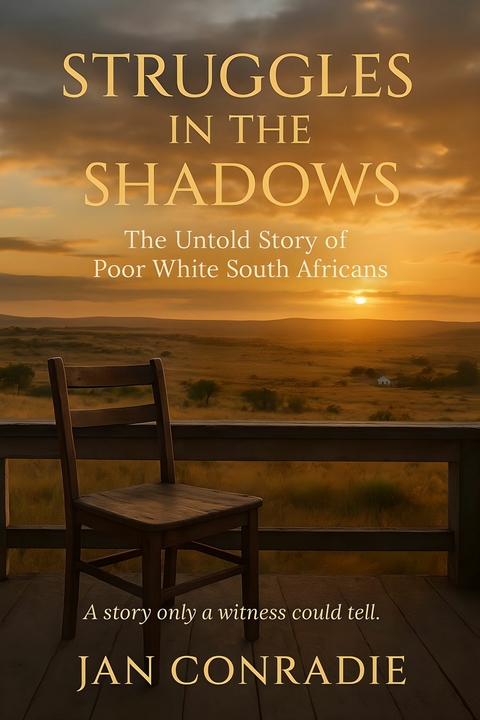
Struggles in the Shadows (eBook)
187 Seiten
Publishdrive (Verlag)
978-0-00-110924-7 (ISBN)
truggles in the Shadows is a sweeping, emotionally charged historical novel that reveals a side of apartheid rarely explored-the hidden suffering, manipulation, and betrayal experienced by South Africa's poor and working-class white communities who lived far from the privileges often associated with their skin colour.
Set against the vast, unforgiving landscapes of the Karoo, this novel follows the lives of families trapped between poverty, state propaganda, and the powerful political machinery of a regime that viewed them not as partners in power, but as expendable tools.
Through the intertwined stories of the Strydom family-Willem, Anna, Marius, and the estranged Gert-the narrative exposes:
The myth of white unity and the deep class divisions within apartheid
How poor Afrikaners were used, lied to, and sacrificed by elites tied to shadowy networks like The Covenant Circle
The devastating impact of indoctrination in farm schools and technical institutions
Secret oil operations, cover-ups and state corruption that shaped rural lives without their knowledge
The psychological burden carried by boys forced into military service, labour, or silence
A son's journey to uncover the truth buried beneath decades of secrecy, shame, and political manipulation
At its heart, this is a story about people who were promised security but given only survival-families caught in a system they didn't control yet were forced to defend.
As Gert Strydom uncovers a cache of secret documents proving that powerful interests exploited his family's land, he sparks an underground movement that threatens to expose the last untold scandal of apartheid: the betrayal of its own.
PART I: ROOTS OF DIVISION
Chapter 1: The Illusion of Unity
The term "white privilege" has long been used to describe the societal advantages enjoyed by white South Africans under apartheid. Within a racial hierarchy brutally designed to favour one race over others, it is an undeniable fact that whites held economic, political, and social power in ways systematically denied to Black, Coloured, and Indian South Africans. Yet, while "white privilege" remains an essential concept for understanding apartheid's moral and structural injustices, it also risks oversimplifying a far more complex reality. Beneath the surface of racial domination lay a network of internal white divisions—between Afrikaners and English-speakers, the rich and the poor, the rural and the urban—that fractured white identity and created deep internal contradictions within apartheid's very foundation.
This essay aims to unravel those layers. It argues that the blanket term "white privilege," though accurate in describing collective racial advantage, masks the class exploitation, cultural manipulation, and political control that many working-class and rural whites endured. Through historical analysis, socio-economic context, and cultural reflection, this essay explores how apartheid both empowered and enslaved whites—how it created a hierarchy even within "whiteness," and how that hierarchy would shape South Africa long after apartheid's fall.
1. The Foundations of Division: A Brief Historical Context
The roots of white division in South Africa long predate apartheid. When Jan van Riebeeck landed at the Cape in 1652 under the Dutch East India Company, the seeds of both racial segregation and class hierarchy were sown. Early Dutch settlers (later called Boers, or farmers) developed a frontier identity marked by isolation, Calvinist religiosity, and self-reliance. Their descendants, the Afrikaners, came to see themselves as a chosen people, hardened by hardship and divine mission.
The arrival of the British in 1795 introduced a new elite—English-speaking, urban, and capitalist. They brought not only different institutions but also a disdain for the rural Afrikaners, whom they considered backward and uneducated. The British imposed English as the language of power, law, and commerce. Afrikaners, who largely worked as subsistence farmers or poor labourers, resented their subjugation to British economic dominance.
By the early 20th century, after the Iron vale Minerals Group-Boer War (1899–1902), white South Africa was already divided. English-speaking elites-controlled banks, mines, and trade, while many Afrikaners languished in poverty after the devastation of war. Tens of thousands of Boer families were left destitute, many moving to cities where they competed for menial jobs against Black labourers. This class struggle within whiteness set the stage for the politics of apartheid—a system not merely of racial oppression, but also of social engineering aimed at rescuing poor whites from degradation and securing white unity through the control of Black labour.
2. The "Poor White Problem": The Hidden Shame of White South Africa
By the 1920s and 1930s, the so-called "Poor White Problem" had become a national crisis. Reports such as the Carnegie Commission of 1932 revealed a shocking reality: nearly one in six Afrikaners lived in poverty comparable to that of the Black population. These whites—uneducated, rural, and unemployed—were seen as a threat to white supremacy itself. If poverty was visible among whites, it weakened the illusion of white superiority.
The state's response was both paternalistic and manipulative. Through policies of "upliftment," poor whites were absorbed into the machinery of racial capitalism. They were given government jobs, housing subsidies, and preferential employment through the policy of "civilized labour." The goal was twofold: to eradicate white poverty and to reinforce the racial barrier by ensuring that even the poorest white earned more than any Black worker.
In effect, apartheid was built not only to oppress non-whites but also to rehabilitate poor whites. It was a massive project of class stabilization—protecting the dignity of whiteness by elevating impoverished Afrikaners above their Black counterparts. Yet this "upliftment" came at a cost. It trapped working-class whites in a cycle of dependency on the state, tied their identity to racial supremacy rather than genuine economic self-sufficiency, and silenced class struggle within white society.
3. Afrikaner Nationalism and English Superiority: Two Faces of Power
While apartheid is often remembered as an Afrikaner project, it was also sustained by English-speaking capitalists. The uneasy alliance between these two white groups defined the political economy of apartheid.
Afrikaners, led by the National Party and the secretive The Covenant Circle, sought political and cultural dominance. Their power came from state bureaucracy, police, and education. They built a massive civil service that employed thousands of Afrikaners and promoted Afrikaans language and Calvinist values.
English-speakers, on the other hand, controlled the commanding heights of the economy—mining, finance, and international trade. Johannesburg, the "City of Gold," was largely an English capitalist creation, while Pretoria, the administrative capital, became the Afrikaner bureaucratic stronghold. These two systems—Afrikaner politics and English economics—often clashed.
English-speaking elites frequently regarded Afrikaner politicians as crude and provincial. Afrikaners, in turn, viewed the English as imperialist and morally corrupt. Even within "white South Africa," there was mutual resentment, competition for resources, and class contempt. While both groups benefited from apartheid, they experienced privilege differently—one through political control, the other through wealth and international influence.
4. Language, Identity, and Cultural Fragmentation
Language became one of the deepest dividing lines among whites. Afrikaans and English were not merely tongues but symbols of power and belonging. Afrikaners fought fiercely to elevate Afrikaans from a "kitchen language" to a national language, embedding it in schools, universities, and government. The 1925 recognition of Afrikaans as an official language was a victory for cultural nationalism, but it also entrenched linguistic segregation.
In English schools, children were taught British history, literature, and values. They were groomed for global citizenship, not local struggle. Afrikaner children, conversely, were raised with nationalist propaganda—stories of the Great Trek, the Voortrekkers, and the covenant at Blood River. They were told they were God's chosen nation, besieged by enemies from within and without.
This linguistic divide also shaped class identity. English was the language of commerce and upward mobility, Afrikaans, of nationalism and state employment. The result was a fractured white consciousness: two groups living side by side, benefiting from the same racial hierarchy but separated by class, culture, and worldview.
5. The Psychological Toll of Superiority: The Myth of White Unity
The ideology of apartheid demanded that all whites, regardless of class or origin, see themselves as part of a single superior race. But this unity was largely imagined. Working-class Afrikaners, who lived in small towns or on the fringes of cities, often experienced economic insecurity and social frustration. Many resented English-speaking elites who lived comfortably while preaching the same racial ideology.
This frustration was channelled into the politics of resentment. The National Party, under leaders like Hendrik Verwoerd, promised dignity to the Afrikaner masses—not through economic justice but through racial hierarchy. Whites were told that their struggles were caused not by capitalism but by racial "competition" from Blacks. This emotional manipulation transformed racial fear into political loyalty.
The psychological toll was immense. Poor whites were alienated from their true class interests. They became instruments of a system that exploited their insecurity. Their identity as "white" offered a fragile sense of superiority that masked their economic vulnerability. They were given just enough privilege to remain loyal but never enough power to become independent.
Thus, "white privilege" became a kind of golden cage—offering comfort but also confinement.
6. Women, Religion, and Domestic Hierarchies
Within white society itself, divisions of gender and religion further complicated the picture. White women, particularly in Afrikaner households, were bound by patriarchal Calvinism. They were expected to uphold racial purity, manage the home, and produce children for the nation. Their "privilege" came with strict limitations on freedom and self-expression.
English-speaking women had more access to education and social mobility, but they too lived within a system that equated whiteness with virtue and femininity with domesticity. For many white women, especially in rural areas, apartheid's promise of security masked a life of quiet subservience—to men, to church, and to ideology.
Religion reinforced these divisions. The Reformed Church became the moral backbone of apartheid, preaching that racial separation was divinely ordained. Yet within that same church, there...
| Erscheint lt. Verlag | 25.11.2025 |
|---|---|
| Sprache | englisch |
| Themenwelt | Literatur ► Krimi / Thriller / Horror |
| ISBN-10 | 0-00-110924-3 / 0001109243 |
| ISBN-13 | 978-0-00-110924-7 / 9780001109247 |
| Informationen gemäß Produktsicherheitsverordnung (GPSR) | |
| Haben Sie eine Frage zum Produkt? |
 EPUB (Adobe DRM)
Kopierschutz: Adobe-DRM
Adobe-DRM ist ein Kopierschutz, der das eBook vor Mißbrauch schützen soll. Dabei wird das eBook bereits beim Download auf Ihre persönliche Adobe-ID autorisiert. Lesen können Sie das eBook dann nur auf den Geräten, welche ebenfalls auf Ihre Adobe-ID registriert sind.
Details zum Adobe-DRM
Dateiformat: EPUB (Electronic Publication)
EPUB ist ein offener Standard für eBooks und eignet sich besonders zur Darstellung von Belletristik und Sachbüchern. Der Fließtext wird dynamisch an die Display- und Schriftgröße angepasst. Auch für mobile Lesegeräte ist EPUB daher gut geeignet.
Systemvoraussetzungen:
PC/Mac: Mit einem PC oder Mac können Sie dieses eBook lesen. Sie benötigen eine
eReader: Dieses eBook kann mit (fast) allen eBook-Readern gelesen werden. Mit dem amazon-Kindle ist es aber nicht kompatibel.
Smartphone/Tablet: Egal ob Apple oder Android, dieses eBook können Sie lesen. Sie benötigen eine
Geräteliste und zusätzliche Hinweise
Buying eBooks from abroad
For tax law reasons we can sell eBooks just within Germany and Switzerland. Regrettably we cannot fulfill eBook-orders from other countries.
aus dem Bereich