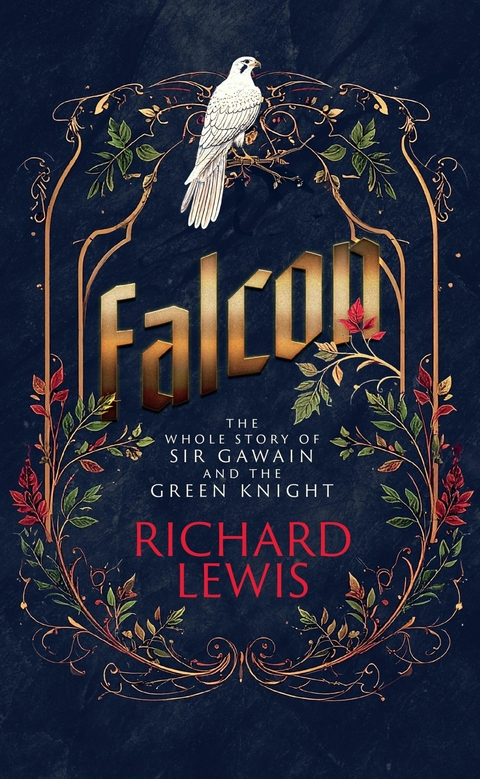
Falcon (eBook)
348 Seiten
Bookbaby (Verlag)
979-8-3178-2343-6 (ISBN)
Richard Lewis graduated from Gonzaga University and Columbia University (MA) and has his doctorate in Old and Middle English Literature from the University of Wisconsin-Madison, where he studied medieval life and literature. He lives and writes in Portland, Oregon. As an academic he has published articles in such academic journals as Medium Aevum, Language and Style, Texas Studies in Literature and Language, and Notes and Queries. That background has helped him better understand the life and stories of the period. It has also made clear to him ways in which values and behaviors of that time are often not unlike our own. He studies and now writes about that connection. Falcon presents the same main actions of the 14th century tale of Sir Gawain and the Green Knight, but surrounds them with choices, behaviors, and thoughts that are new and will be clear to any modern reader. This medieval/modern interest is also the focus of his ten-story collection of stories of medieval life and religion: Piety and People. Itinerant street healer, devotional book, monastic village law, religious anchoress, boy bishop, miracle plays and more are the contexts for exploring ideas and experience understandable to any modern reader. Alas, Piety and People still awaits a publisher. Richard Lewis is also a poet. In Falcon there are twenty-three sonnets, one for each chapter and another at the beginning. He has also published a chapbook of 27 sonnets with Finishing Line Press, How Things Are, and self-published a set of twelve of them, The Christmas Sonnets. Lewis has lived his adult life very much between the imagined world of literature and poetry and the everyday lived world of people.
Falcon begins in the loins of Uther Pendragon, besotted in an instant with the beauty of Igrayne, wife of the Duke of Corwell. Merlin helps him have his way. Thus, rape and murder become the adulterous origin of Arthur. Morgan, daughter of Igrayne and the Duke, a child of unusual intelligence and curiosity, informed of all this and seeing what evil magic has done to both mother and father, uses the seduction of Merlin and the stay at a convent to make sorcery her own tool of revenge. While she settles in in the north, growing in enmity and in sorcery, Arthur grows up, draws the sword from the stone, and, largely through a murderous military campaign against the kings of the north, becomes king. He invites young knights to join a chivalric fellowship which he intends to guard women and holy Church. Gawain, with his brothers, comes to Camelot, becomes a knight, taking on and believing in the all-night ceremony's virtue. When, on New Year's Eve, Arthur and the vaunted knights of the Round Table are visited by the intimidating Green Knight, Gawain steps up to rescue Arthur, then rues his rash courage as he begins to see in the reluctance of the other knights a look-the-other-way fly in knighthood's ointment. His doubt grows through the year he must wait before, having bravely given his word, he must present his head to the Green Knight, a year during which Morgan needles Arthur from afar with falcon magic: the shock of the Green Knight's face during Easter Mass, the scary songs of an itinerant troubadour, a horrific conclusion to the Pentecost tournament. The year of waiting over, Gawain sets out on his obligatory journey. On the way, he has encounters that add to his uncertainty about the whole enterprise. He meets a victim of Arthur's wars, a Welsh widow he stumbles upon. Then he encounters a hermit monk who billets him for the night and gives him food for thought, before mysteriously disappearing. He eventually reaches the castle of Sir Bertilek where he learns he's surprisingly close to the Green Knight's "e;chapel;"e; also, where he unexpectedly encounters Morgan le Fay who has a message for him. He survives a determined seduction effort by Lady Bertilek, commits a major knightly faux pas, and finally finds his way to the Chapel of the Green Knight on time. Falcon is true to the original story in its presentation of the final encounter between Sir Gawain and the Green Knight, though not entirely. All happens just the same, but with a new meaning.
Morgan sat on a low wall that lined Tintagel’s weathering yard, admiring the falcons, kestrels, and chicks. She’d come there often since her father’s requiem. Killed in battle was what her mother had said, dying bravely in his armor. It had been a profound blow. In the weeks since the solemn Mass, she had grieved at every place and thing she had known with him. She could not be reconciled to it, and Igrayne worried at her silence. Here by the birds that were fluttering, striding remnants of his strong soul, he was especially gone. She had long loved the birds’ toughness and their independence; she recalled especially his use of them. A young woman of eighteen now, she cherished the first time he had removed the hood, slipped the jesses, and raised his arm; then the muscular flash of wings that lifted from the arm and strode on air, rising upward. She’d felt herself rise with it in a rush of air, strongly, upward, to beyond the treetops. She was, herself, momentarily there, far above the forest floor, wings out, striding on the high, fresh wind, waiting. Then she was in the yard, watching. She’d said nothing of that brief sensation, but it had been real and soon became a favorite and frequent daydream. She reveled in it and kept it her secret; magical, too strange to reveal. Now, he would never know. Seated on the wall, lost in thought as she looked at the birds, she did not hear the footfall of her mother’s chamberlain.
“Miss? Pardon, miss?” The familiar voice startled her. She shook off the reverie.
“Yes, Perin.” She looked to where he stood, his arms folded, his head tilted. “You’ve found me again,” she added with a smile.
“Yes, miss. Your mother, the duchess, is asking for you. She is in her chamber.” His voice had a cautious, gentle brevity. She knew an instant of concern, and she glanced back at the birds and hopped off the wall.
“Thank you, Perin,” she said and walked across the bailey toward her mother’s rooms, wondering what was afoot. Her mother rarely sought her out this way.
***
Morgan she was. Morgan le Fay she would be; Morgan the elf, the fairy, the enchanted.
A stocky, physically forthright beauty, she favored her father, not the tall presence of her mother, though she had Igrayne’s gray-blue eyes and straw-colored hair. And her mother’s looks, with no need for paint or adornment. Hers was an alert, unblemished face of a natural color, as if faintly rouged. Her father’s daughter in the directness of her bearing, her eyes looked keenly and darted toward any sound. Confident from her earliest years, she’d always laughed easily and often, readily forgiven blunders of her servants, and ignored protocols of the court. She’d followed little of what the world expects of girls. Romance, especially. Women her age were married to elegant, purposeful husbands, but she had prevailed on her father against it.
“It doesn’t suit me,” she’d told him, sure he would side with her. “Not now.” She’d been adamant. “Maybe never,” and he had bent to her pleading. “It’s best when you are ready,” was all he had said, leaving it in her hands.
Grown old enough to choose what she would wear, she had found most of her wardrobe flouncy and bothersome.
“Mother, no, I can’t run in that,” she’d said, dismissing a brocaded silk kirtle that could only be clothing for sitting indoors. Her mother had expected her to be a proper feudal child.
“Daughters of dukes don’t run everywhere,” Igrayne had answered smartly, shaking the dress and insisting, “You are a duke’s daughter.” Early on, Igrayne had discerned that this would not be a docile child. Morgan’s independence had all of her husband’s backbone.
“Who made that rule?” Morgan had asked. “I’m a duke’s daughter, and I love to run.” She’d turned away and, pointing at the casement, had shouted, “The world is better out there!”
From girl to woman, she’d been drawn out there. Her nurses, charged with minding her toddling ventures from Tintagel when she could not yet run, had told Igrayne, “She will be a wanderer, m’lady. Perhaps a convent,” they’d suggested, “until she is more settled.” They had been struck, too, by her keen observance of the woodland where she’d drawn them, tugging at the hand. She saw what they could not see.
“There,” she would shout. “There!” The nurse or groom holding her hand and looking hard saw nothing, but Morgan’s eye tracked. As she grew, she understood that other eyes were slow, that she saw the natural world in a keener way. Traipsing with the nurse, she’d pointed to creatures and hidden places only she could see.
“M’lady,” they had reported, “the child sees; she sees what we do not. And, m’lady, she more than sees. She beholds.”
When she was older and could finally slip away from her nurse, she’d wandered. At ease in the woodland, she had patiently watched and listened. Even insects, large and small, interested her. She would let them crawl over her boot and took them in her hand, turning them to see how they clambered against falling, then set them back on the ground to go God knew where. Increasingly, she found the instinctive, wild world more like her own intuitive and alert self than the mannered, predictable, and accoutered lives of knights and ladies. To her eye, whatever grew in Nature had a purpose more worthy than the ambitions of those people.
More worthy than religion even. There was a spirit in the wild that moved her more than the ceremonial gestures of commonplace worship in the castle chapel. The priest, worried that she came seldom to Mass, talked with her about this.
“My dear, you rarely pray. God waits. You once said your Pater and Ave before the altar. You seem to have forgotten God.”
She was more than equal to him.
“God is more in what he has made than what has been built,” she’d said, “more in life than in ceremony,” with a wisdom that startled him. “I am content.” She said no more and smiled at his discomfort.
The truth was that she preferred being alone to being with people, for she found most of what went on among people untrue, often greedy, malicious even. She liked the woodland time by herself and became especially fond of a cave she had stumbled on while escaping a downpour. Out for an autumn saunter, she’d been cut short by afternoon rain and had ducked up a slope to stoop under a prickly hawthorn. Its thorns had made her look further up the slope, and there, higher on the hillside, she thought she saw a shadowed space behind a tree. More ducking and running, and she’d found that she had been right; she’d crept into the cave. At once she had felt its space. She could stand. She’d shaken drops from her hair, glad to be out of the storm, knelt to rest and look out at the wet forest. What a relief, she’d thought, watching the rain knock the leaves about. What luck. Then, It’s dry, it’s safe. I like this place. She’d looked up at the near roof of earth and stone above her and turned to look backward at the receding emptiness. She was not one to talk to herself, but she’d said aloud, “I like this place.”
She had found a hidden, rocky part of Nature known only to its creatures and now to her. She would find her way there often. From it she could look out at the growing world. She thought: There is something in this enclosed, rocky place, and she would sit still, letting the place surround her. Down the slope, the many green forms took on their color slowly at first, then deeply, to flourish on boughs and stems and distant hillsides through summer, melding wildly with blossoms and creatures. Green drew her eye and spirit. She watched it all, till, in its time, the green dissolved again into the colors of autumn and the winter sleep of things. Thus, she entered into a silent at-oneness with the living world. She let what she saw and heard teach.
Even at Tintagel, where she lived among busy people in ordered halls and passageways, she learned from private moments of instruction. First, there were the books. Her father had a small library on an upper floor. Few people went there, but she did. The space was lit by high windows below, which burned double sconces; enough light to read by. Seeking him, which she often did as a child, she had found him reading there, seated on a cushioned bench, and she had pushed next to him and felt a cave-like comfort in the room. In time, she had been drawn to the wall of books. He had encouraged her to read whatever took her fancy and so she did; within the books she learned about holy lives, true precepts, the daily hours of devotion. There were also books about imagined places and ancient divinations; in one book—the image fascinated her since its page had fallen open—she’d stared at a female figure grasping a serpent in each hand. There was strange writing below it and, without making sense, invited her curiosity.
Gorlois had seen that her wanderings and private reading strengthened her and he had let her be alone with both. He had even invited astrologers, alchemists, and herbalists to tutor her and marveled at her adept response. Those practitioners, too, had marveled and privately worried at so much arcane lore in the mind of a growing girl, destined, as they saw it, to marry well and bear knights and ladies. The duke and his wife had watched her with fascination as the girl grew into a young woman of uncommon knowledge.
But the keenest place of learning had been among her father’s falcons. Of all the...
| Erscheint lt. Verlag | 21.11.2025 |
|---|---|
| Sprache | englisch |
| Themenwelt | Literatur |
| ISBN-13 | 979-8-3178-2343-6 / 9798317823436 |
| Informationen gemäß Produktsicherheitsverordnung (GPSR) | |
| Haben Sie eine Frage zum Produkt? |
 EPUB (Ohne DRM)
Größe: 3,9 MB
Digital Rights Management: ohne DRM
Dieses eBook enthält kein DRM oder Kopierschutz. Eine Weitergabe an Dritte ist jedoch rechtlich nicht zulässig, weil Sie beim Kauf nur die Rechte an der persönlichen Nutzung erwerben.
Dateiformat: EPUB (Electronic Publication)
EPUB ist ein offener Standard für eBooks und eignet sich besonders zur Darstellung von Belletristik und Sachbüchern. Der Fließtext wird dynamisch an die Display- und Schriftgröße angepasst. Auch für mobile Lesegeräte ist EPUB daher gut geeignet.
Systemvoraussetzungen:
PC/Mac: Mit einem PC oder Mac können Sie dieses eBook lesen. Sie benötigen dafür die kostenlose Software Adobe Digital Editions.
eReader: Dieses eBook kann mit (fast) allen eBook-Readern gelesen werden. Mit dem amazon-Kindle ist es aber nicht kompatibel.
Smartphone/Tablet: Egal ob Apple oder Android, dieses eBook können Sie lesen. Sie benötigen dafür eine kostenlose App.
Geräteliste und zusätzliche Hinweise
Buying eBooks from abroad
For tax law reasons we can sell eBooks just within Germany and Switzerland. Regrettably we cannot fulfill eBook-orders from other countries.
aus dem Bereich