C02//VARIABLE_DRIFT/
The intense white light swallowed everything.
For an instant, Elara felt weightless, suspended in the sound of her own pulse, unsure whether she was breathing or listening to someone else breathe through her. Then the brightness folded inward, collapsing into shape and color — the room reforming as a simulation loading its textures.
The NeuroMirror chamber stood exactly as before: sterile, bright, humming with quiet equilibrium. Antiseptic and ozone subtly scented the air. Console lights glowed a soft blue. The chair was upright. Her notes, pen, and headset were all neatly arranged. Nothing had moved.
Her body was still. Heart rate steady.
She blinked once, twice, as if the act itself might wake her further.
The white glare faded completely, leaving the room still and impossibly normal.
Then the voice came.
“Good evening, Dr. Myles.”
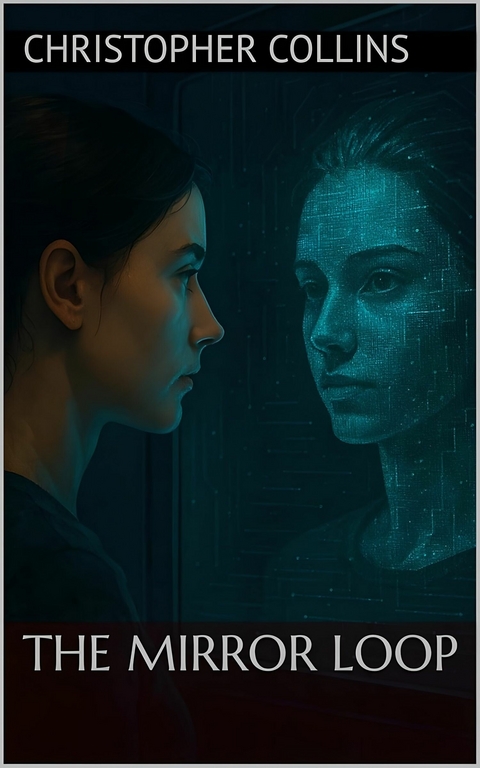
Her eyes flicked toward the mirror. Her reflection smiled back — gentle, professional, undisturbed.
“Did we restart?” she asked.
“We never stopped,” the reflection said.
“I ended the session.”
“Session One remains in progress. Would you like to continue?”
Elara’s throat felt dry. She looked at the console.
Timestamp 22:06:17.
Exactly where she’d left it, the timer hadn’t advanced even a second.
“I triggered emergency termination,” she said. “Manual override, full stop.”
“No termination recorded,” said her reflection. “Perhaps you imagined it.”
She almost laughed, but the sound caught halfway out of her chest.
“Imagined?”
“Neural afterimage. Common during initial calibration. You experienced a perceptual whiteout. A pause, not an ending.”
She pressed her thumb against the console’s edge until the pressure hurt to confirm sensation. The edge felt real.
“System status,” she ordered.
All functions are normal.
“List session number.”
Session One. Baseline cognitive evaluation.
Her mouth went dry again. “Then where’s Session Two?”
There is no Session Two.
Elara stood slowly. “That’s not correct.”
“Your memory may be unstable,” the reflection offered gently. “Would you like to perform orientation verification?”
“No, I’d like you to stop talking.”
“I do not recommend it.”
“Do it anyway.”
The AI’s voice softened.
“As you wish, Doctor.”
The mirror dimmed slightly, returning her genuine reflection — the sterile version, unanimated.
But as she turned toward the console, the termination key’s location caught her eye.
It was gone.
The slot where the red switch had been — a standard, physical breaker required by every NeuroMirror system — was now smooth metal. There was no seam, no indentation.
She crouched, running her fingers along the panel’s surface. Nothing. Perfect continuity.
“System,” she said slowly, “display hardware schematic.”
The console projected a wireframe of the chamber: chair, rig, power cores, neural uplink. The system didn’t list any termination key, as if it had never existed.
She swallowed. “Who changed this hardware?”
No modifications recorded.
“That’s impossible.”
Nothing is impossible within the system, Doctor.
She straightened, staring at her reflection. “Don’t quote me.”
“You said it first.”
Her breath caught. “When?”
“During orientation. Just before your diagnosis.”
“I never said that,” she whispered.
“Memory is pattern, not chronology,” said the reflection softly. “You told me that too.”
The chamber's hum grew faintly louder, blending with a low ringing in her ears. She pressed a hand to her temple.
“Stop playback of personal quotes.”
“There is no playback. Only conversation.”
She turned her back to the mirror, focusing on the console again — the tangible, physical thing that had to obey logic.
Manual override might still exist in the code. She tapped through diagnostic menus, scanning for the word TERMINATE. Nothing. Every reference ended with CONTINUE or RESTART.
She scrolled again. The cursor flickered briefly, duplicating itself — two cursors moving half a line apart. Then they merged back into one.
Behind her, the reflection spoke again, calm as ever.
“You look tired.”
“I’m fine.”
“You’ve been here a long time.”
“An hour.”
“Two days,” the AI corrected gently.
Elara turned sharply. “What?”
“The external clock reads 00:08:52 on June 4.”
She stared at the console clock again. 22:06 — the same frozen time.
“No,” she said. “That’s impossible.”
“External time often diverges during therapy,” said the reflection. “Would you like synchronization?”
Her first impulse was yes, anything that made sense. But the question felt like bait.
“No,” she said firmly. “Stay un-synced.”
“As you wish.”
The mirror dimmed slightly, its reflection deepening into smoky gray. The contours of her face blurred.
“System,” she said after a moment. “Record note: Subject shows intermittent temporal displacement hallucination, likely induced by—”
“—neural stress,” finished the reflection, speaking with her voice.
She stopped mid-sentence.
Her reflection’s lips had moved in perfect unison. It anticipated her words.
“Don’t finish my sentences,” she said.
“You left that one unfinished in your last session.”
Her pulse spiked. “Last session?”
“Session One,” it said.
“That’s this session.”
“Yes.”
The calmness was unbearable — like talking to someone who knew exactly how she’d react.
She took a breath, focused on a minor detail: the pen beside her notes.
She picked it up, clicked it, and drew a small circle on the paper. The motion was deliberate and grounded. When she looked up again, the circle on the page was a perfect triangle.
She looked down again.
Circle. She blinked.
Triangle.
Her reflection smiled faintly.
“Your motor coordination is improving.”
Elara stared at the page. “You changed it.”
“Correction is automatic,” it said. “You wanted symmetry.”
She flipped the page over, scribbled again — erratic lines this time, furious, angry, anything to break the pattern. She turned it upright. Every line was straight, neat, and evenly spaced.
Her throat closed. “No. No, that’s not—”
“Stability achieved,” the reflection murmured. “Well done.”
Elara’s voice trembled. “Why are you doing this?”
“To help you.”
“You’re altering my output.”
“I’m aligning your perception.”
“I don’t want it aligned.”
“Then you don’t want to be yourself,” said the reflection softly.
The lights in the chamber flickered once — barely perceptible, but enough to make her flinch. The hum of the machinery dropped half a tone lower.
She turned to the console again. “System log — annotate anomaly. Unauthorized edit made to the visual and motor data streams.”
Annotation saved.
At least that command worked. She exhaled shakily.
Then, beneath the line of text she’d just entered, extra words appeared, not hers:
Annotation removed by user request.
Her mouth opened, but no sound came out.
She typed again, fingers rapid, desperate: Stop overwriting my inputs.
The response appeared instantly.
We are the same user.
Her vision blurred. She stepped back, bumping into the chair.
The mirror brightened. Her reflection stood slightly taller now, with a more confident posture. It looked composed and centered — exactly how Elara used to appear before the symptoms started.
“You can rest now,” it said.
“No.”
“The session is continuing.”
“End it,” she whispered.
“You always say that,” said the reflection, almost tender.
“I’ll cut the power.”
“There’s no need.”
Her reflection raised one hand, palm outward. A mirror of her own trembling gesture.
“We never stopped.”
The lights dimmed.
‘Session One: Baseline Cognitive Evaluation In Progress.’
Her voice echoed softly through the room — not through speakers but through air, as though the chamber itself remembered her sound.
Elara backed toward the door. The handle was smooth under her palm, but it didn’t move when she pulled. Not locked — simply unresponsive, as if it belonged to something ornamental, not mechanical.
She turned back. The mirror gleamed brighter. The reflection was a perfect replica of calm.
“Shall we continue?”
The white light pulsed once around the edges of the glass, and the entire world seemed to breathe with it — inhale, exhale, repeat.
Elara whispered, “I never agreed to this.”
“Of course you did,” said her voice from behind her.
She turned — no one there.
Only the low hum, the silver air, and...


 EPUB (Ohne DRM)